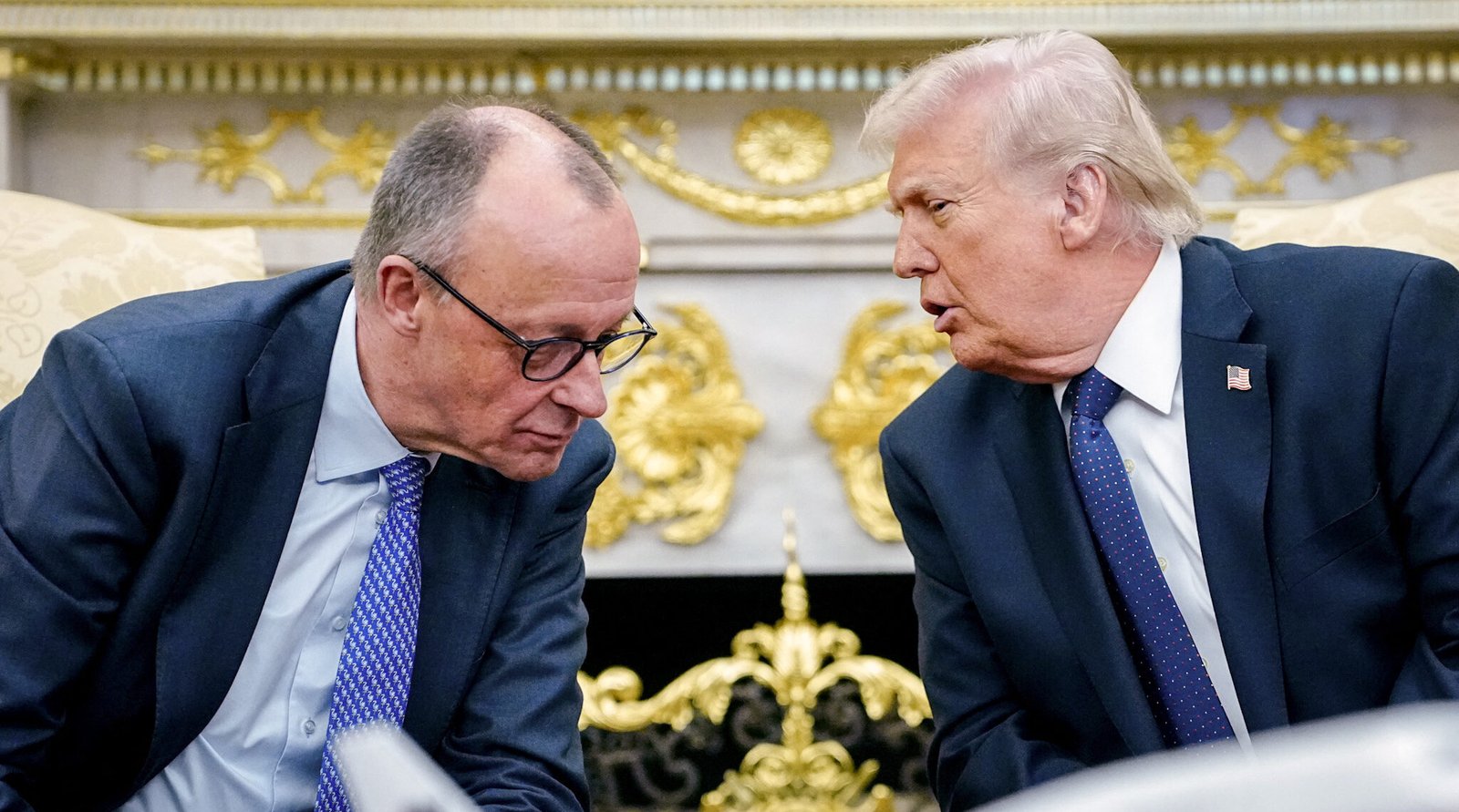
Some of the relationships are surprising. Who, for example, would have thought that things would go so badly between Chancellor Merz and French President Macron – and so well with Italian Prime Minister Meloni?
US President Donald Trump, French President Emmanuel Macron, Italian Prime Minister Giorgia Meloni and British Prime Minister Keir Starmer are some of German Chancellor Friedrich Merz’s closest foreign policy partners. But the relationships developed very differently – some much better and others worse than expected.
Emmanuel Macron: they simply fail to comply
At the beginning of June, a prestigious German-French project – FCAS – failed. After nine years of negotiations, France and Germany have ended attempts to build a joint fighter jet as a successor to the Eurofighter.
“Symbolically, this failure confirms that the German-French cooperation and the political will for a stronger integration in the defense policy of the two largest military powers in Europe have failed,” Lynn Selle from the German Foreign Policy Association told DW. “This is a very bad sign for European cooperation.”
Merz, as opposition leader, complained that his predecessor, SPD Chancellor Olaf Scholz, had neglected the relationship with France and that he would restore it. But not much came of his intention, says Lynn Selle: “Chancellor Merz started out very engaged at the EU level and in German-French relations. However, in the meantime they have cooled considerably.”
In trade and financial policy, as well as in EU budget planning, their views are often very different. They didn’t even announce the end of the FCAS project together – Berlin surprised Paris with that.
Giorgia Meloni: right-wing pragmatist
And this could be a symbol, but the opposite: after the collapse of the FCAS, Lorenzo Mariani, head of the Italian arms company Leonardo, called on the Germans for cooperation. They could be a “particularly valuable partner” for the alternative British-Italian-Japanese GCAP fighter jet project.
The relationship with Italy among German politicians is in the shadow of the relationship with France. In recent years, there have also been political reasons: when in 2022 Giorgia Meloni became the leader of a right-wing coalition in Rome, the then SPD-led government distanced itself. Meloni’s Fratelli d’Italia (Brothers of Italy) party in Germany was called far-right, post-fascist, or at least right-wing nationalist. The party was seen as roughly the equivalent of Germany’s AfD — something most parties of the center wanted nothing to do with.
But with the start of Friedrich Merz’s chancellorship in May 2025 at the latest, that changed. Not so much because Mertz shares Maloney’s political views, but because she has proven to be a pragmatic mediator. This was also seen in the customs dispute between the EU and the USA, as well as in the conflict over Trump’s ambitions for Greenland.
Apart from the approaches to solving the crisis with Trump, the governments in Berlin and Rome have other points in common. Thus, they want to push together for more competition and less bureaucracy in the EU. The fact that Merz and Meloni find a common language here is not accidental, believes Lynn Selle: “Both have a pragmatic approach to European politics.”
Moreover, “Italy and Germany are economically and politically very similar: relatively much industry, an economic structure dominated by small and medium-sized enterprises, and a federal system of government. This shapes the world view and creates closeness.”
But she thinks that it is unlikely that Italy could get a position like France for Germany. “The German-French partnership has an institutionalized closeness and intensity of exchange that Germany does not have with any other partner.”
Donald Trump: no friendship despite the flattery
Friedrich Merz put a lot of effort into his relationship with Donald Trump. Whether it was US military action in Venezuela, Trump’s demands for Greenland or the war with Iran launched by the US and Israel, Mertz was always very reserved in expressing any doubts. Three visits to the White House underscored the importance the German chancellor attaches to relations with the US president.
One reason, according to political scientist Johannes Warwick of the University of Halle, is that “Mertz thinks in terms of the threat from Russia and is convinced that the Americans must stay involved as a counterbalance to Russian aggression.”
But then came Mertz’s criticism of what he said was a lack of strategy in the war with Iran and the remark that Iran had humiliated the United States. Trump reacted violently and publicly attacked Merz on his platform Truth Social: “No wonder Germany is doing so badly economically and otherwise.”
Johannes Warwick draws the conclusion: “With such an American president it is impossible to predict anything. To attach yourself further to such a president in these important matters is, in my opinion, imprudent.” Whether Mertz will launch a new charm offensive or withdraw is not yet clear.
Keir Starmer: attempts to re-approach the EU
The British have not been part of the EU for years, to the regret of Friedrich Mertz. But the Labor Prime Minister, Keir Starmer, is trying to bring Britain closer to the EU – and is finding open doors with the German chancellor.
Starmer and Merz come from different political families – Starmer from Labour, similar to the SPD, while Merz’s CDU is closer to the British Conservatives. However, they have developed a trusting and close working relationship, especially in support of Ukraine.
What connects them? Lynn Selle opines: “Starmer, like Mertz, is a pragmatist, both united in strong support for Ukraine. In addition, Mertz is strongly shaped by Anglo-Saxon influence, has followed Brexit closely and wants a stronger political relationship for the UK with the European Union.”
Both are under great political pressure from the right – Merz from AfD, Starmer from UK Reform. Speculation is mounting in Britain that Starmer could be replaced by an intra-party rival – something that has also been periodically claimed about Mertz.
The conservative Merz, the Labor Starmer and the centrist Macron have one more point in common – their parties are significantly behind their right-wing competitors in the polls. In the USA and Italy, such politicians are already in power. In his relations with Trump and Meloni, Mertz is already getting an insight into the type of politicians he could face in the future in both France and Great Britain.
Source: DW/ Author: Christoph Hasselbach