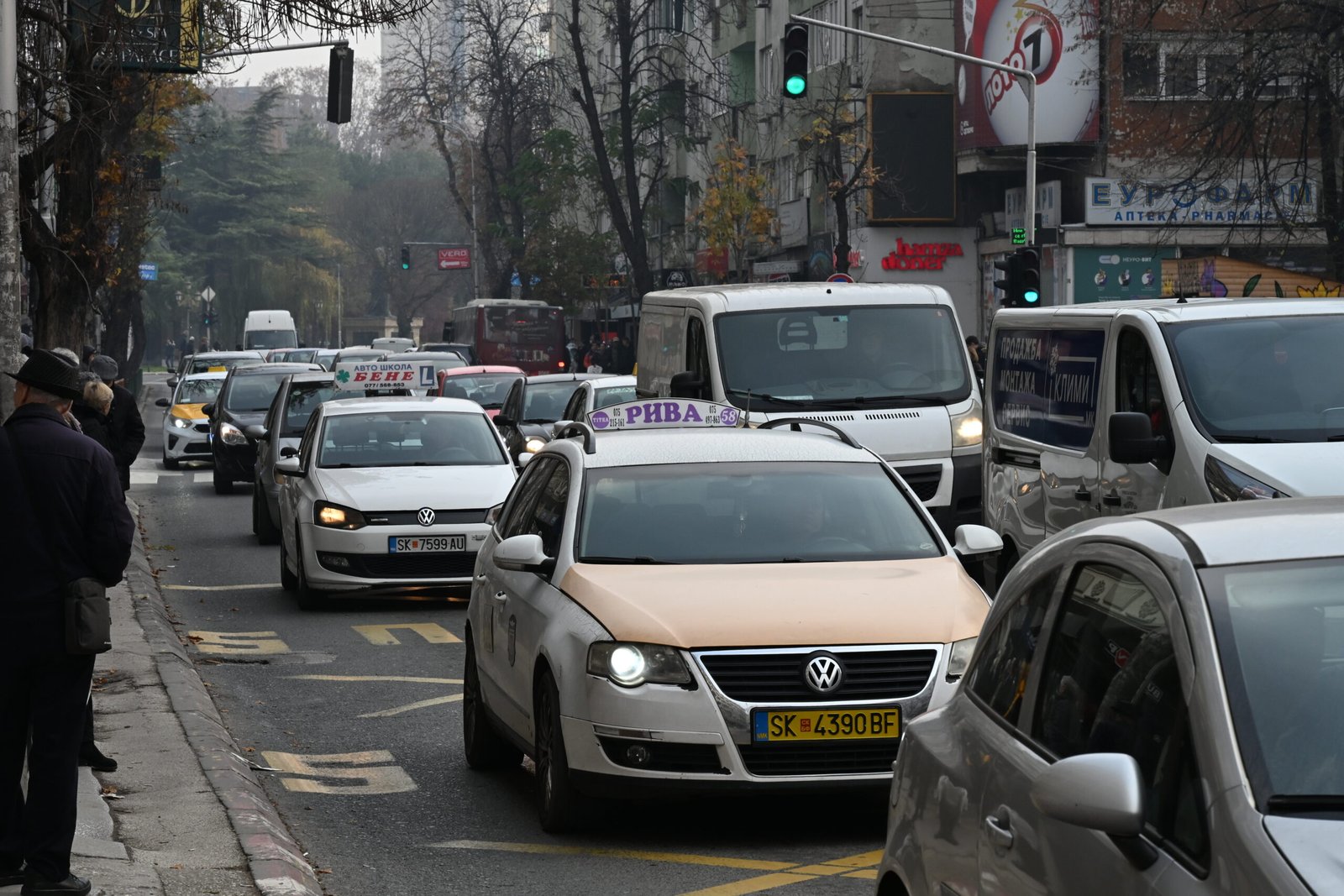
The taxi drivers already had a meeting with the mayor Orce Gjorgjievski on February 12, and a few days later they officially submitted proposals for solving all the problems they face on a daily basis. Since then, as they say, there has been no reaction from the City.
Many unresolved issues have been accumulating for years, which directly affect the work of taxi carriers and the safety of passengers. Despite numerous indications and initiatives, the institutions still do not react to overcome the problems.
This is claimed by the Group for auto-taxi transportation of the city of Skopje, from where they point out that the revolt among taxi drivers is rightly very large, and because of this they are already in constant contact with the union, with whom they are agreeing on the way, date and place to hold the protest.
The taxi drivers already had a meeting with the mayor Orce Gjorgjievski on February 12, and a few days later they officially submitted proposals for solving all the problems they face on a daily basis. Since then, as they say, there has been no reaction from the City.
Last month, they also sent a request for a meeting and immediate resolution of the problems to the Government, but there has been no reaction from there either.
A deadline is required for adapting vehicles to environmental standards
On the one hand, we have complaints from the citizens that there are no taxis in Skopje, taxi meters are stolen wildly and passengers are stolen, we have unregistered employed taxi drivers, wild taxis without a license, and on the other hand, the City has started not issuing and renewing licenses for older vehicles since 2011, without any official announcement, nor is a reasonable deadline like everywhere else for taxi drivers to adapt. This means that hundreds of vehicles will not work, says Sasho Rajchanovski, president of this group.
According to him, everywhere in Europe, the conditions are tied to environmental standards Euro 4, and in several highly developed countries, Euro 5, and now Euro 6. The taxi drivers themselves demanded that Euro 1, 2 and 3 be dropped and that a one-year adjustment period be given, but the way things are being done now is not good.
City of Skopje: No final decision has been made
The City of Skopje, on the other hand, claims that they are actively working to improve public transport, traffic in the city, as well as taxi transport in the capital.
In that direction, our commitment is to advance all these spheres for everyone involved in them as well as for the users, while at the same time positively influencing the environment and the air. For those reasons, several directions are being considered, but no final decision has been made, and one of them is a ban on the use of old vehicles (e.g. Euro 4) in taxi transport – the City responds to “Sloboden Pechat”
At the same time, as they say, daily controls are carried out by the city inspectors for the removal of illegal taxi drivers in coordination with the Ministry of the Interior, and so far a large number of fines have been imposed and a large number of traffic licenses have been revoked from illegal taxi drivers, with the aim of suppressing illegal competition in taxi transportation.
We point out that the mayor has already had a meeting with the taxi carriers, and you will be notified in time about the next meeting and proposals – say the City of Skopje.
Taxi drivers with suggestions for overcoming the chaos
Taxi drivers have several suggestions for solving the taxi chaos.
First of all, they propose protection of the color combination for taxis in the State Industrial Property Office. They believe that in this way, wild taxis will not be able to be painted white with yellow hoods, because they will be accountable to institutions.
They also propose solving the problem with yellow plates, that is, they think it is a good solution to issue a document from the City with the chassis number of the vehicle in order to get yellow plates.
The mayor should request an immediate amendment to the Road Traffic Law so that the City must issue license statements to taxis with at least one employed driver per vehicle, as it was until 2018, which is normal and as it has always been everywhere. If employment is one of the conditions for obtaining a license (as it was), then traffic inspectors will be able to control that as well – reads one of the proposals.
This proposal comes because it turned out that the amendment of the Law in 2018, made at the request of three taxi companies during the time of the mayor Petre Šilegov, created many problems. Namely, today the City issues licenses without the condition of having a registered auto-taxi driver, which allows a taxi company to operate with 90 vehicles, only 13 taxi drivers registered with the ESA, and to request a VAT refund from all 90 taxi meters.
This is a classic example of how an activity is destroyed in order to meet the needs of 3 taxi companies, without consultation, conversation and assessment from other forms of association in the taxi activity – the Group points out.
One of the proposals – confiscation of vehicles without licenses
In addition to this, the taxi drivers propose confiscating the vehicles that do not have licenses, expanding the capacity of the taxi stations and opening new ones in places where citizens need them, which will not interfere with the normal functioning of the traffic and their marking, and from March 2027, no licenses will be issued to taxi vehicles under the Euro 4 standard, which would drastically refresh the fleet of taxi drivers.
They also demand that the inspectors do their job and demand results from them because, as they say, there are taxi-vehicles without licenses on the streets, licensed taxi-vehicles without fiscal taximeters, but also with wildly inflated taximeters, then there are licensed taxi-vehicles without the mandatory markings – unpainted, without a price list and without the mandatory stickers.
And not only are taxi drivers dissatisfied with the conditions in which they work, the passengers who use their services are even more dissatisfied, because the number of illegal taxi drivers is constantly increasing, and it is increasingly difficult for citizens to distinguish between them and regular ones, due to the large number of those who have yellow plates and no longer drive for a licensed taxi company. Skopje residents also complain that it is difficult to find a free vehicle, especially in the evening hours, and that almost no one answers the call for a shorter journey.
Their biggest problem is how to know if the taxi meter will give them a higher amount, that is, if it is tolled or not. Rajchanovski explains that the regularly fixed and painted taximeters have a seal sticker, as well as a price list on the glass on the back doors.