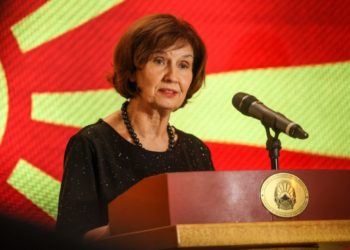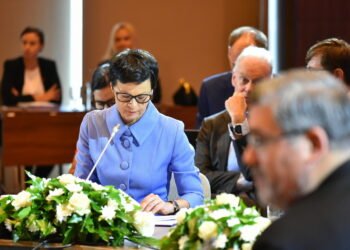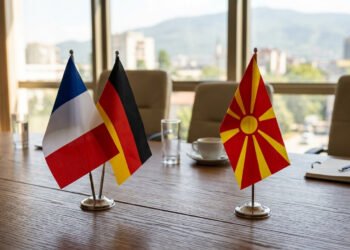
At the beginning of July, the European Commissioner for Enlargement Marta Kos is coming to the country, who, according to unofficial information, will talk with the Macedonian head of state regarding the non-paper led by German Chancellor Friedrich Merz and French President Emmanuel Macron.
Whether that non-paper will finally become an official paper remains to be seen, but if the signals from Brussels are followed, it is very likely to happen quickly. The European Commission, in order to speed up the enlargement process, decided to open all negotiation chapters with Ukraine and Moldova at once. He will have to follow this pattern with the countries of the Western Balkans, including Macedonia, which at this moment is ready not only to immediately open all negotiation chapters, but also to immediately close them, given that we have been quietly negotiating with the EU for two decades and we have already fulfilled most of the conditions and harmonized almost all the laws.
However, what is noticeable is that Brussels is preparing a serious cleaning of the inert and hardened bodies that have so far hindered the Union in all directions, including the enlargement process. It is no coincidence that Prime Minister Hristian Mickoski returned from the summit in Tivat with a bunch of optimism after meetings with French President Emmanuel Macron and German Chancellor Friedrich Merz. After the heart-warming photos, a debate was immediately opened in our house. Some wonder what this optimism is due to when we are still blocked from all sides, others, on the other hand, stick to the position that everything was just some kind of PR. Now, after the impressions have subsided, it seems that behind that optimism is something much bigger, which is already simmering behind the scenes of the European Union. Namely, it seems that France and Germany have decided to take all control into their own hands and cut the wings of small countries that constantly blackmail something, block, obstruct, enforce some of their anachronistic policies and so on.
To put it bluntly, Paris and Berlin got a headache. As the world faces wars in Ukraine and the Middle East, the EU has become the object of ridicule and is perceived as a completely irrelevant factor, unable to make a single timely decision. That is why Europe was not at any table where essential decisions were made. After all, you don’t need a particularly high IQ to understand why this is so. Namely, things are like this because until now the rule “one country, one vote” was valid. This means that some small country, guided by its own internal political points or historical complexes, can veto and block the whole of Europe. That’s why the big players were shocked by this “emotional diplomacy”, so they decided to make a silent diplomatic coup.
Some time ago, “Financial Times”, referring to information from reliable sources, came out with an article in which it is written that France, Germany and two or three other strong Western European countries are making plans for radical reform. Kaja Kalas, the head of European diplomacy from Estonia, is the first on the wallpaper. Instead of her leading the game and focusing only on the Eastern Front and Russia, the bigwigs want to drastically reduce her powers. A key objective of this internal operation is that Europe is no longer a hostage to small countries and their bilateral accounts.
This is nothing but the so-called return of “realpolitik”. The great powers openly tell each other that if the biggest financial and military burden falls on their backs, then they too will dictate which notes the “European symphony” will play. It can be seen firsthand that an unofficial “directory” of the powerful is being created. When they agree privately, the decision will simply go down as an order, that is, it will be acted upon in a hierarchy. The EU is becoming militarized not for nothing, so when it already forms an army where the orders are followed by hierarchy, it will be the same in the political part, the main “commanders” will give the orders, the “soldiers” will execute. Small member states will no longer be asked, but will only have to listen and sign. The romantic story that everyone is equal in the EU definitely disappears in this year 2026, so that even the current member states will lose the tool that was important for them to blackmail, and there is no question of future members at all. They will only be de facto full members, but de jure they will be without the power to abuse membership for their own purposes.
And again someone will find himself here and ask what this coup inside the EU means for Macedonia. Will we survive without constitutional amendments? What about the protocols, will at least one drop? Does anyone give guarantees? A year, two, three? One thing is certain, and that is that this is a completely new reality for our European integrations. First, it means that the key to our unblocking will no longer be sought in Brussels, through the labyrinths of bureaucrats and European commissioners. If the big ones decide that they need us and that it is strategically important for us to move forward, the small neighboring countries will not be able to play games with vetoes and conditionalities so easily.
But more importantly. We at home have a number of things to finish to make a decent country. When the big ones decide, they only look at their own interest, and we, since we are not big, should look at our own interest. Our diplomacy must be extremely smart, analyze these new trends and have a prepared scenario for any possible development of events. We must be prepared for the demands that Paris and Berlin will deliver directly to us. We can only hope that these new “bosses” in Europe will be principled and that they will value us according to real criteria and not according to the whims of the neighbors. The game is getting rough, but at least there will finally be rules and we will know exactly who we are playing with.