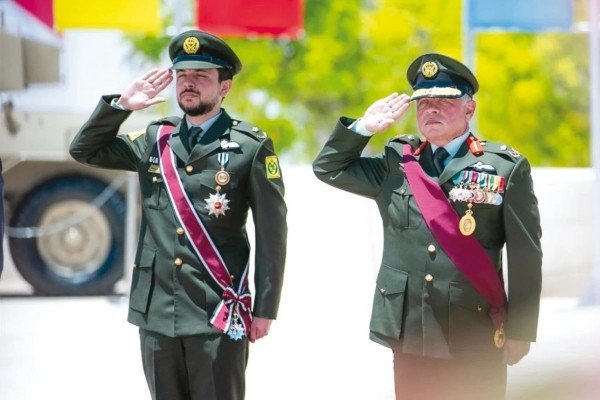
A royal vision leading the modernization of the armed forces and enhancing their operational efficiency
On the tenth of June of each year, the meanings of pride and pride in the anniversary of the Great Arab Revolt and the Arab Army Day are renewed in the Jordanian national memory, an occasion that does not represent just a passing historical event, but rather embodies the journey of a homeland built on sacrifices, solid will, and wise Hashemite leadership. On this anniversary, Jordanians recall bright pages of their national history, starting with the banner of the Great Arab Revolt, which carried the principles of freedom, dignity, and unity, all the way to the Jordanian Arab Army, which over more than a century has become a symbol of loyalty and belonging and an impenetrable fortress that protects the nation and preserves its achievements.
A number of retired military commanders also confirmed that Army Day and the anniversary of the Great Arab Revolt constitute a solid national occasion to remember the sacrifices made by fathers and grandfathers in order to build the Jordanian state and defend its security and stability, stressing that this occasion reflects the depth of national belonging and embodies the values on which the Jordanian state was founded since its founding.
In turn, the former director of moral guidance and professor of political science, retired Major General Dr. Muhammad Khalaf Al-Raqqad, said that Army Day and the anniversary of the Great Arab Revolt constitute two cherished national occasions that embody turning points in the history of the Jordanian state, and reflect the wisdom of the Hashemite leadership and its role in building the nation and consolidating the values of belonging and loyalty.
Al-Raqqad said that this occasion calls for remembering the sacrifices of the martyrs of the Jordanian Arab Army, who wrote with their pure blood the pages of glory, pride, and independence, and contributed to building the Jordanian state and protecting its achievements, stressing that the Great Arab Revolt and Army Day are inseparable, as they represent an extension of a national and nationalist march that carried the principles of freedom, dignity, and unity.
He added that the Great Arab Revolt formed the intellectual and political foundation from which the modern Jordanian state was launched, as it came in response to the Arab aspirations for freedom, independence, and the establishment of an independent Arab state, based on the vision of Sharif Hussein bin Ali, may God rest his soul, who believed in the importance of the Arab national dimension and placed the nation’s interest above all else.
He explained that Sharif Hussein bin Ali embodied, through the Great Arab Revolt, clarity in the political and military vision, based on the principles of Shura and commitment to national and national values, and remained committed to his positions and principles in defense of Arab issues, especially Palestine and Jerusalem, an approach that continued through the Hashemites until the Hashemite custodianship of the Islamic and Christian holy sites in Holy Jerusalem.
Al-Raqqad pointed out that the Jordanian Arab Army represents one of the most prominent manifestations of Hashemite loyalty to the nation and homeland, and is considered a fundamental pillar of the strength of the modern Jordanian state, pointing out that the Hashemite Kingdom of Jordan, over a period of more than a hundred years, was able to build strong and solid institutions, of which the Arab Army was at the forefront, as it contributed to consolidating independence, protecting national security, and defending the issues of the Arab nation.
He stated that, since assuming his constitutional powers, His Majesty King Abdullah II has led an integrated project to modernize the Jordanian Armed Forces, which was based on continuous strategic reviews aimed at developing defense policies and military doctrine, raising the efficiency of human resources, and enhancing logistical and technological capabilities.
He stressed that the military modernization strategy focused on building modern and flexible forces capable of dealing with the challenges of the future, by providing them with the latest military technologies and advanced armament systems, in addition to developing systems of military education, health care, and support services, in a way that enhances the readiness of the armed forces, their operational efficiency, and their ability to perform their national duties with the highest levels of professionalism.
Al-Raqqad stressed that the Arab Army will remain a symbol of pride and national pride, a strong fortress that protects Jordan, preserves its security and stability, and continues to carry the message from which the Great Arab Revolution began in the service of the homeland and the nation.
Retired Major General Bassam Abdel Hafez Al Majali said that Army Day represents a national occasion in which Jordanians remember the story of a homeland shaped by sacrifices and heroism, indicating that His Majesty King Abdullah II led a comprehensive modernization process for the armed forces that strengthened their defense, technological and operational capabilities, and established their readiness to face modern and changing challenges.
Former Assistant Chairman of the Joint Chiefs of Staff for Planning, Organization and Defense Resources, retired Major General Hilal Al Khawaldeh, confirmed that this precious national occasion embodies the meanings of sincerity, dedication and sincere belonging to the homeland, and enhances feelings of pride in Jordan’s history and achievements, stressing that the Jordanian Armed Forces have witnessed great qualitative development over the past decades in terms of training, qualification, armament and military technology, which has enhanced their readiness and ability to deal with various security challenges.
Al-Khawaldeh pointed out that the Arab Army has paid increasing attention to modern technologies, cybersecurity, drones, and advanced defense systems, in line with the royal directives aimed at modernizing and restructuring the armed forces in a way that suits the nature of contemporary challenges.
For his part, retired Major General Abdul Rahim Ali Al-Zoubi stressed that this national occasion embodies the journey of a country that was able to build a unique model of stability and moderation despite the challenges, noting that Jordan, under the leadership of His Majesty King Abdullah II, has strengthened its regional and international standing as a voice of wisdom and moderation, while the Arab Army continued to perform its national role in protecting the homeland and defending its achievements.
Al-Zoubi explained that the armed forces and security services were and still are the fortified shield of Jordan, and that the achievements achieved are the result of a long-term leadership vision, continuous institutional work, and a solid national will that believes in the importance of construction and modernization.
Retired Major General Khaled Irsheed Al-Azamat stressed that Army Day and the Great Arab Revolution represent a renewal of the pledge and loyalty to the Hashemite leadership that carried the message of Arab freedom and pride, noting that the Arab Army has witnessed, since the beginning of the third millennium, a qualitative transformation that has made it an advanced model in the region through modernizing the air force, enhancing the capabilities of special operations and electronic warfare, and developing national defense industries.
For his part, retired Major General Abdullah Al-Hasanat stressed that the Great Arab Revolt established the principles of freedom, unity and dignity, and formed the basis from which the path of the modern Jordanian state began, while the Arab Army became a source of pride for all Jordanians thanks to the development it achieved in defense, technical and armament capabilities.
Al-Hasanat pointed out that the Armed Forces continued to invest in the fields of cybersecurity, artificial intelligence, drones, and modern technologies, ensuring that they maintain the highest levels of readiness and efficiency.
In turn, retired Brigadier General Muhammad Al-Manajra explained that the nature of wars has witnessed fundamental changes in recent years, which necessitated the development of Jordanian military capabilities in the fields of cyber warfare, drones, and modern defense technology, noting that Jordan has achieved remarkable progress in the field of military manufacturing through the King Abdullah II Center for Design and Development.
Al-Manajra stressed that the Jordanian Armed Forces continue to perform their national role with high efficiency, based on a clear royal vision that seeks to enhance readiness and professionalism and keep pace with global military developments.
For his part, Brigadier General Hassan Al-Hawarni said that the Great Arab Revolution was based on the principles of liberation, renaissance, and preserving Arab identity, stressing that the Jordanian Arab Army has carried the message of the revolution since its founding, and has continued to embody its values in defending the homeland and the nation’s issues.
As for Brigadier General Ghazi Al-Saghir, he confirmed that the Arab Army represents the natural extension of the Great Arab Revolution, and that throughout its history it has written bright pages of heroism in the battles of Jerusalem, Latrun, Bab Al-Wad, and the Battle of Al-Karama, leading to its current role in protecting the security and stability of the homeland.
He pointed out that the process of development and modernization witnessed by the Armed Forces over the decades made it a model of efficiency, discipline and professionalism, and a source of pride for Jordanians and Arabs alike.
The testimonies of military leaders unanimously confirm that the Jordanian Arab Army was not just a military institution, but rather was and remains an essential pillar in building the modern Jordanian state, and a major partner in protecting its security and stability and preserving its achievements, based on the legacy of the Great Arab Revolt and its established values.
On Army Day and the anniversary of the Great Arab Revolt, Jordanians continue to recall the lives of the Founding Fathers and the martyrs who gave their lives in defense of the homeland and the nation, stressing that the banner of the Arab Army will remain fluttering with glory and pride, and that Jordan will continue its march with confidence and ability under the wise Hashemite leadership, drawing inspiration from its glorious history as a force that pushes it towards the future and maintains its position as an oasis of security, stability and achievement.