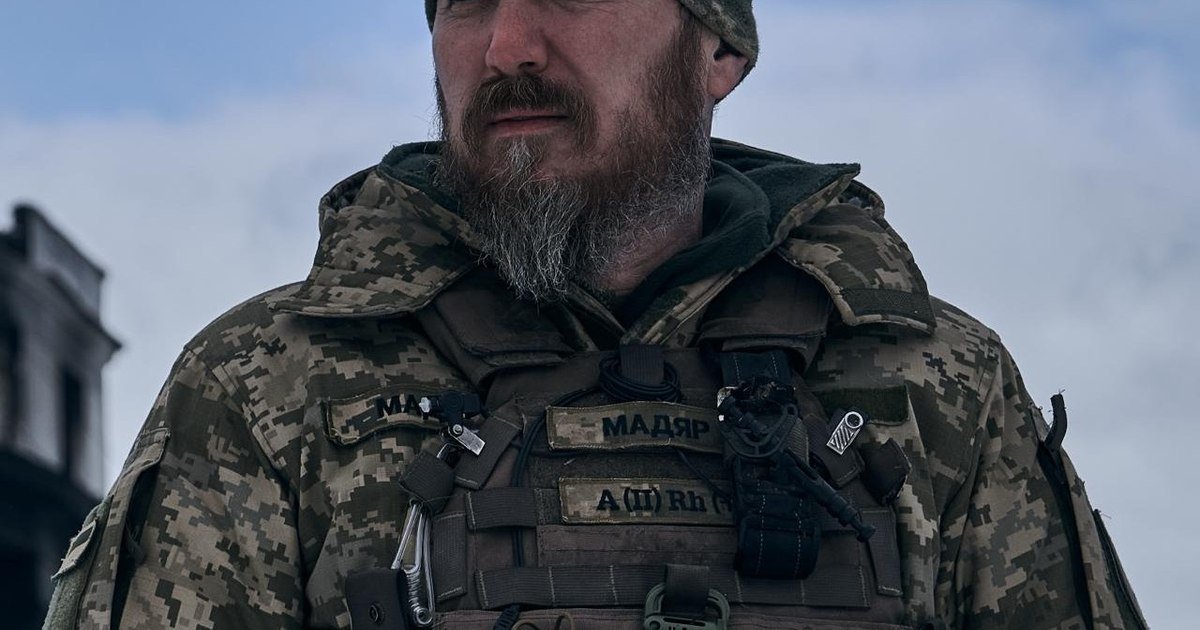
In an underground bunker whose location is kept secret, Robert “Madyar” Brovdi watches Ukrainian drone strikes on Russian forces in real time. On the walls are images transmitted by drones, maps of the front and tables accounting for destroyed targets. Each attack is recorded, analyzed and turned into a lesson for the next operation.
Robert “Madyar” Brovdi, head of the Ukrainian Unmanned Systems Forces/PHOTO:X
At 50, with a graying beard and a reputation that makes him one of Moscow’s most sought-after targets, Brovdi heads Ukraine’s Unmanned Systems Forces. Although he avoids public appearances and professes to dislike interviews, he becomes visibly excited when the discussion turns to mathematics and how it can influence the course of war.
“Numbers are the foundation of war. It all starts here. He who ignores this cannot lead the game, he can only follow it“, he declared to journalists from AFP.
Best known by his military callsign, “Madyar”, Brovdi had no military experience before the Russian invasion in February 2022. A prosperous businessman in the grain trade, he volunteered to fight and set up his own drone unit – the “Birds of Madyar” – at a time when the importance of this technology was not yet fully understood.
His initiative quickly caught the attention of the Ukrainian military, and in June 2025 President Volodymyr Zelenskiy appointed him to head the Unmanned Systems Forces.
Brovdi’s path reflects one of the most important transformations of the Ukrainian military: the use of innovation and technology to offset Russia’s numerical and material advantage.
“I brought the accounting system I used in business with me to war”
“I brought the accounting system I used in business with me to the war. I replaced the types of grain with the types of drones and munitions“, he explains.
Under his coordination, some of the most spectacular attacks on Russian territory were carried out. Long-range drones have struck refineries, warehouses and military targets, damaging infrastructure supporting the Kremlin’s war effort.
These operations have made it a priority target for the Russian services and military, which is why it operates from underground bunkers and frequently changes its location. Journalists who managed to visit one of his command centers were forced to comply with strict security measures, including traveling in vehicles with fully covered windows.
“A dangerous and professional opponent”
The interior of the bunker combines seemingly incompatible elements: fragments of destroyed drones and Ukrainian artwork. From here, Brovdi coordinates some of the Ukrainian military’s most powerful drone units.
Kiev criticizes Trump’s team after the Riyadh negotiations. “It will only feed Putin’s appetite”
His windowless office is animated by constant calls and rapid exchanges of information with the teams watching the command center screens.
Recently, its forces launched an attack on St. Petersburg right during Russia’s main economic forum. Other strikes caused fires that burned for days at oil facilities hundreds of kilometers from the front line.
The efficiency of these operations has even attracted recognition from some Russian military commentators. Andrei Medvedev, a blogger and reporter for Russian state media, described him last year as “a dangerous, dedicated and professional opponent.” Russian channel Rybar credited him with creating “the most effective formation of its kind” in the Ukrainian army.
The Unmanned Systems Forces claim to be responsible for 30–35% of all Russian targets confirmed destroyed, although they represent only about 2% of the Ukrainian military.
Brovdi’s strategy is built around a simple but ruthless logic: take out more Russian troops than Moscow can mobilize.
To increase the effectiveness of strikes, he relies on the analysis of data collected by drones. Continuous footage on monitors shows Ukrainian aircraft tracking Russian soldiers through fields and forests until the moment of impact.
Art as a refuge during war
In contrast to the images of battle displayed on the screens, on the walls of the bunker are works signed by famous Ukrainian artists, including a still life with flowers by Maria Primacenko.
“Art helps us stay connected to normality and detach for a few moments from the circumstances that brought us here“, says the commander.
Before the war, Brovdi ran a cultural foundation in his native region of Transcarpathia in western Ukraine. Today he cannot return home for security reasons.
“I can no longer look at my favorite place at home, familiar objects, a vase or the view from the window.” he confesses.
His wife enlisted shortly after the outbreak of war and coordinates the unit’s military support service. Outside of that, only a very small circle of people know where the commander will be even a few hours in advance.
A father of two, Brovdi says the success of the operations is a form of compensation for the personal sacrifices imposed by the war.
“There’s that momentary sense of satisfaction when you take the remote into your own hands, see the results of your work, and feel like you’ve achieved some form of revenge“, he states.