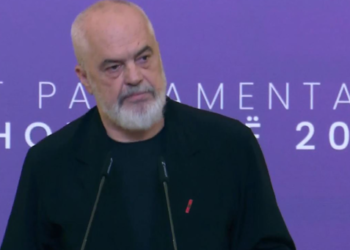
When he took power in 2013, Edi Rama promised the Albanian citizens that he will be their “chief servant”. He promised them that the task will be his, but “the power will be yours”. Today, when the citizens ask for power back, he has a message for them: “Fuck you”
If you intend to be a leader who will be remembered, you must meet many criteria. One of these is being an exceptional orator. Great leaders have an innate ability to inspire people and capture historical moments beautifully. They are political poets. That’s why we remember “Ich bin ein Berliner”, “Don’t ask what your country can do for you, but ask what you can do for your country”, and the like. This is how I remember a very beautiful sentence by Edi Rama. When he won the 2013 elections and came to power, he appeared before the Albanian citizens and promised that “I will be your prime minister, but also your chief servant. The task will be mine, the power will be yours.” The use of the word “chief servant” was very elegant and beautiful. I don’t know the reason why, but I remembered this sentence of Rama when I read this week that now Rama addressed the Albanian citizens with “Fuck you”.
You can write endless pages about the degradation of Rama’s power, but nothing can better capture the moral and political bankruptcy of Edi Rama than his own words. The one who started power with the promise to be the “chief servant” of the people, today says “Fuck you” to his own people. The only other politician in the world who has used such vocabulary towards his own citizens is Rodrigo Duterte. “Putang Ina” or “Son of whores” is the slur that Duterte regularly used against those with whom he disagreed. Thus today Edi Rama finds himself in a different society than the one in which he started his rule. What started as Kennedy is ending as Duterte.
The eventual degradation in “Fuck you” was the logical conclusion of the entire discourse that Edi Rama has chosen to respond to the Flamingo Revolution. Initially they were accused of being elements of Iranian, Greek and Serbian agencies. Then Rama revealed that the protest is part of a digital coup against Albania. Then it became anti-American, anti-Israel, anti-capitalist and anti-development. Then it was the caravan and the hysteria of the raging influencers of Albania who endanger Albanian tourism. Then it was the fault of the madmen who come from Kosovo and North Macedonia. And so on. The most remarkable thing about all of Rama’s accusations against the protesters was not their nature or substance, but the speed with which they changed. Ironically, the charges proved that something was wrong with Rama, not with his accusers.
In “The Power of the Weak”, Havel talked about how the entire totalitarian system existed because the citizens agreed to “live within the lie” of power. They knew that everything was wrong, they knew that the government propaganda was a lie, they knew that the elections were a farce, they knew that the economy was not the “global miracle”, but each of them chose to accept this ritual of lies until the day one of them decided to end this ugly performance. Others then joined in, as totalitarian systems collapsed one by one.
The Flamingo Revolution is Havel’s “greengrocer” who finally decided to refuse to live inside the lie. He refused to be part of this performance of Rama’s power. It rejected the ritual of normality of an abnormal policy, it rejected fear and propaganda. Instead of a lie, they chose the truth – elections are not fair, corruption is not gone, the economy is not a miracle and the media is not free. And criticizing the government is not treason. Ironically, Revolucioni Flamingo and Edi Rama have switched places. In 2026, the Flamingo Revolution is doing what Edi Rama did in 2013. In 2013, Rama was a “greengrocer” who rejected Berisha’s lies and embraced the truth of the Albanians. In 2013, he showed the Albanian people that the king is naked. Today in 2026, Edi Rama is the king, while the Flamingo Revolution is a “greengrocer” that rejects his lies. The dissident who once fought the corrupt government is now defending it.
There are public voices that, looking at what is happening in Albania, say that Edi Rama will survive the Flamingo Revolution. The protests will not be the end of it. It may be true that the protests will not destroy Edi Rama politically, but they are already doing something much more serious – they are revealing the real Edi Rama. A Ram who from an inspiring dissident for freedom has transformed into another Balkan autocrat.
Thus, the irony of Edi Rama’s political fate is that he has achieved what he wanted – he has changed Albania. But this change has come with a price – this journey has also changed Edi Rama. When in 2013 the Albanian people gave everything to Rama, Rama promised them that he will be their chief servant. Today, when the people hold him accountable, Rama gives him the middle finger. He has nothing more to offer. The flamingo has become an owl.