‘I would like to see the Dutch Intelligence Service archives public’
Text and image Euritha Tjan A Way
PARAMARIBO — The Internal War is often characterized as a ‘war’ between the army of Suriname and the Jungle Commando. But Agir Axwijk’s research shows that it was a war at the highest level. “A war between the Surinamese government and the resistance in the Netherlands led by people like André Haakmat, Romeo Hoost, Paul Somohardjo and others.
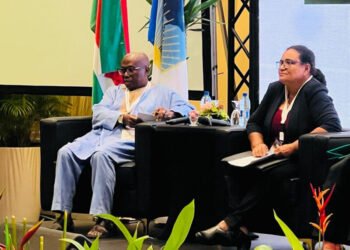
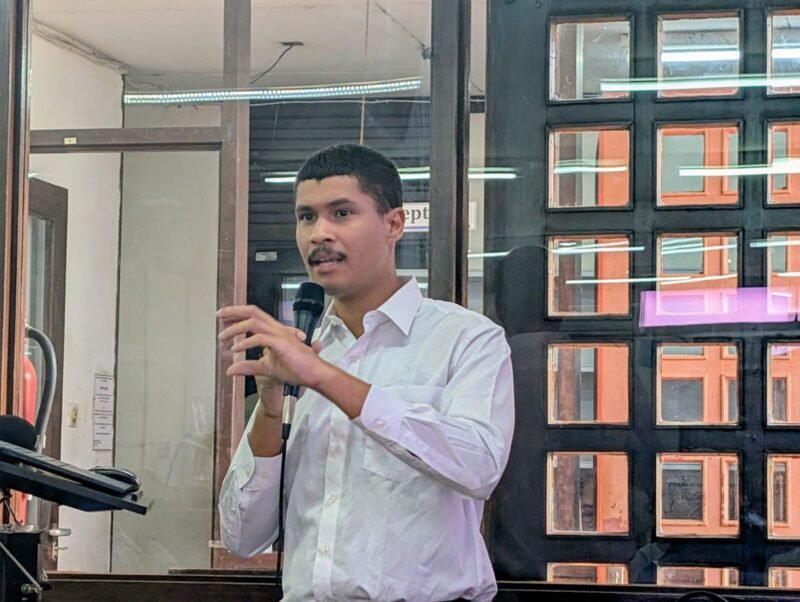
The Surinamese government deployed the army and the resistance deployed the Jungle Commando,” historian Axwijk immediately drops a proverbial bomb at the start of the presentation of his master’s thesis in book form entitled ‘The Indigenous Population and the Surinamese Internal War 1986 – 1992.’ In a library room filled to the last chair, Axwijk brought history to life.
“For example, Axwijk reports that he had a lot of problems with his supervisor in the Netherlands, because he did not want to go along with the research results because of his personal ties with the resistance at the time.”
Zeister Missionary Society
Axwijk says that, according to his sources, the Dutch state did finance the Jungle Commando led by the current leader of Abop, Ronnie Brunswijk. “That was done through the Zeister Missionary Society. The Dutch government gave money through this society to support the victims of the Internal War in French Guiana. But there was a Dutch Colonel there named Bas van Tussenbroek. And Van Tussenbroek was also able to access the money and was an advisor to Brunswijk at the time,” Axwijk explains.
In his 114-page book, he mainly explains what the role of the natives was during the Internal War. He thus gives a different view on previous publications such as that of Father Toon te Dorsthorst, who published that the uprising of the indigenous people after the Kourou Agreement was because they were armed by the National Army. “The indigenous people I spoke to were against the idea that the agreement included a police unit of Jungle Commando members that would be for the interior. That caused an uprising.”
He also says that since 1986, indigenous people joined the army because of the enormous violence used by the Jungle Commando when visiting indigenous villages. “It started in Bigiston and shifted to other places. And while indigenous people told stories about violence and rape by the Jungle Commando, the resistance in the Netherlands reported in the Dutch media that it was not true and also that the Jungle Commando did not attack civilians,” Axwijk explains.
Narrative
Axwijk’s research and his subsequent publication ensure that the narrative (angle) from which the years around 1980 are presented in Suriname and the Netherlands changes. That doesn’t always happen without a fight. For example, Axwijk reports that he had many problems with his supervisor in the Netherlands, because he did not want to go along with the research results because of his personal beliefs.
When asked whether he fears that his narrative will be generated by the groups that continue to determine the angle in Suriname and the Netherlands, Axwijk says that this is not relevant. “History is always rewritten as soon as research is done. It doesn’t matter if my research is discarded. In thirty years, someone will pick up my book and continue with it,” he said calmly.
Intelligence Service Archivest
Axwijk is pleased that the archives of the House of Representatives for the period from 1980 are being released. “But what I am curious about are the archives of the Dutch Intelligence Service from 1986 to 1992. I am almost certain that the intelligence service knew what Bas van Tussenbroek did in French Guiana and also what the resistance did. And those archives are not public,” says Axwijk. His next book is already being written and will be about the Internal War itself.
During the presentation on Thursday, a number of historians from the Faculty of Humanities, which includes the History course, were also present in the room of the University Library. It sounded with eyes shining with pride. “It is our first student who has completed a bachelor’s degree here and who is publishing a book. We hope for more!”