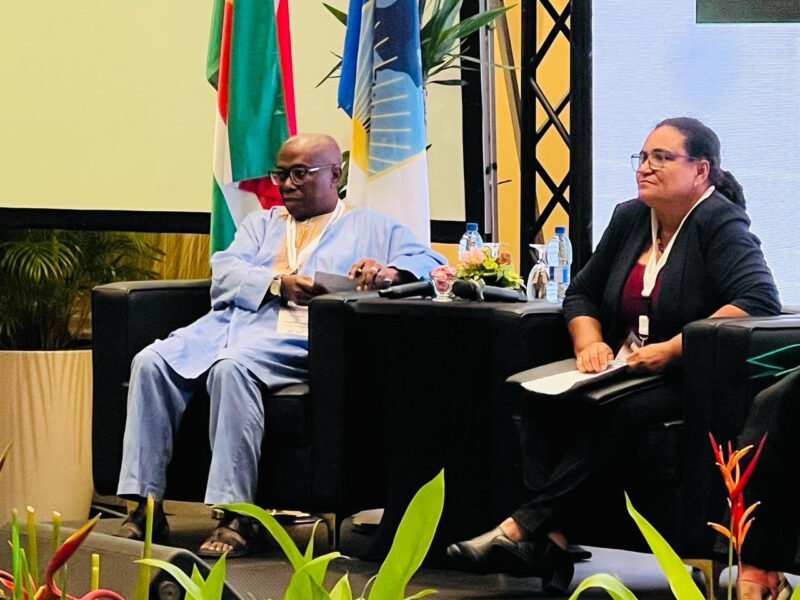
Last week was dominated by the second phase of the Education Congress 2026, which started on Monday and ended on Wednesday. Speakers from home and abroad gave keynote speeches, while dozens of participants were active in panel discussions every day. On the first day, President Jennifer Simons served as the keynote speaker. During the final day, Minister Andrew Baasaron and Professor Frank Jabini took a central place in the program.
Text & image Edwien Bodjie
On Wednesday, at Hotel Torarica, Jabini addressed more than two hundred attendees with a presentation about the significance of a national qualifications framework (NQF) for Suriname. He made it clear that its introduction is necessary for a transparent, flexible and future-proof education system.
“The framework must smell Surinamese and taste Surinamese”
Jabini explained that themes such as educational innovation, quality and connection to the labor market are closely related. “What we have discussed so far are important matters, but without a qualification framework we will not make any progress. We cannot introduce components separately. There must be a coherent system in which everything has a place.”
More than just diplomas
A national qualifications framework goes further than a list of diplomas. It systematically describes all qualifications within education and looks at what someone actually knows, understands and can apply. These are divided into levels based on concrete learning outcomes and competencies.
This does not only look at formal education. Informal and non-formal learning also have a place within the system. “We not only train people for the labor market, but also contribute to their education,” says Jabini. The Surinamese model therefore looks at knowledge, skills, responsibility and life skills.
An important element is the recognition of previously acquired competencies, also known as recognition of prior learning. People who have gained knowledge and experience outside formal education can still be classified at a certain level. “We already do that at the highest level, for example with honorary doctorates,” Jabini noted. “The question is why this is not applied more widely.”
Regional and international connection
Jabini placed developments in Suriname in a broader regional context. In the Caribbean, the focus was initially on vocational education, but this grew into a broader qualifications framework for the entire education system within CARICOM.
Suriname established its own qualification framework in 2024 with eight levels and additional entry options. According to Jabini, the emphasis is not so much on the number of levels, but on the way in which they are substantively elaborated. “The description allows comparison with other systems,” he indicated.
He also pointed out that the model must match Surinamese reality. “The framework must smell Surinamese and taste Surinamese,” he said, referring to factors such as language, educational diversity and socio-economic conditions.
Implementation requires clear choices
In addition to the content, Jabini discussed the implementation in detail. According to him, an independent authority is necessary for management and implementation. He advised not to use existing institutes for this, but to set up a new, specialized organization. “It has to be done by experts,” he said. “Experts only.”
In addition, there is a need for broad awareness. Working with a qualification framework is new for Suriname and requires training and guidance. Teachers and educational institutions will have to learn how to assess and certify competencies, not only based on diplomas, but also on skills and experience. The legal basis also deserves attention. The system must be carefully laid out, with room to make adjustments when necessary.
Gap between training and practice
An important point in his presentation was the gap between the level at which students are trained and the level at which they function in practice. As an example he mentioned graduates of pedagogical institutes. They are qualified at a certain level, while in practice they often bear more responsibility.
“We train people for a certain level, but let them function at a higher level for which they are not prepared,” Jabini said. This difference makes it clear that a well-functioning qualification framework is needed, in which expectations, competencies and responsibilities are better aligned.
Panel discussion
The presentation was followed by a panel discussion led by educational coach Loraine Vreden. Panel members included Manuela Veldkamp, Zita Jaipersaud, Leanda Zeldenrust and Joyce Lapar, all active in different parts of the education field. During the conversation, the practical implementation of the qualifications framework was discussed, as well as the role of institutions and the contribution to quality improvement and connection to the labor market.
The final day of the conference was therefore all about structure and coherence. While previous sessions mainly focused on content and innovation, Jabini made it clear that sustainable improvement is only possible within a clear and well-organized system. “The framework gives us that structure. Without that structure, we continue to take individual steps, without real progress.”