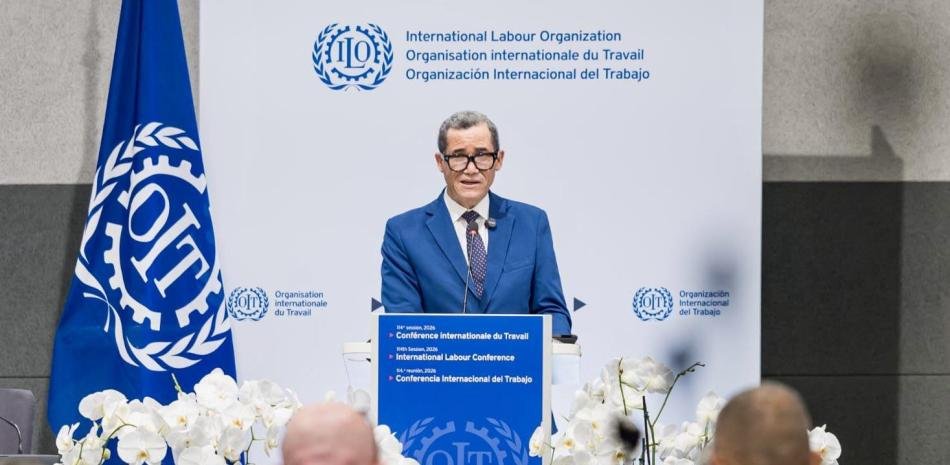
The Minister of Labor of the Dominican Republic, Eddy Olivares Ortega, stated that the reform to the Labor Code that the National Congress is preparing to approve is an initiative that seeks to update the labor regulatory framework to adapt it to the new dynamics of the market.
He considered that the labor reform seeks to strengthen the protection of fundamental rights, as well as guarantee greater legal security and competitiveness.
The official reaffirmed the country’s commitment to social dialogue, decent work, labor justice and the strengthening of workers’ rights, during his participation in the 114th International Labor Conference, organized by the International Labor Organization (ILO), in Geneva, Switzerland.
When addressing representatives of governments, employers and workers present at the activity, Olivares highlighted that the meeting agenda addresses fundamental challenges related to the future of employment, the protection of labor rights and the construction of more inclusive and sustainable economies.
He pointed out that these objectives are aligned with the vision of President Luis Abinader, who has promoted public policies focused on people, promoting institutions, coordination and respect for fundamental rights in the workplace.
Olivares indicated that the Dominican Republic appears in category 2 of the Global Rights Index of the International Trade Union Confederation, positioning itself among the three highest-rated countries in Latin America and the Caribbean in terms of respect and guarantee of labor rights.
He also highlighted the recent launch of the Model for Identification of Places with Risk of Child Labor (MITRI), a tool developed with the auspices of the ILO to strengthen preventive actions and inspection processes aimed at eradicating child labor in the country.
Employer sector
While the president of the Employers’ Confederation of the Dominican Republic (Copardom), Laura Peña Izquierdo, brought today to the 114th International Labor Conference a position focused on three key axes for the country: more formal employment, labor modernization and defense of social dialogue as a way to reach sustainable agreements.
He stated that the country needs to accelerate reforms to increase productivity, strengthen social security and create conditions so that companies continue generating decent jobs.
The business leader stressed that economic growth will only be sustainable if it is accompanied by public policies that facilitate formalization, promote investment and preserve business freedom.
In this sense, he insisted that dialogue between the government, employers and workers must continue to be the main mechanism for building consensus on labor matters.
The conference has among its central themes decent work in the platform economy, gender equality in the world of work and the strengthening of tripartism, issues that according to the president of Copardóm directly connect with the challenges of the Dominican economy.
Peña Izquierdo specified that informality continues to be one of the main barriers to productive inclusion and social protection, which is why he called for promoting modern, balanced standards adapted to the reality of companies and workers.
With its intervention in Geneva, Copardom reaffirmed its role as the voice of the Dominican employer sector in international debates on the future of work, defending an agenda that combines competitiveness, social justice, formal employment and business sustainability.
In addition, the business leader warned about the accelerated impact of artificial intelligence on the labor market, pointing out that its advance forces countries, companies and workers to prepare for a profound transformation of employment.
He indicated that technology must be assumed as an opportunity to increase productivity and competitiveness, but insisted that its implementation must be accompanied by training, updating of skills and balanced regulatory frameworks that protect both innovation and decent employment.
Vice President: it will be by consensus
The Vice President of the Republic, Raquel Peña, assured that all discussions and agreements related to the labor code were carried out based on the result of a consensus and in this decisive section it would not be different either.
“Everything that we have approved has been based on the result of a consensus and now it will not be different,” she indicated when interviewed during her participation in the International Congress “360° Digital Transformation, at the Embajador hotel in the capital.
He explained that, although he holds various meetings with the parties involved to reach the highest degree of consensus, in the end the main objective will be to mainly benefit the country’s workers so that “every day they can have more achievements in their working conditions”, without leaving aside the business community.
In that sense, the president of the Senate, Ricardo de los Santos, added that there will always be room for dialogue with the willingness to listen to all sectors to achieve the best possible result.
“There will always be room for dialogue. The Chamber of Deputies is taking the steps it must take and we must be open to listening to all sectors. A good product will come out,” she also predicted in an interview during her participation in the activity organized by the Federation of Women Entrepreneurs (FEM).
He specified that they are only waiting for the document to reach the legislative body to decide what to do.