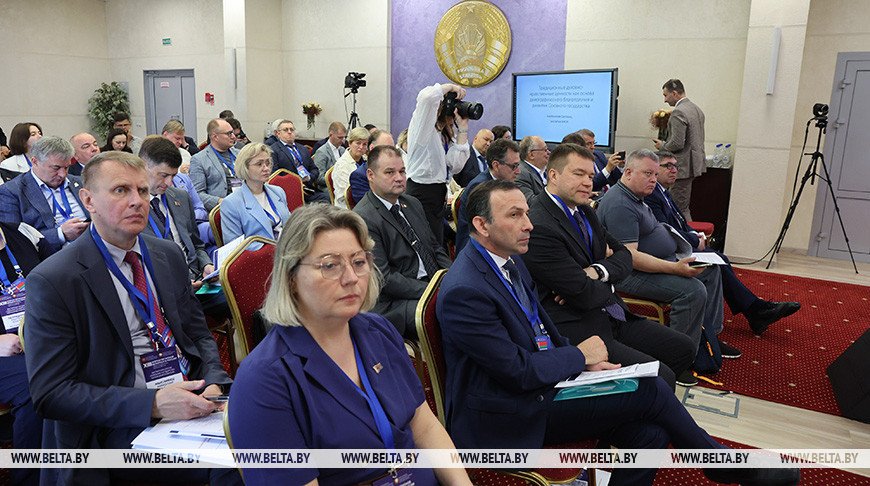

MINSK DISTRICT, 25 June (BelTA) – The most promising growth points for the Union State economy were identified by Deputy Chairman of the Board of the Development Bank Dmitry Yaroshevich during an expert session of the 13th Forum of Regions of Belarus and Russia at the Yunost sanatorium, BelTA has learned.
“Speaking about the development prospects of our countries and the Union State, I would like to focus on stimulating the development of scientific, technical, and innovative activities, primarily on building an institutional environment that encourages innovation creation along the entire chain, from science to production. It is precisely to address this task that it is advisable to join efforts within the Union State,” Dmitry Yaroshevich said.
He pointed out that the foundation of an innovative environment is legislation. “It exists and works in both Belarus and Russia. Its unification based on model legal acts developed with due regard for global best practices and domestic experience seems to be a top priority,” the deputy chairman of the Board of the Development Bank emphasized.

Another important aspect of innovative development is the development of infrastructure for scientific and technical activities. “Building the infrastructure necessary for the functioning of the economy has always been one of the state’s primary tasks. Much attention is paid to the development of energy and transport communications. State support in creating a production base for goods and services is also part of infrastructure development. In the Union State, innovation financing could become a priority. The primary task is to increase the share of effective government funding by combining grants for fundamental science and competitive programs for applied research. State participation in venture financing of innovative projects, as well as the creation of cross‑border innovation and industrial clusters in the Union State, is also necessary,” said Dmitry Yaroshevich.

More active use of big data could also become a growth point. “The analysis of vast amounts of data collected by companies during user interactions is valuable to other businesses. However, the exchange and trade of such data are constrained by data protection legislation. The solution lies in data exchanges that ensure state‑supervised, safe, standardized exchange of various data and their shared use by businesses and state development institutions. A case in point is China’s experience: the Shanghai Data Exchange has been successfully operating since 2022. Data has become an asset that not only needs to be purchased but can also be used as collateral for bank loans and as security for securities,” the deputy chairman of the Board of the Development Bank said.