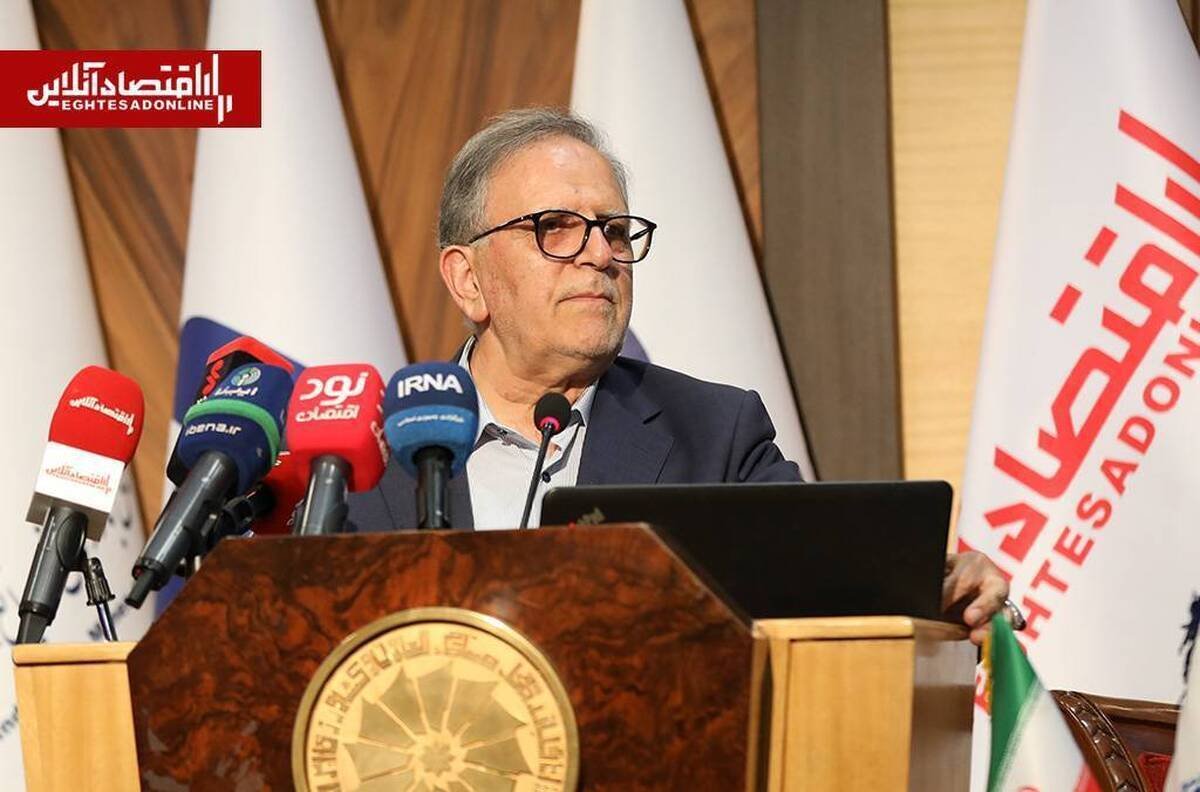
According to the report of Economy Online, Valiullah Saif, the former Governor of the Central Bank, addressed the policy makers in the “Businesses in Crisis” conference, which was held in cooperation with Economy Online and the National Organization of Entrepreneurship of Iran, and made suggestions in the field of monetary and banking policies, which you can read below:
The subject of monetary policy during the crisis, especially in war conditions, is one of the most complex areas of economic policy. In such a situation, classical goals such as inflation control conflict with more urgent requirements such as maintaining survival and economic stability. It is important to pay attention to the fact that, in spite of extensive sanctions, even before the military attacks, Iran’s economy was far from normal conditions and was facing various crises, the severity of which, of course, increased after the military attacks.
In other words, the monetary policy in this situation does not seek optimization, but seeks to prevent collapse.
In the following, I will try to present an analytical framework of monetary policy requirements in crisis conditions, focusing on the characteristics of Iran’s economy.
1. Structural characteristics of the economy on the verge of crisis
Iran’s economy was facing important structural imbalances even before entering the war conditions, which have intensified in critical conditions after the military attacks:
First, chronic inflation and unstable expectations
Chronic double-digit inflation has greatly increased society’s sensitivity to price shocks. As a result, hedging behaviors such as moving towards alternative assets and a form of informal dollarization have developed.
Second, financial dominance over monetary policy
Chronic budget deficits have created a significant dependence between the government and the central bank, and the financial dominance of the government has severely limited the independence of monetary policy.
Third, the inadequate banking system
Accumulation of non-productive assets, non-current claims and bank overdrafts have reduced the capacity of the banking system to play a stabilizing role in the economy.
Fourth, external restrictions
Sanctions have limited access to foreign exchange sources, foreign financing and even money transfers. In sum, it must be admitted that monetary policy in a crisis practically starts with closed hands.
2. Redefining monetary policy objectives in crisis
In a war situation, classic targeting needs to be redefined and the main focus should be on more operational targets:
- Preventing uncontrollable inflationary spikes. Failure to pay attention in this matter will quickly cause our economy to face serious hyperinflation.
- Maintain minimum government funding. In the conditions of a war crisis, part of the government’s financing is inevitably done through the monetary base and increasing liquidity. The danger is where we are indifferent to its amount. We should try to limit the contribution of this type of financing as much as possible.
- Guaranteeing the performance of the payment system and banking network. Continuity of the banking system and payment network is very important. In this situation, it will not be possible to carry out fundamental reforms and resolve banking disputes completely, and its expansion should be prevented as much as possible.
- It is very necessary to manage the currency market with the aim of preventing the collapse of expectations, which should be done carefully by using past experiences and avoiding trial and error.
To be clear, the goal in this situation is crisis management, not a complete solution to structural problems.
In the meantime, the existence of a nominal anchor, even implicitly, is vitally important; Because its lack can lead to extreme instability of expectations. The proposed options can be exchange rate, monetary base or inflation target.
3. Government Financing: Designing a Middle Path
One of the most sensitive points is how to finance the government. In the absence of extensive access to external sources, the risk of monetizing the budget deficit is very high.
The suggested solution is to move in a middle path. Includes:
First, targeted development of the debt market
Issuing bonds at rates that are neither suppressed nor completely free, and focusing on institutional buyers.
Second, controlled monetization
Setting a transparent quantitative ceiling for monetary financing, along with regular reporting.
Third, the use of complementary tools
such as pre-sale of resources or clearing in the conditions of currency restrictions.
The key point is that predictability is more important than the amount of monetization.
4. Interest rate policy should be based on avoiding excesses.
In times of crisis, interest rate policy should move away from a purely prescriptive mode and move towards a managed framework. This policy can be implemented using methods such as:
- Creating an interest rate corridor
- Preventing the real interest rate from becoming extremely negative.
- And the use of open market operations should be applied as much as possible and in a controlled manner.
It is important to note that:
- A very low interest rate leads to a rush to the asset and currency markets
- Very high interest rate aggravates recession and banking crisis
5. Liquidity management should be done by focusing on the composition of liquidity, not just on its volume.
In crisis conditions, it is not enough to control the volume of liquidity; But its composition is also important.
The increase in uncertainty causes the conversion of pseudo-money into money and increases the speed of money circulation. This process can intensify inflationary pressure even without a strong growth of the monetary base.
Therefore, the policymaker should carefully monitor the changes in liquidity components.
6. In the management of the banking system, priority will be given to survival and ensuring continuity of activity.
In crisis and war conditions, deep banking reforms and solving important imbalances that exist in banks, such as income-cost imbalances, asset-liability, liquidity and low capital adequacy ratio, are practically not possible; Therefore, the main focus should be on maintaining minimal stability. including:
- Providing targeted liquidity to prevent systemic crisis
- Temporary regulatory flexibility
- and directing credit to critical sectors such as food, medicine, energy and transportation.
It can bring positive results.
This approach has been experienced in many economies in war conditions.
7. Currency policy: curbing the cycle of instability
In the crisis, the currency market plays a decisive role in the formation of expectations.
The fact is that in the short term, multi-rate is inevitable and we cannot implement the main goals such as managed floating and single rate regime of the currency, but we must:
- Its scope is limited and targeted
- Be allocated to absolutely necessary goods
- And there should be a plan to gradually reduce the rate gap and gradually move towards a single rate.
At the same time, the formation of a dangerous cycle should be avoided by controlling the demand and strengthening the currency supply:
Exchange rate jump = increase in inflation = increase in expectations = currency jump again
Controlling this cycle is one of the most important tasks of monetary policy in the short term.
8. Informal economy and weakening of monetary policy channels
In times of crisis, the share of the informal economy increases. Examples of destructive activities of unauthorized institutions active in the money market can be mentioned. The volume of their activity, which was carried out outside the regulatory umbrella of the central bank and regardless of monetary regulations, included more than 25% of the country’s liquidity volume, which resulted in chaos in the money market. We remember what problems we faced at that time in order to organize and put them under the statistical coverage of the Central Bank, which finally came to a conclusion with the efforts of the employees of the Central Bank.
In general, the high share of the informal economy causes:
- The effectiveness of monetary policy instruments will decrease
- And the transfer of policies will be disrupted
This fact should be taken into account in policy design.
9. Management of expectations as the most important policy maker tool
One of the missing links in economic policymaking is the weakness in communication with society.
In times of crisis, transparency can play a decisive role.
This goal can mainly be achieved with actions such as:
- Regular publication of monetary policy reports
- Explicit declaration of financing policies
- and avoid surprising decisions.
Finally, the most important asset of the central bank in this situation is its credit, which should always be strengthened.
10. Social considerations
Monetary policy in a crisis is not just a technical tool. Rather, its distributional consequences can be:
- exacerbate inequality
- and even lead to social instability
Therefore, minimal coordination with supportive policies is necessary.
11. Institutional coordination
One of the key requirements is to establish a coordinated mechanism at the highest level:
- Central Bank
- Ministry of Economic Affairs and Property
- Program and budget organization
- and other related institutions
With the aim of making quick decisions, reducing conflicts and prioritizing resources.
12. The necessity of designing an exit from the crisis
One of the common mistakes is the persistence of emergency policies. From the very beginning, the way out of these policies should be done with measures such as:
- Gradual reduction of monetization
- Removal of price and currency controls
- and the movement towards the restoration of the central bank’s independence should be designed.
Final summary
In Iran’s war situation, the monetary policy has to change its direction from a purely anti-inflationary approach to a survival-oriented stabilization policy.
A policy whose goal is not to eliminate inflation, but to prevent multi-digit inflation and the collapse of the macro economy.
The success of this policy will not be measured by the immediate reduction of inflation, but by three key indicators:
- Preventing the collapse of the national currency
- Continuity of government and payment system
- Maintain a minimum of public trust
And finally, the most important asset of the policymaker in this situation is not only monetary instruments, but also his credibility and predictability.