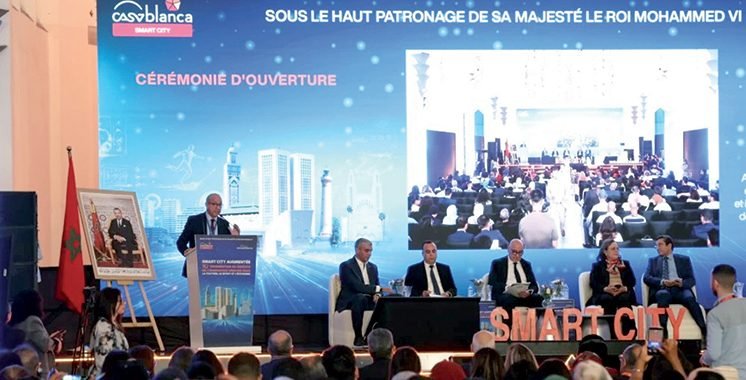
Casablanca Smart City has established itself, since its launch in 2016, as one of the main African platforms dedicated to territorial innovation and urban intelligence.
Augmented cities: Entrepreneurship, innovation and mobilization of talents marked the second day of the 10th edition of Casablanca Smart City. Placed under the theme of “Augmented Smart City”, this anniversary edition highlighted the role of innovative ecosystems in urban transformation, while promoting the sharing of experiences between Moroccan and international actors around the challenges of digital technology, employment, intelligent governance and sustainable economic development.
Work on the 10th edition of Casablanca Smart City continues. Entrepreneurship and urban creativity were at the heart of this event which this year celebrates the “Augmented Smart City”, highlighting a decade of innovation in the service of urban transformation in culture, sport and the economy. An opportunity to discuss the challenges of digital transformation and the role of technological innovation in the development of public services as well as the strengthening of urban governance, in a global context marked by the acceleration of the digital transition and the growing use of intelligent solutions in city management. The second day of the event was, in fact, an opportunity to explore ways to stimulate the local economy and citizen synergies. Several levers have been identified.
In this sense, let us cite entrepreneurship, innovation and mobilization of talents. In this sense, the speakers highlighted the importance of developing ecosystems that promote innovation, the emergence of startups and the creation of economic opportunities, while ensuring that human capital is placed at the heart of urban transformation strategies.
Speaking in this regard, Lamia Benmakhlouf, general director of Technopark, recalled that the development of the Moroccan entrepreneurial ecosystem is part of a vision initiated by His Majesty King Mohammed VI aimed at promoting innovation and technological entrepreneurship. She highlighted the role of the Technopark in supporting startups through an approach based on cooperation between universities, financing structures, public and private actors, noting that 35% of resident startups now export their solutions internationally. For her part, Imane Belmaati, president of Human Impact Hub, considered that smart cities must evolve into real platforms of opportunities promoting the employability and entrepreneurship of young people. She called for a strengthening of convergence between public, private and associative initiatives, as well as for the development of financing mechanisms adapted to innovative and high-impact projects. Furthermore, Hamid Bouchikhi, director of the Entrepreneurship Center of the Africa Business School of the Mohammed VI Polytechnic University (UM6P), for his part, called for the establishment of an approach to the city based on the creation of environments favorable to the emergence of innovation and entrepreneurial initiative.
This meeting is also intended to be a forum for sharing experiences. On this occasion, Marc Liew, Acting Executive Director for Africa, the Middle East and Latin America at Singapore Cooperation Enterprise, presented the experience of the Punggol Digital District in Singapore, an integrated ecosystem bringing together universities, startups, incubators, investors and public institutions within a single innovation space. He stressed that this model is based on data sharing, collaboration between different actors and the development of digital skills, highlighting the importance of continuing training and anticipation of the future needs of the labor market. For her part, Isabelle Ferrer, vice-president of Toulouse Métropole, responsible for economic campuses, presented the experience of the French metropolis in the creation of campuses dedicated to strategic sectors such as aeronautics, low-carbon mobility, health, artificial intelligence and cybersecurity. She stressed that these spaces promote synergies between companies, universities, research centers and startups, while offering support systems for students, researchers and innovative project leaders. For his part, Abraham Badji, municipal councilor of the city of Dakar and president of the information and communication technologies commission, presented the digital project “Set Wash”, intended to formalize the activity of vehicle washers while generating economic, social and environmental benefits. He notably highlighted the substantial water savings enabled by this initiative as well as its contribution to job creation and the integration of young people into the formal economy. Casablanca Smart City has established itself, since its launch in 2016, as one of the main African platforms dedicated to territorial innovation and urban intelligence. In ten editions, the event has brought together more than 42,000 participants, 685 exhibitors, 661 speakers and delegations representing 181 cities around the world.
This dynamic is part of a context marked by the Kingdom’s preparations for hosting major international sporting events, in particular the 2030 World Cup, considered as a lever for accelerating urban modernization and the international influence of Casablanca. The program for this 10th edition focused on various themes including digital innovation and youth, economic dynamism, culture and sport as drivers of urban transformation, as well as mobility, intelligent governance, digital inclusion, citizen participation and quality of life in the metropolises of tomorrow.