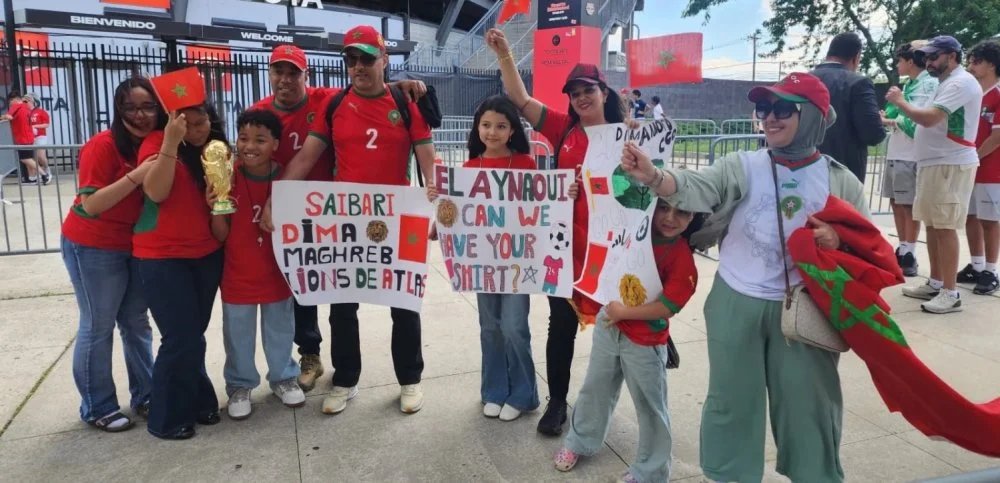
Social networks are flooded with images, videos and comments celebrating the Atlas Lions. The draw (1-1) won against the Brazil during their first release did not in any way dampen popular enthusiasm. Quite the contrary. The performance of the Atlas Lions triggered a wave of enthusiasm on digital platforms. In New York, scenes of jubilation from Moroccan supporters went around the world. Draped in red and green, singing in unison in the streets, the fans put on a spectacle that impressed international observers and media. On TikTok, Instagram or Facebook, content related to the Moroccan selection has millions of views. Between analyses, memories of the Qatari World Cup And videos of supporters on sitethe same emotion crosses the screens: that of rediscovering an adventure which had marked an entire generation. “We find the same emotions,” we can read in many comments. Others evoke “the same thrills” or even “the same pride” felt during the incredible journey which led Morocco to the semi-finals of the World Cup.


This feeling of déjà vu is not trivial. For the psychosociologist Mohcine Benzakourit can be explained by the special place that the national team now occupies in the Moroccan collective imagination.
According to him, the historic journey of 2022 constituted a founding moment in national memory. “A social phenomenon should never be explained by a single factor,” he clarifies from the outset. But the Qatari epic undeniably created whatsociologist Émile Durkheim called a “collective effervescence”, that is to say an exceptional situation where millions of individuals simultaneously experience the same emotions and reinforce their feeling of belonging to a community larger than themselves.
The scenes of celebration observed in Moroccan cities, but also within the diaspora, have contributed to building this feeling of national unity. Traditional media, then social networks, played a central role in this dynamic by disseminating images that have become emblematic of this popular communion.
For Mohcine Benzakour, the national selection also succeeded in embodying an image of Morocco in which a large part of the population recognizes itself. “The team symbolized attachment to traditions, openness to the world, the success of the diaspora and sporting excellence,” he explains.
This dimension is essential to understand the extent of popular attachment. Because in the eyes of many Moroccans, the national team no longer represents only eleven players on the field. She became a collective symbol capable of transcending social, linguistic, generational or regional differences.
The psychosociologist also believes that the current global context reinforces this phenomenon. Faced with economic, social and geopolitical uncertaintiesgreat sporting successes constitute positive benchmarks. They offer citizens opportunities for collective self-esteem and international recognition.
This transformation in the way we view the national team also explains why emotions seem stronger today than before 2022.
Mohcine Benzakour discusses what he describes as“post-exploit effect”. Before the Qatari World Cup, Moroccan fans generally approached major competitions with caution. The exceptional journey to the semi-finals has profoundly modified collective representations.
“Morocco has gone from being a respectable outsider to a team capable of competing with the greatest footballing nations,” he underlines.
This development naturally led to a rise in expectations. When a group achieves an extraordinary performance, it becomes a benchmark. Supporters no longer simply dream of honorable participation; they are now considering the possibility of seeing their team reach the heights.
This new perception was also manifested from the first match against Brazil. Despite the prestige of the opponent, many believed in a Moroccan victory. A confidence that would have seemed much rarer a few years ago.
According to Mohcine Benzakour, this rise in expectations nourishes both hope and emotion. Each encounter carries a stronger symbolic charge. Each victory causes more enthusiasm. And each potential poor performance also risks generating more disappointment.
In this equation, social networks now occupy an essential place. “Their role is central in the production of collective emotions», affirms the psychosociologist.
In the past, the media were mainly limited to disseminating information. Today, each user himself becomes a producer and distributor of emotions. Videos of celebrations, reactions filmed live, chants from supporters or testimonies from Moroccans living abroad constantly feed a shared collective story.
Influencers actively participate in this dynamic. By relaying emotional sequences, patriotic messages or content promoting the image of Morocco, they help to extend the experience on the pitch well beyond the 90 minutes of play.
For Mohcine Benzakour, social networks work like “emotional accelerators”. They promote the rapid spread of enthusiasm, joy and a feeling of pride, but also sometimes anxiety, frustration or impatience.
Despite these risks, the specialist believes that the positive effects remain largely dominant. The fervor around the Atlas Lions creates rare moments of national cohesion. For a few hours, social, generational or territorial divisions fade behind a shared collective identity.
“The national team has become more than a sporting selection,” he summarizes. “It has become a symbol of collective success, a support for national identification and a space in which the aspirations and ambitions of a large part of Moroccan society are projected.”
As the 2026 World Cup progresses, one thing already appears certain: the Atlas Lions continue to embody much more than a sporting project. They represent a collective narrative in which millions of Moroccans recognize each other. And if the competition has only just begun, the emotion already seems to have regained the intensity of the most beautiful nights in Doha.