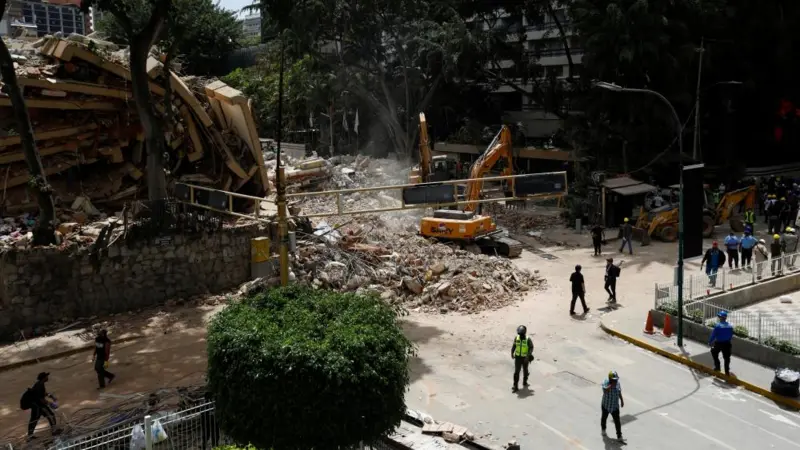
A powerful earthquake off Venezuela has renewed calls for Barbadians to remain prepared for earthquake and tsunami hazards, with disaster officials warning that the island sits in a region that remains susceptible to earthquakes and potential tsunami impacts.
The appeal comes after two catastrophic earthquakes measuring magnitudes 7.2 and 7.5 struck Venezuela less than a minute apart on Wednesday evening, killing more than 164 people, triggering widespread destruction and a massive search-and-rescue effort.
Acting President Delcy Rodríguez revealed that the coastal state of La Guaira, north of the capital Caracas, was hardest hit.
The second quake was the strongest to hit Venezuela since 1900, according to the United States Geological Survey (USGS), which has warned the final death toll could rise significantly as rescue efforts continue.
In an interview with Barbados TODAY, Deputy Director of the Department of Emergency Management (DEM), Major Robert Harewood, revealed that immediately after the earthquake, regional monitoring agencies alerted Barbados and issued information on the possibility of a tsunami.
“Met services received a tsunami information statement which said that given the earthquake impact there’s a possibility for a tsunami, and then they shared that with the media, directly with the media because earthquake and tsunami threats, particularly tsunami threats, are immediate threats. So it didn’t go through any long red tape or anything, it went straight out to the media and emergency services for their information.”
A follow-up report soon after confirmed there was no tsunami threat to Barbados.
Harewood noted that Barbados has strengthened its emergency warning capabilities through the Common Alerting Protocol and warning systems that allow urgent messages to be pushed directly to the public through participating radio stations.
“We have done significant local work with warning systems and common alerting protocols. So we have about six or so radio stations, the number may be more now, that have equipment and then we can ask them to push emergency messages straight out to the public.”
Wednesday’s earthquake should remind Barbadians of the country’s geological vulnerability, Major Harewood said.
“Barbados actually sits very close to the subduction zone in the region which is actually a fault. Barbados itself was created out of the uplift from the fault, where the Atlantic plate meets the Caribbean plate. That alone tells us that we are susceptible. However, given that the hazard is a lower frequency, it means that we’ve been told by the seismologists that the Caribbean region is overdue for a major earthquake.
“One report said that that was the largest earthquake they’ve had in 100 years. If you go on the Seismic Research website to get data you can see how many earthquake activities happen almost weekly. We know that just a couple of years ago, there was an earthquake off Antigua, so we know that the region is susceptible. There was a 6-plus off Barbados a couple of weeks ago, so we know it’s there.”
He argued that earthquakes are more challenging than hurricanes because there is little or no warning.
“If there’s any good thing about the hurricane hazard, and the good thing is that we see them coming, we batten down for them, we go into safe spaces.
“With the earthquake, we don’t see it coming.
“There’s no warning, so there’s no shutdown procedure. There’s no all-clear.”
Harewood noted that in addition to Venezuela, California and Japan also experienced earthquakes on Wednesday.
He encouraged Barbadians to learn from recent events in Venezuela and elsewhere.
“Pay attention to all vulnerabilities, paying attention to what could actually happen. Doing some case studies looking at what happened in Venezuela recently and other places to determine or to understand what they did and how they survived, what actually happened to those people who were in buildings, who were asleep, because there’s no magic bullet.”
Harewood encouraged residents to seek first aid and life-saving training.
“We put out enough information there to just remind people of the challenges that what you need to look for, what you should do, and some of the challenges that you could face, and then also to seek training.
“It’s just to understand what we can do to survive it and then try our best to do that.”
(LG)