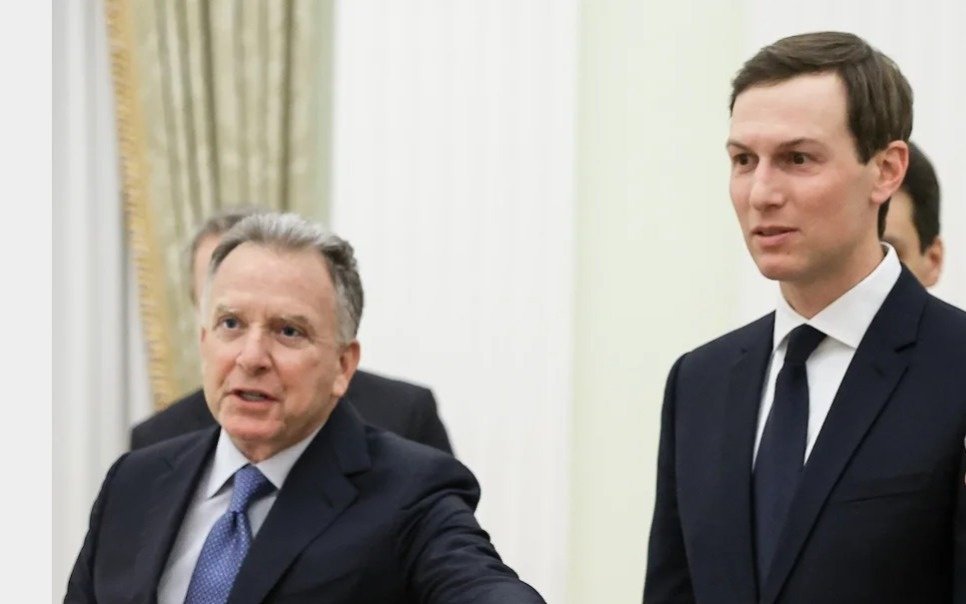
US President Donald Trump sent his envoys Steve Witkoff and Jared Kushner to Pakistan to meet with the Iranian Foreign Minister.
Ceasefire talks between the United States and Iran scheduled for Saturday come amid global tensions over a war that has paralyzed vital energy exports through the Strait of Hormuz, clouded the global economy and claimed thousands of lives in the Middle East.
Iranian Foreign Minister Abbas Araghchi arrived in Islamabad late Friday night. Earlier, he wrote on social networks that he was going to Pakistan to discuss “bilateral issues and regional events.” He did not specify who exactly he would meet.
White House press secretary Caroline Levitt said in an interview with Fox News that Witkoff and Kushner will meet with Araghchi.
“We hope this will be a productive conversation that may move things toward an agreement,” Levitt said.
She added that Vice President J.D. Vance would not travel to Pakistan but would remain “engaged” and would be willing to go there if Washington deemed it necessary.
Vance, Secretary of State Marco Rubio and the president’s national security team are “ready” to fly to Pakistan if necessary, Levitt said.
Araghchi and two Trump envoys held hours of indirect talks in Geneva on Feb. 27 over Tehran’s nuclear program, but ended without an agreement. The next day, Israel and the United States went to war against Iran.
Levitt said that the American president decided to send Witkoff and Kushner to Pakistan “to listen to the Iranians.”
“We’ve certainly seen some progress on the Iranian side over the last couple of days,” Leavitt said, without providing any details.
Tensions in the Strait of Hormuz are extremely high
Tensions remain extremely high in the Strait of Hormuz, a strategic waterway through which a fifth of the world’s oil and natural gas is transported in peacetime.
Iran continues to control traffic through the strait and attacked three ships earlier this week, while the US maintains a blockade of Iranian ports and Trump has ordered the military to “shoot and kill” small vessels that may be laying mines.
“Iran has an important choice, a chance to make a deal, a good deal, a wise deal,” US Defense Secretary Pete Hegseth told reporters on Friday. According to him, in a few days a second American aircraft carrier will join the blockade.
Washington already has three aircraft carriers in the region: USS George HW Bush in the Indian Ocean; USS Abraham Lincoln in the Arabian Sea and USS Gerald R. Ford in the Red.
This is the first time since 2003 that three US aircraft carriers are operating in the region simultaneously. The fleet consists of 200 aircraft and 15,000 sailors and Marines, according to U.S. Central Command. The number of victims is growing, despite the continuation of the ceasefire.
At least 3,375 people have been killed in Iran since the war began and more than 2,490 in Lebanon, where new fighting broke out between Israel and the Hezbollah militant group two days after the war began.
In addition, 23 people died in Israel and more than a dozen in the Arab Gulf states. 15 Israeli soldiers were killed in Lebanon, and 13 American troops were killed in the region.
Let us remind you that this week Iran’s permanent representative to the UN statedthat the country is ready for negotiations.