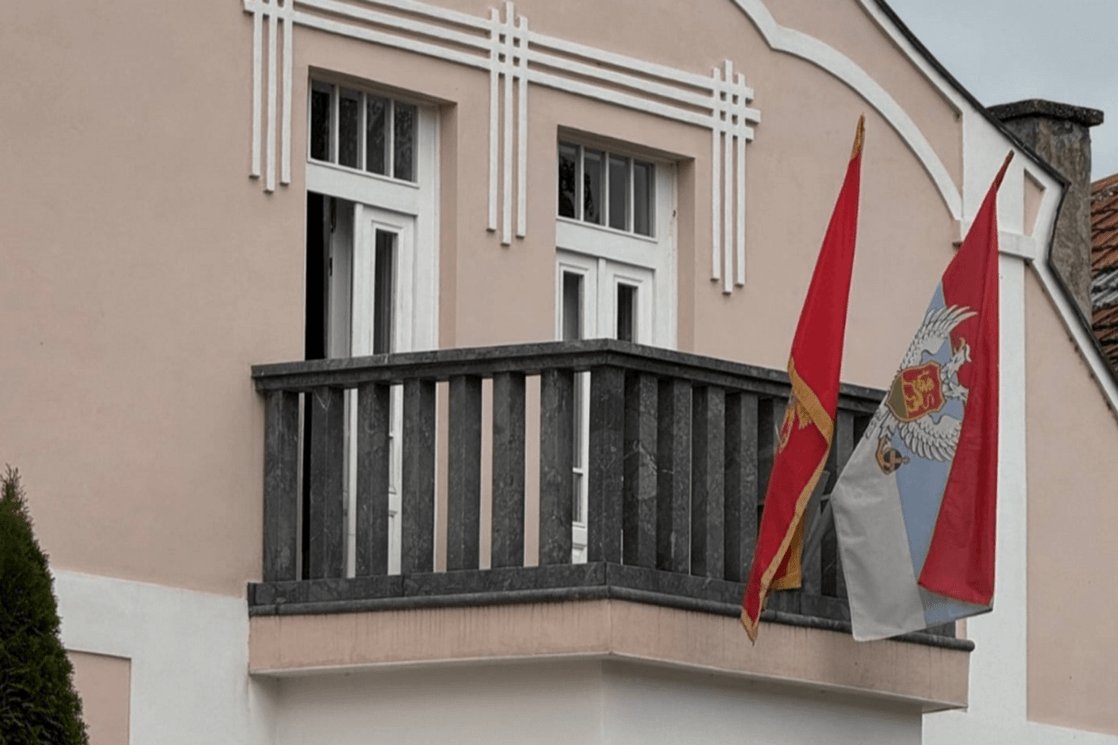
Serbian and pro-Serbian parties in Montenegro once again took hold of the tricolor on July 13. The occasion is, as always, secondary. This time it is about moving the opening of the Summer School for young diplomats from Beran to Cetinje. Dragoslav Šćekić’s reaction exemplarily unites the core of all those reactions.
The Statehood Day of Montenegro is two on July 13. Contemporary Montenegro politically and morally owes the most to the one from 1941 – the national uprising against fascism, which was carried out the day after Joanikije Lipovac, the leader of the Belgrade Patriarchate branch in Montenegro, welcomed the Italian occupiers with open arms for his religious holiday. If methanization had been done in Montenegro then, probably the position of his body would have been somewhat different; intention and humility are certainly unquestionable. However, the population of the majority of Montenegro responded significantly differently – with an armed uprising. From the Second World War, Montenegro came out anti-fascist, with a tricolor with a pentacle.
However, today July 13th is increasingly being associated primarily with the Berlin Congress. It is interpreted as the true date of the unification of the Montenegrin territory, but in fact it is intended to show that the one from the time of the absolutist monarchy is more important than the anti-fascist heritage.
That is why today’s AVNOJ borders and anti-fascist heritage compete with the statement that at the Berlin Congress “the whole of Montenegro celebrated, united in all segments, and its symbol was the tricolor next to its master”. We can discuss whether this interpretation of “the whole of Montenegro” is true ignorance of the history and borders of Montenegro throughout history, or is it a conscious distortion of heritage and the same history into a falsified image that helps to reach power and power today. But the fact is that two dates – important for Montenegro – come down to the same point, which, as we read and hear, is falsely united by the tricolor.
In what Serbian and pro-Serbian parties describe as a state attack on the tricolor, a recently repackaged heraldic symbol has been declared a tradition. And that falsified tradition was given the attribute of “true Montenegro”.
Thus, following a precise cause-and-effect line, from the transfer of the international summer school from one to other Montenegrin cities, we came (again) to the story of the threat of Serbs in Montenegro. And that the Serbs are threatened is proven by a strong methodology. First with a shout: “Understand that Montenegro is a civil state and that many people have died for it over the centuries.”
In the following sentence, that civil state is connected with the Berlin Congress of 1878 and the tricolor: “In 1878, its statehood was confirmed at the Berlin Congress, where the tricolor was also flown, with which the international recognition of the state was celebrated on the throne of Cetinje, led by Nikola I Petrović Njegoš. Then the whole of Montenegro celebrated, united in all segments, and its symbol was the tricolor with of his master.”
Is there anything more civil in this world than calling on the “master”! Three colors of monarchist absolutism in civil clothing.
In order for this fabrication of history not to be a traditionalist monologue, Šćekić includes interactivity in the discussion, so the question follows: “does the symbol of united Montenegro bother you, or do the Vasojevićs and Beranes bother you, who did not give up either the unification, or the unification, or their lives given both in the fight against the Ottomans and in the fight against fascism, again under the tricolor in different forms? This is a continuous attack on civil Montenegro.”
An interesting look at the historical facts of the former Minister of Sports. Like a hurdle race. It could be said that Šćekić really believes that Berane and Vasojević are proof of continuity from 1878, even though Berane was annexed to Montenegro only after the end of the First Balkan War. Until 1912, they belonged to the Ottoman Empire. The Berlin Congress, historically speaking, failed Beran’s expectations, not to say betrayed them. Therefore, the only July 13 that Berane can truly celebrate is the one from 1941. And he comes with a pentacle.
Creating an image as if the Congress of Berlin, Berane, Vasojević, the tricolor and today’s political identity of Serbs in Montenegro are an unbroken symbolic sequence, which is self-evident, is only one in a series of easily proven falsifications. So many easily proven that it is enough to go to the website of the Municipality of Berane.
The perversion of history and the meaning of “civilian” in Dragoslav Šćekić’s performance continues with the statement: “The tricolor of the Kingdom of Montenegro was the flag of the entire united nation at that time, but apparently some associate it with the fact that Serbs also live in Montenegro, which, as he points out, is, by all accounts, a sufficient reason for the continuation of anti-Serb politics, which he will not allow as a civil and popular movement.”
And there it is! Quite (un)expectedly, something that is presented as a national symbol is reduced to the proverbial threat of Serbs in Montenegro. In doing so, the “citizen” movement is equated with the “people’s” movement. If civil equals national, and the tricolor is Serbian, it is easy to interpret whose they want Montenegro to be. But in order not to interpret, the former president of the Municipality of Berana is here to explain to us: “In the same way, we will fight for the identity of every citizen of Montenegro, based on historically based facts and arguments, because there are enough nationalist and chauvinist attempts directed at the Serbian people, who are the nation-building and suffering people in our Montenegro.”
“State-building and suffering people” – one cannot do without the other in Serbian propaganda. Only such quasi-symmetry simultaneously claims the right to symbolic dominance and moral immunity from criticism, and those who do not accept such an interpretation are labeled as chauvinists or enemies of civil Montenegro.
One group thus presents itself as historically crucial for the state (“state-creating people”) and at the same time as constantly persecuted in that same state (“suffering people”), which is somewhat contradictory. But this propaganda technique does not tend to make the citizen check history, but to feel insulted, to recognize himself as a victim. Its goal is to produce continuous emotional mobilization and unite the Serbian electorate in fear.
By the way, pluralism is being perverted from coexistence to hegemony. It is no longer pluralism within one state, but pluralism of states within the Serbian world, but who will look at a horse’s nail now.
Today’s Montenegro grew on AVNOJ’s foundations, despite the wishes of anti-communist-oriented groups. It is in vain that they cover it up with the Congress of Berlin. Anti-fascism fundamentally united Montenegro on July 13, 1941. Anti-fascist Montenegro took matters into its own hands and decided its own destiny. At the Berlin Congress, some major powers and the Ottoman Empire decided to recognize Montenegrin independence. It was the decision of others, we attended. The Berlin Congress and modern Montenegro, perhaps paradoxically, are strongly connected by the fact that Montenegro did not wonder much then, just as (fortunately?) it does not wonder especially today when joining the EU. The candidate is here.
After all, the Berlin Congress only internationally verified the results of the Great War, during which Montenegrins, just like on July 13, 1941, went to liberation under their alajbarjak, a red flag with a double-headed eagle, the symbol of Crnojevic, but also of the modern Montenegrin state.
Vasojevići and Berane were freed under that banner, after all.
Propaganda that replaces argument with emotion and history with myth cannot override historical facts. If the tricolor flag will fly in Berane on July 13, it can only be the one with the five-pointed flag. Well bujrum.