Today, if someone wants a fresh, restaurant-quality pizza, they can order one to their home with a few clicks. The courier usually arrives within an hour, and the pizza is preferably still warm. In the early 1960s, however, an entrepreneur in the state of Wisconsin thought it was possible to go even further: why not bake the pizza on the go so that it literally goes from the oven to the table? That’s how he was born a company called Pizza on Wheels, which was half a century ahead of the modern startups that later tried to revolutionize food delivery with similar ideas.
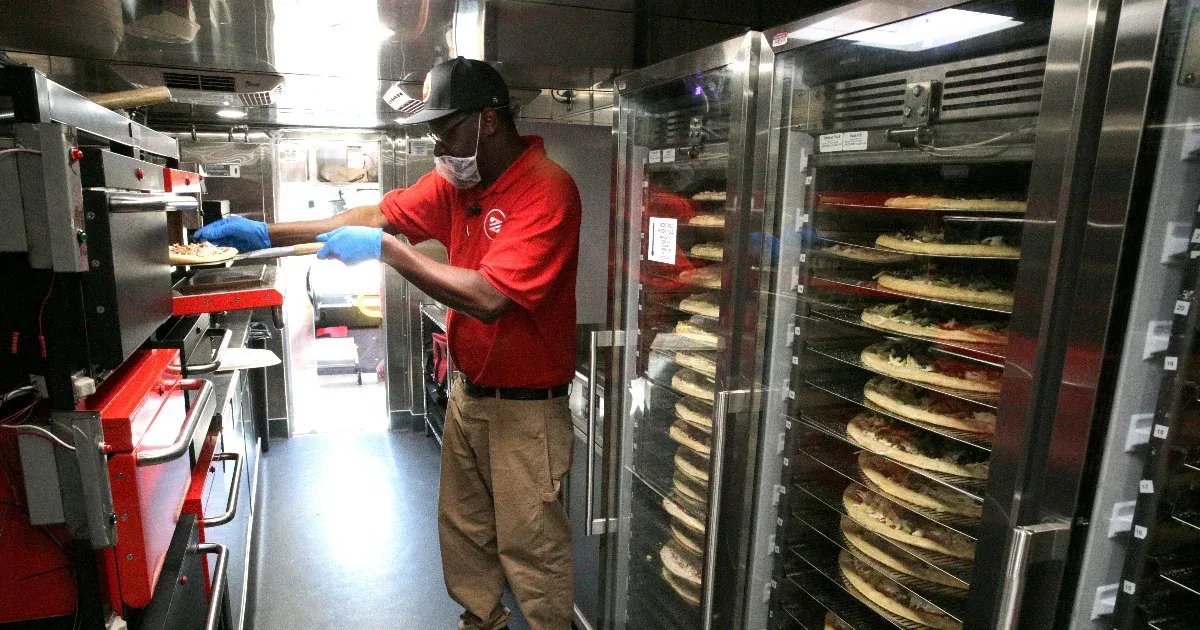
Most of them probably operated in the 2010s, named Zume they know a Californian company that would bake pizzas on the go in trucks equipped with robots. The venture briefly became a Silicon Valley darling, attracting nearly $450 million in investment before eventually collapsing.
However, Pizza on Wheels already tried the same thing in 1962. The business was founded by Wisconsin businessman Dennis J. Sheahan. Sheahan had previously developed radio dispatch systems for buses, and sometime in the late 1950s he had the idea that the same technology could be used to deliver pizzas.
The idea seemed simple at first, but the implementation was far from it. The company bought specially equipped vans that housed a water tank, a sink, a refrigerator, a work counter and a two-story pizza oven. Sheahan claimed in his advertisements that the vehicles had all the equipment of a modern restaurant. The operation of the system was also considered quite modern at the time, customers could place their order by phone to a central dispatcher, who contacted the pizza cars cruising around the city via radio.
The nearest free vehicle was given the task. The driver drove to the address while the cook in the back of the vehicle prepared and baked the pizza. According to the idea, the courier arrived in front of the house just as the pizza was ready. The pizza was sliced and handed to the customer while it was still hot. This system still sounds futuristic today, but in the 1960s it was downright sci-fi.
At the same time, pizza was a so-called mobile food long before that. According to Carol Helstosky, a pizza historian at the University of Denver (yes, there is such a profession), pizzas delivered in portable boxes were sold on the streets of Naples as early as the 18th century. Along with Italian immigrants, the dish made its way to the United States in the late 19th century, where it first spread mainly in Italian communities. However, everything changed after the Second World War.
American soldiers serving in Italy brought their passion for pizza home with them, while suburban sprawl, the spread of telephones, and the growing demand for convenience created a new market. It was then that the now well-known institution of home delivery was born. In the fifties, several pizzerias already offered delivery, but the service was rather rudimentary, and the pizza often arrived lukewarm. Here we turn back to Sheahan, who tried to offer a solution to this problem with his business.
The only problem was that in practice the whole system worked extremely hard. Although the idea of a mobile pizza kitchen sounds brilliant at first, it is actually almost impossible to implement perfectly. Noel Brohner, who runs a pizza-making school and consultancy, said it was hard to imagine how they could have kept a vehicle in constant motion cool enough with technology from the 1960s. In addition, pizza baking is a precise operation in itself.
Even in a stationary kitchen, it is not easy to place the toppings evenly, let alone in a van that shakes on potholed roads. According to Scott Wiener, one of New York’s leading experts on pizza culture, even modern technology has not completely solved this problem. Zume, for example, used robots, sensors and special ovens half a century later, but it still regularly happened that the cheese slipped to one side during baking.
Still, Pizza on Wheels worked. At least for a while. This is also shown by the fact that the company did not work with one car. A year after the launch, there were already three vehicles operating in Madison, and later the pizza vans appeared in Green Bay as well. Sheahan made ambitious plans and planned to conquer eight more Midwestern cities. Today, no one knows exactly how the system worked on a daily basis, what they did with, for example, too many orders or empty flights. It is possible that the drivers stopped near the address for a few minutes to finish baking.
It could also be that the quality of the pizzas just wasn’t particularly good, but the special service attracted enough customers. Based on the remaining advertisements, the company tried to attract customers with aggressive promotions, sometimes they gave free movie tickets, soft drinks or donuts with the pizza, and they were also looking for franchise partners. However, the momentum did not last long. Around 1967, ads for the sale of Pizza on Wheels vehicles appeared in Wisconsin newspapers.
The official explanation for the withdrawal was that one of the local operators fell ill and could not continue the business. It is now impossible to know whether this was really the case or whether the model simply did not work economically. It is certain that the company disappeared by the early seventies. Meanwhile, the American pizza market went in a completely different direction. Domino’s, Pizza Hut and Little Caesars have built systems that are not based on perfect freshness, but on speed and cheapness. Standard pizza boxes, central ordering systems, and later GPS-based tracking and mobile apps appeared.
Over time, pizza gradually became a consumer product, customers less and less expected the food to come straight from the oven. It was enough to receive it quickly and in acceptable quality. Pizza on Wheels is a reminder of a brief period when it seemed technology could solve any problem, and when some Wisconsin entrepreneurs seriously believed the future lay in pizza ovens rolling down the streets. In the end, they were wrong.