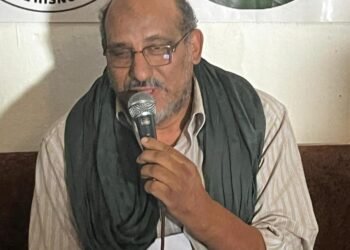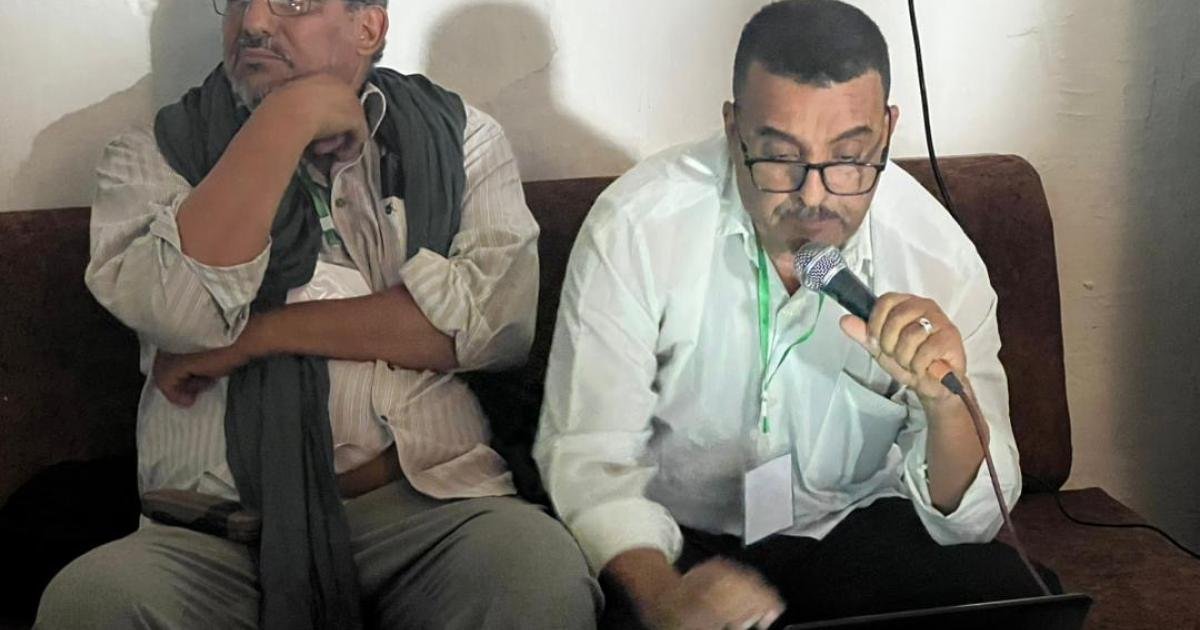
Awsard Province, June 23, 2026 (SPS) – The Central Director of Employment at the Ministry of Personnel, Public Service and Administration Promotion, Mr. Abdelkader Musa, presented today, Tuesday, a lecture entitled: “Administration… Behaviors and Measures: Sahrawi Administration as a Model,” during which he highlighted the genius of the administrative experience of the Sahrawi state, and the stages of its development from nothingness and urgent emergence to today.
During the first day of the National Symposium on Administration, the lecturer addressed the first beginnings of Sahrawi administration, stressing that immediately after the declaration of the Sahrawi Republic on February 27, 1976, and the formation of the first Sahrawi government on March 5, 1976, the process of organizing state structures began by creating ministries of an urgent nature, such as Defense, Foreign Affairs, Education, and Health.
The lecturer highlighted the historical specificity of the Sahrawi administration, saying: “The Sahrawi administration was very modern, and what distinguishes it historically is that it is the only experience that did not inherit any trace or organizational structure from the Spanish colonialists. All the frameworks running at that time had neither experience nor capabilities, but they succeeded with distinction.”
Abdul Qader Musa stressed that this exceptional success is due to the challenge factor, the conscious public response, and the steely desire to prove existence and build self-capabilities. The genius of this young stage, according to the lecturer, was evident in: creating flexible formulas that adapted to the desert element to meet the needs of citizens in light of a comprehensive destructive war, harsh asylum, widespread illiteracy, and deadly diseases.
The lecturer also discussed the 1980s, describing it as a stage of “development and coping with reality,” where laws and regulations were formulated and future plans were drawn up, which created solid integration and harmony between the legislative, judicial, and executive institutions.
At the conclusion of the lecture, the lecturer elaborated on the nineties and the dangers of the “no peace, no war” phase, touching on the pros and cons of this phase.
The lecture sparked an extensive and profound discussion among the attendees, who agreed that reviewing the administrative memory of the Sahrawi state and diagnosing its reality is an inevitable necessity to close ranks, fortify the internal home, and be inspired by the spirit of giving and altruism that distinguished the first generation, to confront enemy conspiracies and protect national gains until victory and independence. (Was)