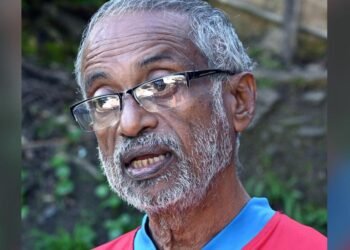
International relations lecturer at the University of the West Indies, Dr Michal Pawinski, believes the latest report from the United Kingdom on gangs in Trinidad and Tobago places the country in a negative light.
Pawinski said yesterday that this report, coupled with last year’s visa restrictions imposed on the country after the number of asylum seekers to the UK grew exponentially, does not help the country’s image.
The report was published on June 5 by UK Visas and Immigration as part of its Country Policy and Information Note series and was designed primarily to assist British officials in evaluating asylum applications.
According to the report, criminal gangs remain heavily concentrated in economically disadvantaged urban communities, particularly in and around Port-of-Spain and along the East-West Corridor. The assessment estimates that approximately 186 gangs were operating in T&T as of 2023, with a combined membership of around 1,750 members. It linked those organised criminal groups to roughly one-third of all murders and involvement in a wide range of criminal activities, including kidnappings, armed robberies, extortion, human trafficking and the illegal firearms trade.
Among the most influential groups identified were the Muslims and Rasta City gangs, which the report said serve as major power centres around which smaller gangs often align.
Asked how this latest update may impact the country’s image, Pawinski said: “There is connection between the gang activity in Trinidad and how other countries are deciding on imposing further restrictions, which is negatively impacting the image of Trinidad as a potentially unstable country that is unable to manage their internal security.”
Even with the ongoing State of Emergency (SoE), which the country has been under with less than a month’s break in between since July last year, specifically called to address gang violence, Pawinski says that may not be enough.
“Something that would potentially repair the image, the international image of Trinidad, is a more comprehensive strategy that is dealing with the causes of the crime and youth joining the gangs. That would be more speaking to actions that are mitigating the situation. The SoE is just basically a Band-Aid on a huge wound that is not healing.”
In a media report last December in The Times, it was revealed that asylum claims from T&T nationals rose from an annual average of 49 between 2015 and 2019 to 439 that year. A UK government spokesperson was at the time reported to have told the newspaper that a new requirement was imposed to address the growing trend of people arriving as tourists and then claiming asylum.
Criminologist Dr Randy Seepersad agrees with Pawinski, saying if people who may be involved in gang activity flock to the UK under the guise of needing asylum, then their rivals may follow them, exporting the country’s problem to the UK.
“Gang members, quite often when they go into a new country, they have a propensity to engage in crime, they might gravitate towards criminal groups, so, of course, it’s a negative thing for the receiving country, and then the rivalries that existed, you know, could be sort of reproduced in the receiving country.”
He said gangsters wanting to migrate and later claiming asylum weaken a country’s image, which may force countries to impose new laws.
“I wouldn’t honestly be surprised if eventually, this leads to some kind of change in the laws when it comes to asylum in the United Kingdom, to kind of, for want of a better word, close that loophole, because my sense from some of the reports I’ve seen coming out of the UK is that the Home Office is pushing back real hard in terms of letting anybody in when they come, and they are fearful of gangs,” Seepersad said.
The UK report stated that just being from areas where gangs have control of the communities or being fearful of a gang’s attack is not enough to warrant asylum.
And while some may be hoping that an impending change in leadership in London could pave the way for easier access to the United Kingdom, a former Foreign Affairs Ministry technocrat, who spoke on condition of anonymity, believes that hope may be misplaced.
The former official told Guardian Media that Britain’s immigration policies are shaped less by individual politicians and more by long-term institutional priorities, national security assessments and public sentiment. In that context, the resignation of a prime minister is unlikely to trigger a significant change in how T&T is viewed by British authorities.
British Prime Minister Sir Keir Starmer’s resignation on Monday fuelled speculation about whether the UK’s immigration policies could be softened under a new Labour leader.
The former technocrat believes the latest assessment is unlikely to strengthen T&T’s case for a review of those restrictions.
Guardian Media also submitted questions to the British High Commission regarding the potential implications of Starmer’s resignation and whether Britain’s position on T&T could change under a new prime minister.
While an official response is still pending, a source familiar with the matter said a change in leadership would not likely alter existing immigration policies in the short term.
Minister: Problem did
In a WhatsApp response to Guardian Media on the report yesterday, Defence Minister Wayne Sturge said that issue did not happen overnight.
“That is the culmination of 10 years of inaction on the part of the last administration. The Government has shown that it is up to the task and having been aware of these facts, we have taken steps to prioritise gang-related violence and we will continue to take steps to deal specifically with the influence and impact of gang violence.”
Caricom and Foreign Affairs Minister Sean Sobers and former minister Dr Amery Browne did not respond to questions up to press time.
Meanwhile, former diplomat and minister Rodney Charles said this situation should be a wake-up call for the Government. In a WhatsApp response, Charles said the UK has now decided to codify who from T&T can and cannot apply for refugee status.
“T&T must develop and rigorously enforce as a top priority, a well-thought-out refugee/migration policy that is consistent with our absorptive capacity, our international treaty obligations, our humanitarian principles and our national security considerations. We delay this at our peril,” he said.
“We cannot, for example, as we have done and are still doing, let in any and every refugee who lands on our shores without appropriate vetting based on agreed principles. The UK is probably telling us without actually saying so, that the time for a laissez-faire refugee policy by T&T is long gone.”
He said the report comes as immigration is now a major political issue among voters in the UK, the EU, Canada and the US, adding that Starmer developed tough immigration policies that seemed to have alienated his own party base.
More from the report
One of the report’s more troubling findings concerns youth recruitment. It said gang membership is largely composed of young men from disadvantaged communities, many with limited educational opportunities and unstable family backgrounds. Sources cited in the document reported recruitment occurring among children between 12 and 16 years, including within schools. Gangs were also reported to recruit members from within the prison system. The report further notes that individuals who refuse to join gangs, attempt to leave gang life, or openly challenge gang authority can become targets for violence. Family members of gang-affiliated persons, as well as police officers, prison officers, members of the judiciary and prosecutors, were also identified as potential targets.
Although the UK assessment acknowledges that T&T possesses anti-gang legislation and specialised police units dedicated to combating organised crime, it raised concerns about the capacity of law enforcement to effectively contain the threat.
Citing information from the United Nations Office on Drugs and Crime, the report says senior police officials have admitted to being overwhelmed by the scale of gang activity. Investigators reportedly face difficulties identifying suspects, gathering intelligence and securing prosecutions, particularly in tightly knit communities where gangs exert significant influence and where officers may fear reprisals against themselves or their families.
The document also highlights concerns over criminal infiltration into public projects. It notes that in October 2025, the T&T Government suspended several public contracts in gang-controlled areas as part of efforts to address allegations of corruption and criminal influence.
Despite these challenges, the UK assessment stopped short of describing T&T as a state overwhelmed by organised crime. It concluded that while gangs maintain influence in specific communities, their power is not considered widespread enough to dominate the national political system or exercise systematic control beyond the areas in which they operate.