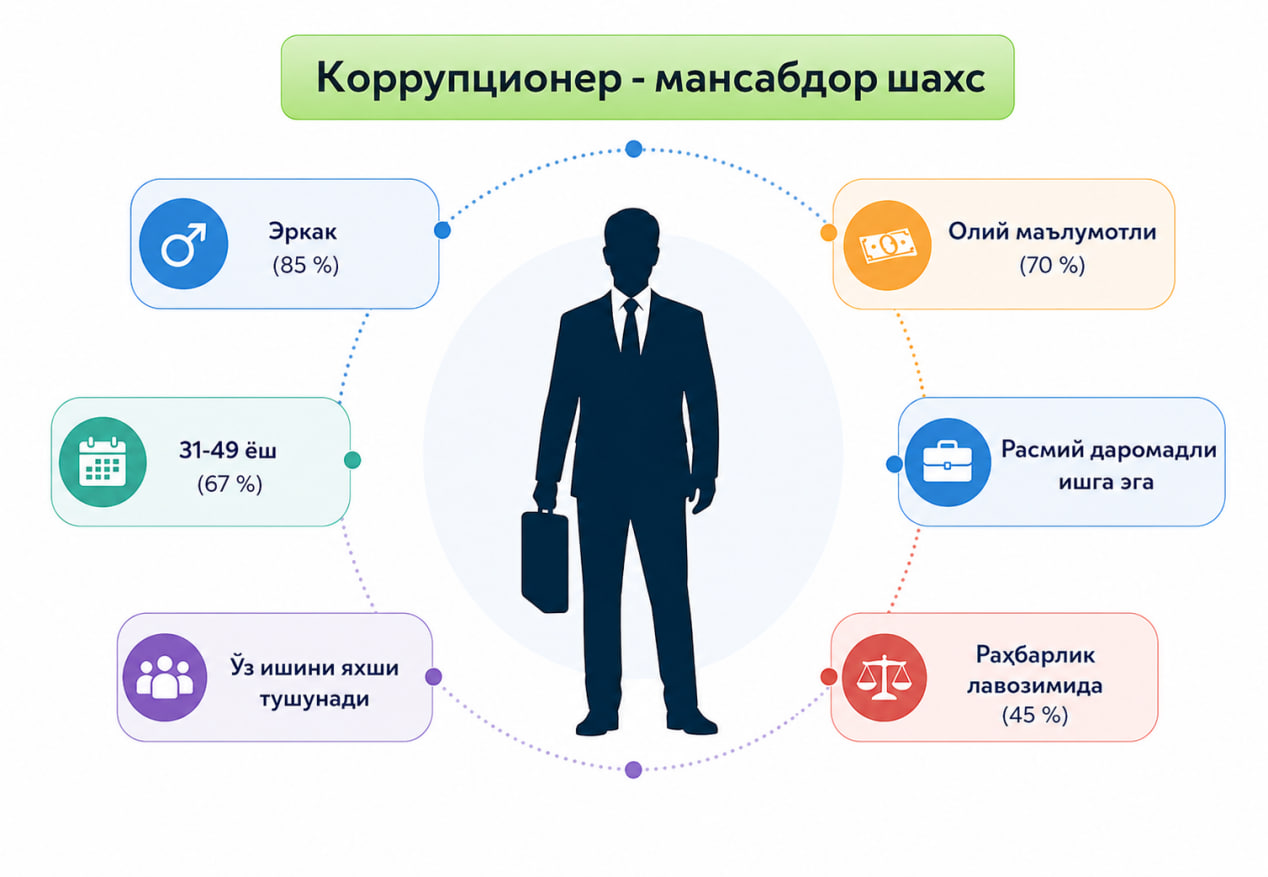
The anti-corruption agency presented a criminological portrait of a corrupt person based on the analysis of corruption crimes in 2025 based on the request of Kun.uz. According to the analysis, the average typical corrupt person in Uzbekistan is a man with no previous convictions, aged between 31-49, with a higher education, a family, who has an official source of income and, in most cases, works in a leadership position.
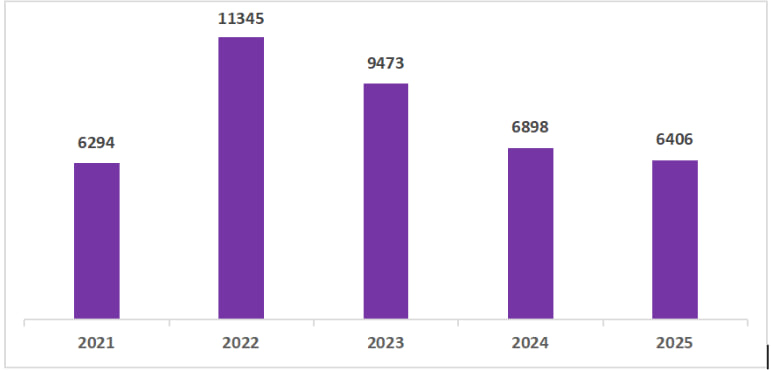
According to the agency, in the period from 2021 to 2025, an average of 7,000 people were prosecuted for corruption crimes annually.
“Corruption disease” increases after the age of 31
According to the analysis, the most common type of corruption crime is embezzlement or embezzlement. This type of crime accounts for more than 33 percent of all corruption cases. That is, every year, on average, more than 2,500 cases are related to embezzlement of state or organization funds “from within”.
It is followed by fraud and forgery using the authority of the position. Bribery crimes make up 13% of all cases. It is noteworthy that the crime of bribery, which is the most discussed by the public, has a relatively low share in statistics: on average, around 200 people are prosecuted for bribery every year.
The majority of corruption crimes are committed by persons aged 31-49. According to the situation in 2025, 67 percent of corruption crimes were committed by this layer. This is the period when a person’s professional activity is most intensified, the possibility of decision-making increases and the sphere of influence expands.
In particular, 76 percent of bribery crimes, 66 percent of robbery cases, and 67 percent of career frauds were committed by this age group.
Although 18-30-year-olds accounted for 14% of total corruption crimes, the share of young people in cases of bribery is 23%. This shows that corruption survives not only through the “receiver”, but also through the environment of the “giver”, who tries to get into the system faster.
One of the most important signals in the analysis is related to the level of information. In Uzbekistan, the percentage of people with higher education is around 20 percent, while in cases of corruption, this figure exceeds 70 percent. That is, in most cases, corruption is not caused by ignorance, but by persons who understand the system well and understand the legal and financial mechanisms.
70% of corrupt people have higher education, 19.6% have secondary education and 10.4% have secondary education. These figures suggest that corruption should be seen not as a “crime of poverty” but as a crime of opportunity and power.
The analysis revealed another interesting fact: 95 percent of corruption crimes were committed by family members. This shows that corruption in most cases is committed by people who are not disconnected from social life, but are fully integrated into society.
In 2025, 85% of corruption crimes were committed by men. Although there are relatively few cases involving women, they are mostly concentrated in the education and health sectors. 46% of women who committed corruption crimes worked in education, 21% in health care. Men mainly worked in executive bodies, entrepreneurship and economic management systems.
The state now checks the “honesty immunity” of the leader
New mechanisms aimed at strengthening the responsibility of the leading personnel in the field of anti-corruption are being introduced. The “Virtual Anti-Corruption Academy” platform was launched by Presidential Decree No. 228 dated June 21, 2024. Now civil servants are required to undergo anti-corruption training at least once every three years.
In 2025 and the first quarter of 2026, about 69,000 civil servants were involved in training. Also, the candidates for the government and the governorship will now have to submit a personal plan for the prevention of corruption along with their program.
It is noted that this criminological portrait is not just a statistical report, it is becoming a document that changes the traditional perceptions of corruption. “Because the corrupt person in this portrait is not a person who is unemployed or excluded from society. He is a person within the system, educated, competent and has an official status. If the fight against corruption does not continue with the strengthening of punishment, but with the reconsideration of authority, control and institutional transparency, the portrait of the “typical corrupt person” may not change for a long time”, – says the agency’s report.