With the “Oyster,” introduced in 1926, Rolex revolutionized the everyday suitability of wristwatches. To mark its 100th anniversary, the Geneva brand is introducing four new models.
Rolex founder Hans Wilsdorf was convinced early on that the future of wearable watches lay on the wrist and not in the pocket. And so, shortly after founding his company in 1905, he equipped his first wristwatches with small yet precise calibers from the Swiss movement manufacturer Aegler. In 1926, the next step towards a wristwatch suitable for everyday use was taken: Rolex presented the so-called Oyster case, which was supposed to be as sealed against moisture and dirt as an oyster thanks to the screwed together individual parts and screw-in crown.
Rolex is celebrating this milestone this year with four new design variants of the “Oyster Perpetual”. The suffix was introduced in 1931, when Rolex used automatic winding for the first time, eliminating the need to unscrew the crown every day to re-tension the spring. Now the company’s watches were completely protected from external influences and were therefore largely perfected.
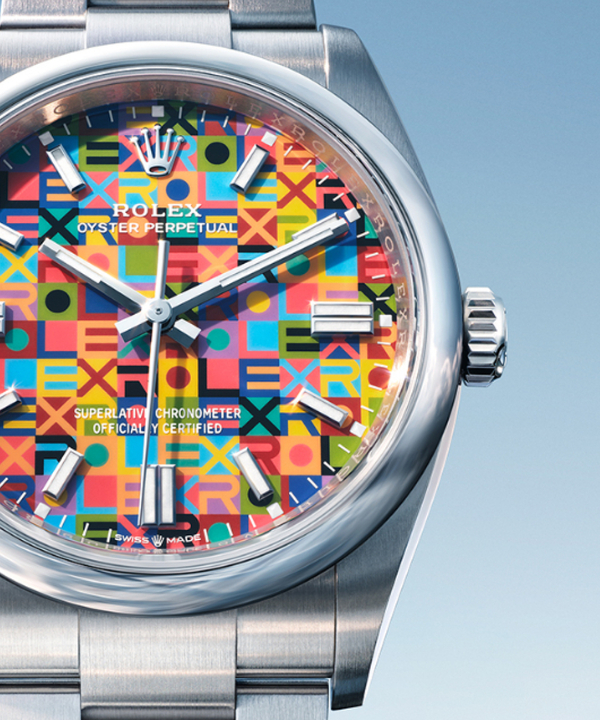
Colorful. The Jubilee motif made up of Rolex letters in ten different colors makes the new “Oyster Perpetual 36” an eye-catcher.
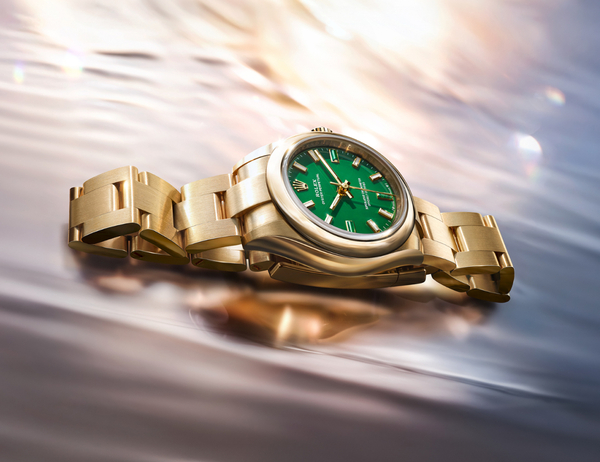
Update. With the “Oyster Perpetual 28” in green, Rolex is expanding its line to include a version in 18 carat yellow gold.
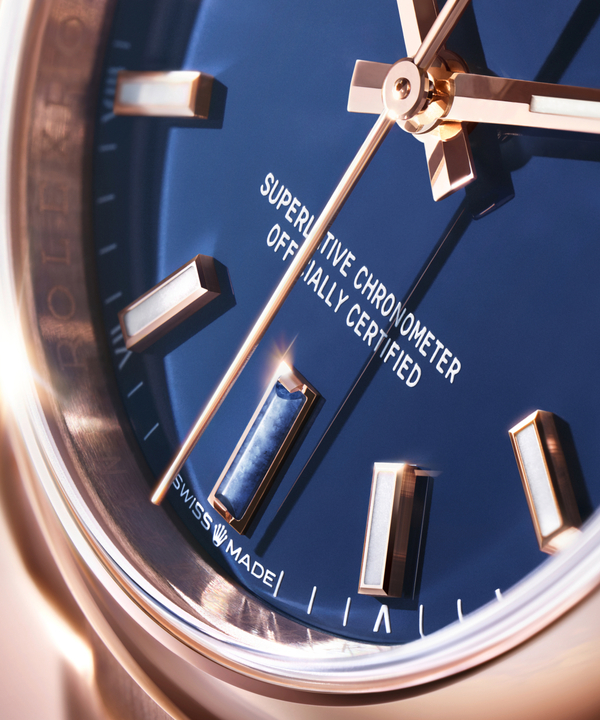
Detail. Three hour indices made of Dumortierite are located on the blue dial of this “Oyster Perpetual 34”.
The three characteristics of precision, water resistance and automatic winding still form the core of the Rolex collection today, and the name “Oyster Perpetual” lives on in the watch line of the same name. To mark the 100th anniversary of the Oyster case, this is receiving a fourfold increase in the form of new design variants.
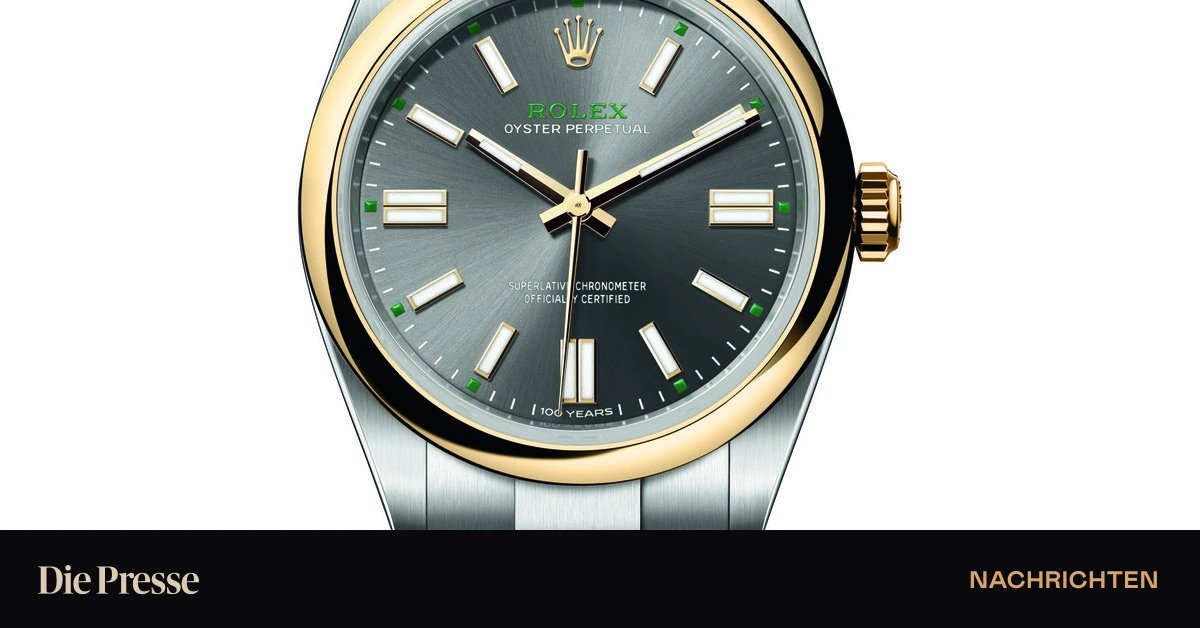
The new “Oyster Perpetual 41” is clearly marked as an anniversary watch with a stainless steel case and bezel as well as a winding crown made of yellow gold, a configuration that is reminiscent of some early “Oyster” models: In honor of its 100-year-old predecessors, it does not have the designation of origin “Swiss made” on its slate-gray dial at six o’clock, but the inscription “100 Years”. The number 100 can also be found in relief on the winding crown. Other special features: five-minute indices in the form of Rolex green squares and the brand lettering in the same color.
Inside the 41 millimeter case, the in-house caliber 3230 runs with a maximum of two seconds of advance or lag per day, as required by the in-house certification as a “Superlative Chronometer”. This has been carried out since 2015 following the official COSC testing and has now been expanded to include three additional criteria. The internal quality seal for all Rolex movements includes tests for accuracy, water resistance, power reserve and automatic winding as well as, more recently, magnetic field resistance, general reliability and aspects of sustainability.
The caliber 3230 also powers the colorful new design variant of the “Oyster Perpetual 36”, which runs for 70 hours at a time when fully wound. It stands out for its reinterpretation of the Jubilee motif, which was developed in the 1970s and consists of the five Rolex letters.
The “Oyster Perpetual 34” in rose gold with a blue lacquered dial and the “Oyster Perpetual 28” in yellow gold with a green face each have three hour indices made of natural minerals for the first time – blue dumortierite and green heliotrope. The in-house caliber 2232 offers the same technical advantages as its big brother 3230, but has to make do with a 55-hour power reserve.
All new products have closed, fully threaded bases and are worn on a three-row Oyster bracelet. As real “oysters”, they last up to 100 meters.