Nathaniel Hawthorne’s The Scarlet Letter confronts us with a historically shocking example of stigmatization. In the story, the adulteress Hester Prynne has to pin a scarlet “A” (probably for “adultery”) to her chest and thereby make her sinfulness publicly visible. The stigma causes her to flaunt and repeatedly attract the social disapproval she supposedly deserves. The letter signals – like the infamous Jewish star later – that whoever wears it is not a “member in good standing”. The stigma of not being a good community member is universally noticeable.
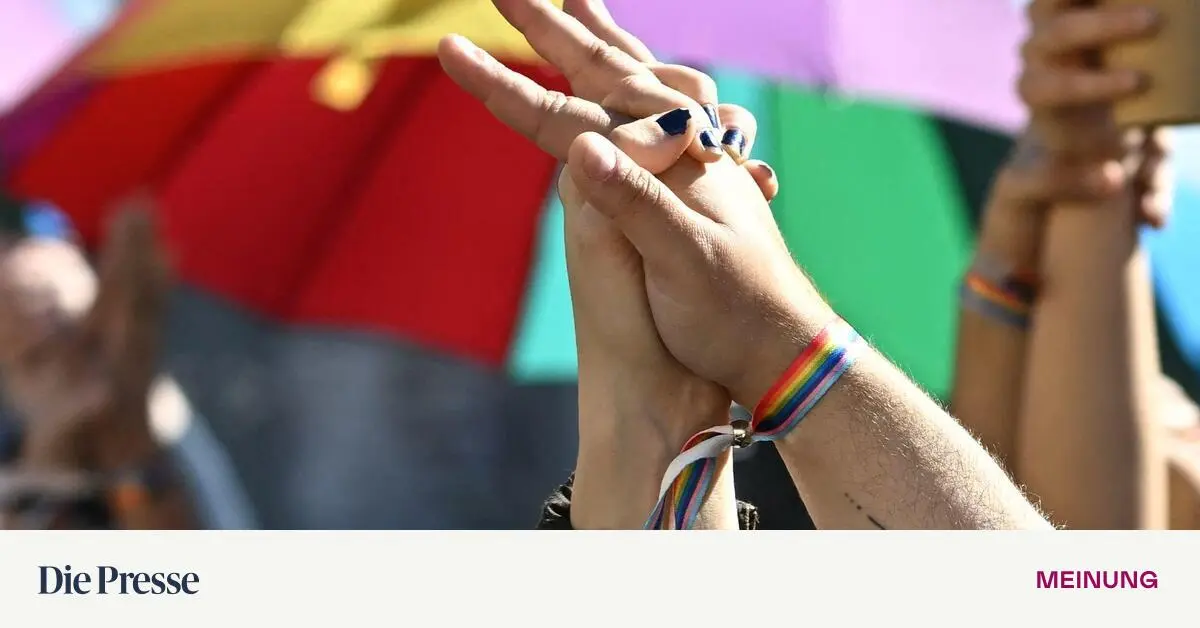
From the European Union’s perspective, something similar happened to sexual minorities in Hungary (whether in terms of sexual orientation or gender identity). According to the Commission and the Court, they were “stigmatized” (and “marginalized”) by a law that purported to protect minors from the temptation to deviate from their birth gender or natural orientation. The ECJ stated that this law deprived sexual minorities of their visibility by denying children access to information about alternatives to old-fashioned heterosexuality or breaking out into the afterlife of their birth gender. In an age in which it is all about seeing and being seen, it is obviously not only the compulsion to wear a visible sign that is stigmatizing, but also the prescribed invisibility.
The decision clearly differentiates between three levels of violation of the law. It identifies violations of secondary law, primary law and the fundamental values of the Union set out in Article 2 of the EU Treaty (TEU). The free-standing addition of this highest level was certainly the “innovative” step – already prepared in the opinion of Advocate General Capeta.
To the author
Alexander Somek is Professor of Legal Philosophy at the Faculty of Law at the University of Vienna.
Hungary’s objections that primary and secondary law serve to articulate and protect values and that the finding that Hungary had violated fundamental values in addition to disproportionate interference with fundamental rights was normatively redundant were brushed aside with a grand gesture. The values are normatively significant precisely because of their radiating manifestation in the lower legal classes. Probably in order to counter the obvious counter-argument that this view invites us to consider any violation of European law as a violation of the fundamental value of the rule of law, it was added, with the notorious joy of legal development, that only “manifest and particularly serious” violations of fundamental values are relevant for the application of Article 2 TEU.
To justify why Art 2 TEU should be viewed as directly applicable law even without combination with other provisions of the Treaty, reference is made, among other things, to Art 49 TEU, the accession provision. In order to become a “member in good standing”, you have to adapt to the values. The ECJ is likely to assume that anyone who reverts to a previous habitus (“backsliding” or “regression”) after joining will lose their reputation through self-exclusion. It is as if the Member State were breaking a promise. In the face of a serious breach of the law, doubts must therefore arise as to the respectful attitude towards the common legal order required for membership. The state is suspected of lacking identification with common values. Although he is still a member, he has become “suspect” because of his non-conformity, just as if he were a delinquent alien or asylum seeker who is considered dangerous because he has not internalized “our values”.
There is nothing to sugarcoat about the legal situation in Hungary. Sexual minorities do not have to allow themselves to be treated as if their existence represents a danger to young people. Basic rights serve to protect their honor and integrity. What seems strange, however, is the doubling of the normative containment of member state law with regard to fundamental values. In the present case, the determination of the violation acts as a shame sanction. The ECJ ruling is Hungary’s scarlet letter.
The ECJ must, of course, ask itself whether the moralism that overflows in the reasoning is not short-sighted and malicious. The moral judgment in this case is short-sighted and slightly narrow-minded out of emotion because it takes at face value that the Hungarian prohibitory legislation makes minorities socially invisible. But couldn’t this also have the opposite effect and make breaking out of the heterosexual matrix seem even more attractive to the little ones because they would have to taste the fruit of forbidden knowledge? How cool would that be? Seen this way, the legislation would fail simply because it is not suitable for achieving its goals. But morality also likes to ignore its own evil. What impression must this judgment give rise to among conservative Catholics, Muslims or Orthodox Jews who perhaps believe that people have their heterosexual orientation and birth gender “by nature” (and that anyone who denies their nature must become unhappy)? Do such people now have to see themselves as strangers in the European Union simply because their reserved attitude towards sexual pluralism does not allow them to participate in the unity of basic values? Don’t they become just as suspicious as the suspected Member State?
At a glance
The ECJ ruled on April 21 (Rs 59/26) that the Hungarian LGBTQ law violates the EU Charter of Fundamental Rights. The “Child Protection Act” prohibits depictions of homosexuality and transgender people towards minors in all media. The EU Commission, supported by several member states, took action against this. According to the ruling, Hungary not only disproportionately interfered with fundamental rights, but at the same time violated the EU’s fundamental values.
It is obvious that this jurisprudence harbors the danger that member states will in future be disciplined solely by resorting to vague values. What an impressive demonstration of “self-empowerment”: all power to the judges! The morally inexorable harshness towards the “margin of appreciation” and the national identity (Article 4 Paragraph 2 TEU) of the member states makes this European liberalism worryingly undemocratic. This liberalism acts as if there were ultimate certainty on issues on which opinions traditionally differ in democracies. That is why it is to be feared that it is not even liberal and therefore does not offer any suitable means of countering illiberal democracy.
Liberal societies are characterized by the fact that they exclude exclusion – even on a symbolic level – and simply render human behavior harmless where it causes or could cause harm. Nazis, Stalinists, racists, Satanists and other unpleasant contemporaries can live in liberal societies as long as they adhere to the laws – admittedly also those that restrict their freedom of expression and assembly. And to put governments in their place, there is the protection of fundamental rights. If this works, enough has been done to make the state liberal. There is no need to award “attitude grades” from the infamous “tyranny of values” (Schmitt).