Revolution / Agencies
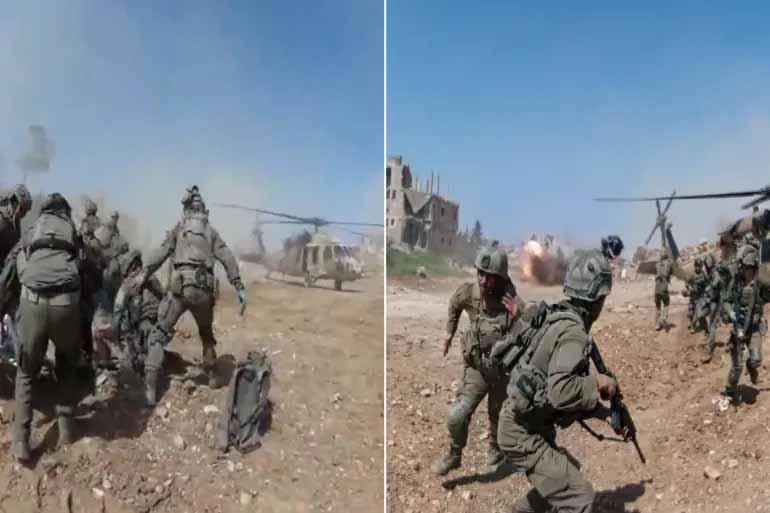
The Israeli occupation army’s continued ground operations in southern Lebanon will inevitably lead to a reality that is more complex and costly than it appears at the beginning of any military campaign. Military history is full of events that show that occupying a country’s territory is usually the relatively easiest stage, while the real challenge begins when the attacking force is asked to remain in the region, control it, face continuous resistance, and bear the accumulated costs of a war of attrition, as happened with Napoleon Bonaparte in Russia (in 1812 AD), and what happened with the Nazis in Russia during World War II (in 1941 AD) and with the Americans in the Vietnam War (from 1955 AD until 1955 AD). 1975 AD).
In this context, expanding and deepening ground operations against the Islamic resistance in Lebanon – Hezbollah will plunge the Israeli army into a quagmire of human and material losses, which will worsen as the fighting continues. Hezbollah, based on its military experiences and expertise that it acquired since the 1980s and 1990s, through the July War of 2006 AD, all the way to the final rounds of fighting during the Battle of Uli al-Bass in 2024 AD, and the current battle of “The Evoking Storm,” all of this confirms that a deep and prolonged Israeli ground incursion into Lebanon will turn into a “quagmire,” especially with the absence of a clear strategic goal for the interim entity from these incursions.
The geographic and topographical trap of southern Lebanon is the first factor that turns any prolonged ground operation in Lebanon into a constant threat to erode and exhaust Israeli military capabilities. The south is characterized by complex mountainous terrain, deep valleys, dense vegetation, natural reserves, and many rocks. This terrain provides a clear and inherent advantage to the resistance, and neutralizes a large part of the technological advantages of the modern Israeli army, especially the air force. In such terrain, the Israeli army’s ability to move armored forces (tanks and armored personnel carriers) is limited to narrow roads, which in recent days have quickly proven to have turned into fiery ambushes using assault rings. However, if the occupation dares to take wide paths, it will make its vehicles vulnerable to ambushes of explosive devices and guided anti-armor missiles. Therefore, the terrain itself is an effective weapon in the hands of Hezbollah, and the direct result is an inevitable increase in the number of casualties among Israeli army personnel daily in the field.
The complementary element of geography is Hezbollah’s asymmetric and hybrid tactics. The party does not operate like a traditional army that maintains strict defensive lines; Rather, it relies on flexible defense, avoiding direct confrontation – although there are many cases that were characterized by cases of defense and martyrdom attacks by the resistance fighters – and resorting instead to a daily war of attrition. The resistance forces widely use advanced anti-tank missiles (such as the Kornet and newer models) with long range and high accuracy. In addition, powerful roadside bombs are spread throughout the region, and the use of attack drones and tactical drones attacking Israeli army assembly points and positions is increasing. Attack drone operations against stationed forces or armored personnel carriers are among the main reasons for the current Israeli losses in Lebanon. As the ground fighting continues, the forces transform from “hunters” to “hunters.”
In a related aspect, the material aspect of the ground operation is of great importance. Prolonged ground warfare consumes enormous amounts of ammunition, fuel, spare parts, and engineering equipment. Armored vehicles are damaged, systems wear out, and maintenance costs rise dramatically. Even if the damage to each individual system appears limited, the cumulative economic cost is enormous. When a campaign lasts for weeks or months, the economic cost becomes a critical factor in itself.
On the other hand, the state of attrition over time will result in a continuous flow of dead and wounded among the ranks of the occupation army. Unlike short military operations, in which the settler community is willing to bear casualties in order to achieve an immediate goal, prolonged fighting without a clear finish line, and daily images of funerals and hospitals crowded with the wounded, will have a profound psychological impact. The moral erosion will not stop at the Israeli home front, but will also penetrate the reserve forces, which undertake the greatest efforts in the field, but they constitute the main element in the entity’s economic wheel. Then, the longer the fighting continues, the more questions will arise among public opinion in the Israeli occupation entity about the objectives of the operation, the high price it pays, and the time period required to achieve the desired results.
Hezbollah prepared the quagmire for Israel
As for Hezbollah, it can be said that it has been preparing for this particular scenario – and perhaps even worse – for years. It has invested in building capabilities aimed at slowing the advance of forces, increasing human and material losses, and prolonging the fighting. Every additional day of conflict will contribute to weakening the opponent. Therefore, even if the Israeli army achieves some tactical achievements on the ground, this does not mean achieving strategic results, but rather deepening the swamp of losses. In such a situation, this “quagmire” does not form in one day, but develops gradually – step by step, battle after battle – until it becomes the main challenge of the entire ground operation.
The continued ground operations of the Israeli occupation army in southern Lebanon will inevitably lead to a reality that is more complex and costly than it appears at the beginning of any military campaign. Military history is full of events that show that occupying a country’s territory is usually the relatively easiest stage, while the real challenge begins when the attacking force is asked to remain in the region, control it, face continuous resistance, and bear the accumulated costs of a war of attrition, as happened with Napoleon Bonaparte in Russia (in 1812 AD), and what happened with the Nazis in Russia during World War II (in 1941 AD) and with the Americans in the Vietnam War (from 1955 to 1955 AD). 1975 AD).