Revolution/follow-ups
The so-called UAE projects in the city of Rafah have raised Palestinian fears of reshaping the geography of the Gaza Strip as it is taking place under direct Israeli military control, while hundreds of thousands of displaced Palestinians are still unable to return to their homes.
The Dark Box intelligence platform said that what the UAE is publicly promoting in the media as humanitarian reconstruction, in the eyes of many Palestinians, appears to be a coordinated effort to reshape the geography of Gaza, the distribution of its population, and its political future in line with Israeli strategic goals.
According to the platform, the controversy exploded after increasing information emerged regarding UAE-funded reconstruction initiatives linked to Rafah, including housing projects, rubble removal operations, and plans to create entirely new urban areas within areas still under the control of the Israeli army.
For the Palestinians inside Gaza, the problem does not lie in the reconstruction itself, but rather in the reconstruction imposed under the occupation, without the participation of the displaced residents of Rafah, while the city remains isolated militarily and politically.
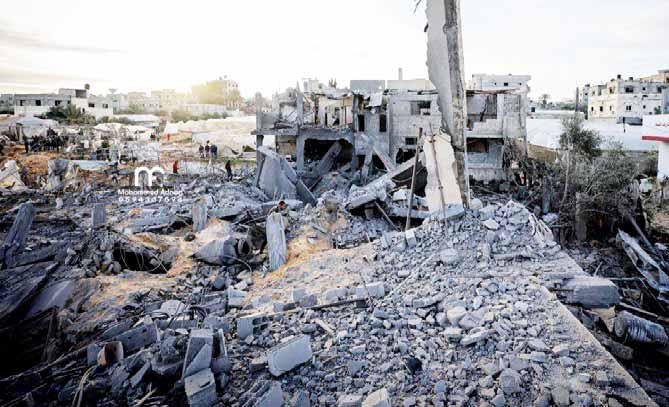
The platform highlighted that Rafah is today considered one of the most destroyed places in modern Palestinian history.
Since the start of the Zionist aggression against the city in May 2024, entire neighborhoods have been systematically destroyed through aerial bombardment, artillery shelling, and planned demolitions.
The city of Rafah – which was the last refuge for displaced Palestinians fleeing northern Gaza and Gaza City – turned into a scene of devastation and mass displacement.
Even after the ceasefire agreements entered into force later, the occupation forces maintained their control over Rafah and refused to withdraw completely from the area. As a result, hundreds of thousands of Palestinians remain displaced, while their city continues to be under military control.
It is precisely under these circumstances that the reconstruction plans supported by the Emiratis began to advance.
Among the most controversial proposals is a project known as “New Rafah,” which revolves around building huge residential complexes containing about one hundred thousand housing units, with funding from initiatives supported by the UAE.
Other projects include plans called “Green Rafah,” which focus on removing rubble and restructuring areas east of the so-called “yellow line,” which are areas directly linked to Israeli military arrangements and security separation frameworks.
At the same time, broader redevelopment visions emerged in American and Israeli circles about transforming parts of Gaza into coastal investment and tourism areas integrated into broader economic corridors.
For many Palestinians, the intersection of Israeli military control, Emirati funding, foreign investment schemes, and the exclusion of displaced populations reveals a coordinated attempt to impose a new political and demographic reality on post-war Gaza.
The destruction of Rafah is thus transformed into an opportunity for geopolitical engineering, where instead of rebuilding the city according to the needs and rights of its indigenous inhabitants, these projects move forward within a framework shaped by occupation authorities, foreign capital, and externally imposed security calculations.
According to the intelligence platform, this explains the enormous anger and suspicion surrounding the projects inside Gaza itself.
Community leaders, families of war victims, and local sources inside Rafah have publicly rejected any participation in the reconstruction efforts being conducted under the supervision of the Israeli army.
Many residents see cooperation with projects linked to the occupying structures as direct participation in reshaping Gaza in accordance with Israeli strategic interests, while the Palestinians themselves remain displaced and politically excluded.
The UAE’s role in this process has become pivotal in the ongoing controversy, as over recent years, Abu Dhabi has increasingly strengthened its political, economic, and security coordination with the Israeli occupation state in the wake of the normalization agreements between the two countries.
Since then, Emirati influence has expanded to include multiple regional files related to security arrangements, economic restructuring projects, and political normalization frameworks throughout the Middle East.
Within Gaza, many Palestinians now view the UAE intervention as part of a broader regional agenda closely aligned with Israeli and American strategic priorities, while Rafah reconstruction projects have greatly reinforced this perception.
The overlap between Emirati funding, Israeli military control, and externally designed redevelopment schemes has led to widespread fears that reconstruction is being used as a political weapon to reshape Gaza’s future without Palestinian sovereignty.
According to the platform, the problem goes far beyond just housing, as the emerging projects around Rafah include strategic areas located near the Egyptian border, major security corridors, and coastal areas that have long been considered pivotal to future economic and geopolitical plans related to Gaza.
Therefore, controlling reconstruction means controlling the future map of Gaza itself.
This is why many Palestinians increasingly view these initiatives as part of a larger effort to fragment Palestinian geography, isolate populations within controlled areas, and replace national reconstruction with externally administered enclaves linked to military-security arrangements.
The controversy also revealed deeper concerns about turning humanitarian reconstruction into a mechanism for political normalization.
Under this model, the devastation of war becomes a springboard for foreign powers and investors to redesign territory according to strategic interests, while displaced populations lose control over their land, property, and urban future.
The UAE’s role appears particularly controversial because Abu Dhabi markets itself internationally as a humanitarian actor while participating in regional security alliances and normalization frameworks that are deeply intertwined with Israeli strategic policy.