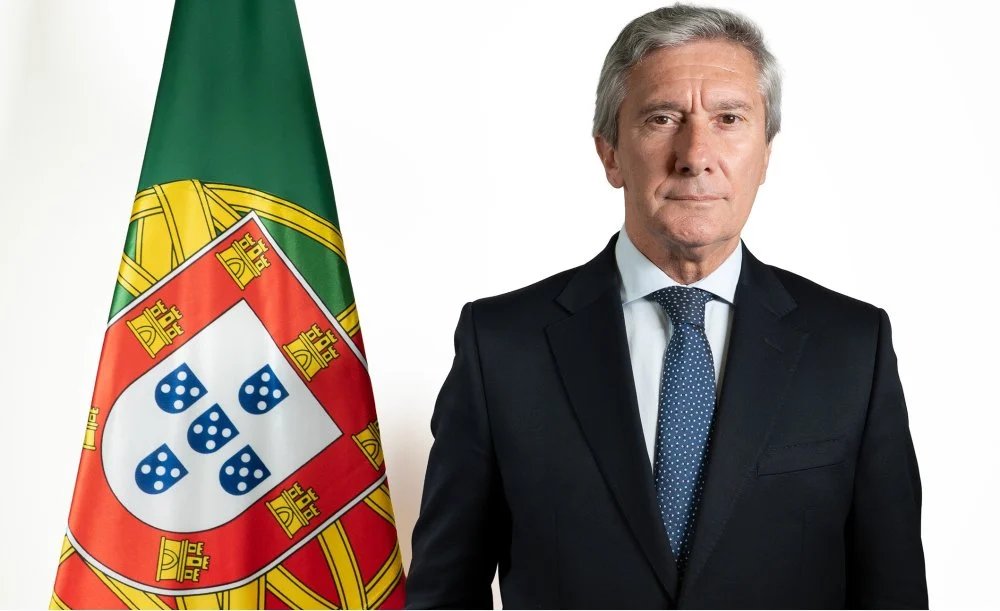
By 1. Luís Faro Ramos, ambassador of Portugal, 2. Alexandre Parola, ambassador of Brazil, 3. José Filipe, ambassador of Angola, 4. Filomena Tipote, ambassador of Guinea-Bissau, 5. Elias Andrade, ambassador of Cape Verde, 6. Américo Lima, charge d’affaires of São Tomé and Príncipe
There Community of Portuguese-speaking countries is an atypical organization, and that suits us perfectly. Bringing together countries very different in their geographical location, their population, their social situation and their culture, located on all continents and without common land borders, this community, which includes nine countries and nearly 280 million inhabitants, is distinguished by the choice of Portugueseofficial language of all its Member States, and of the cultures expressed there, as a fundamental element of its international character.
Portuguese is often the mother tongue of citizens of CPLP member states, but even when it is not – and the geographical diversity of member states explains this – it is a language of national unity, culture, education, business and, ultimately, individual and national identities. Identities forged over the centuries, gradually, through prosperous periods and trials, which converge and diverge freely, responding to the challenge taken up 30 years ago by statesmen, Heads of State and government, during the creation of the CPLP.
There Portuguese languagespoken and expressed by approximately 280 million people worldwide, according to conservative estimates, arose from the confluence of Latin and Arabic. It arose initially from the need for understanding between the Christian and Muslim populations of medieval Al-Andalus, which owed so much to North Africans in general and Moroccans in particular. Subsequently, it was built upon by Renaissance Portuguese and other languages and cultures, to become what it is today, the language lived, studied and taught around the world.
Far from its origins on the “Western Lusitanian beach” of Luís de Camões, the poet who lived and fought in Morocco in the 16th century, Portuguese finds its full development: in South America, where Brazil is the largest Portuguese-speaking country in the world; around the Indian Ocean, where many communities preserve Portuguese as a heritage language, between India and Malaysia, in Thailand and China; finally, in Africa, where the growth in the number of speakers is the fastest on the planet and where Portuguese is an official and working language of the African Union.
According to UN estimates, by the end of the 21st century, the geographical center of the Portuguese language will move from Latin America to Africa, from Brazil to Angola and Mozambique, potentially reaching more than 500 million speakers in Portuguese-speaking countries. And who knows, this language will perhaps finally see the prestige it deserves recognized, by becoming an official language of the United Nations.
In 1996, visionary Portuguese-speaking statesmen agreed that a world liberated from the Cold War required a new model of multilateralism and international cooperation. The societies of Angola, Brazil, Cabo Verde, Guinea-Bissau, Mozambique, Portugal, São Tomé and Príncipe and Timor-Leste wanted, in their respective realities and contexts, to make their voices heard, with their own accents and rhythms, to define their realities and their ambitions in a rapidly changing world, for the benefit of their regions and the world. These voices were expressed in Portuguese, and today again, we pay tribute to the Heads of State and Government who knew how to interpret their times and work towards the creation of a new forum, anchored in the culture and human links which already characterized relations between the countries constituting our Community.
Names such as José Eduardo dos Santos (Angola), Fernando Henrique Cardoso (Brazil), Mascarenhas Monteiro (Cape Verde), João Bernardo Vieira (Guinea-Bissau), Joaquim Chissano (Mozambique), Jorge Sampaio (Portugal), Armindo Vaz de Almeida (São Tomé and Príncipe) and José Ramos-Horta (Timor-Leste) will remain forever engraved in the history of the CPLP, embodying an ideal that became reality after years of preparation and reflection, and which has continued to bear fruit, ever more numerous and visible, to the incontestable benefit of the States that compose it and the peoples united there.
Since then, the CPLP, with its diversity, has seen, according to the demands of the situation, the restoration of the independence of one of its members – Timor-Leste – which, free, chose Portuguese as one of its official languages. In other Member States, our Community has supported national reconciliation and the construction of pluralist democracies, following the paths chosen by its citizens, and democratically determined by its people. It has also contributed to the external aspects of the regional integration processes of its Members, whether within ECOWAS, SADC, Mercosur or the European Union.
Throughout its history, and still today, the CPLP has proven itself to be an international organization that brings people together and promotes the sharing of democratic experiences and economic and social progress. Its member states have established bodies and bodies that promote policy coordination, strategic analysis, electoral observation and cooperation in areas as diverse as water, e-governance, gender equality, defence, youth and sport, oceans, health, food and nutrition security, combating child labor and promoting tourism, and many others.
Morocco embarked very early on the path to membership as an associated observer to the CPLP, thus demonstrating its keen interest in multipolar multilateralism, inspired by the desire for international cooperation which characterizes the Moroccan nation. Morocco’s millennia-old knowledge and experience are also reflected in its interest in the Portuguese language as a cultural reality and in the CPLP as a political expression, between free and sovereign states and peoples united by fraternal friendship. Morocco plays a leading role in the study and promotion of the learning of Portuguese in the Arab world, thanks to the work carried out in its universities and the dynamic commitment of a teaching staff resulting from a long-standing partnership between Portugal and Morocco, the fruits of which we are reaping today.
The CPLP and the language that animates it are thus envisaged in a future where all its friends will contribute to building a more human and plural world.
Long live the Portuguese language, pluricentric and pluricontinental!