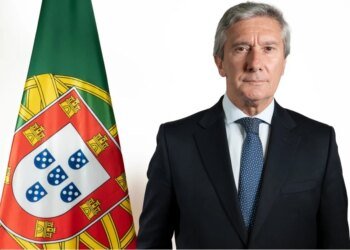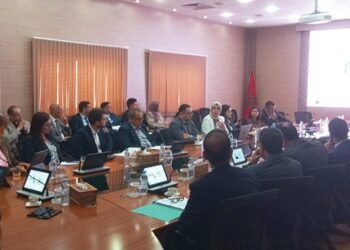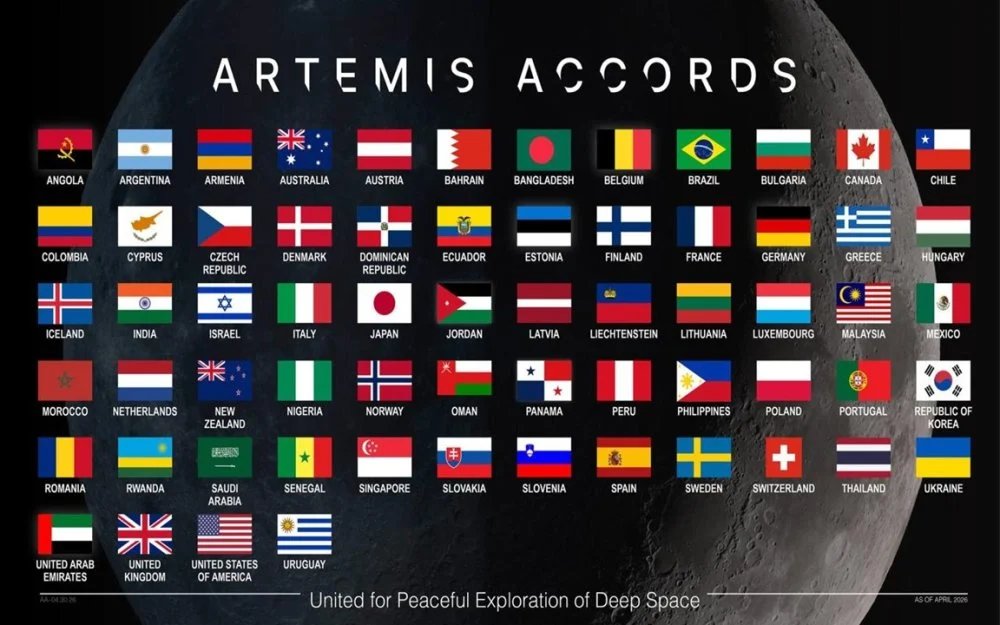
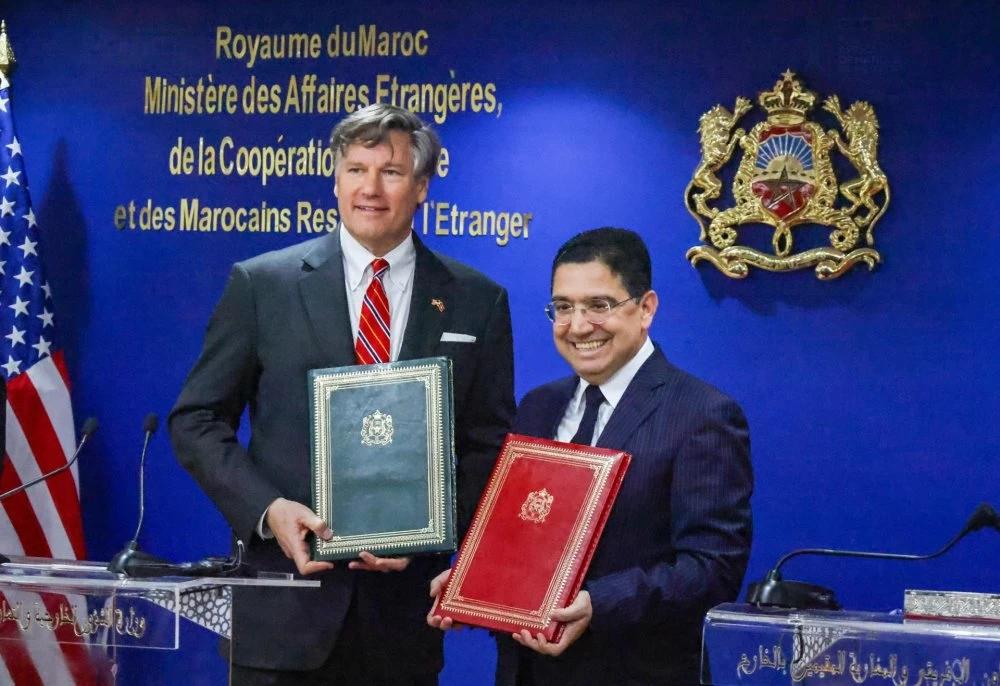
“The sky is no longer the limit.” The formula, launched by journalist Khadija Ihssane on Medi1TV, found its immediate response in the mouth of the American Under-Secretary of State Christopher Landau : “Space is the limit.” A statement which sums up, in two sentences, the meaning of the diplomatic sequence held this week in the capital. Wednesday April 29, in the presence of the American diplomat and the ambassador Duke Buchan III, Nasser BouritaMinister of Foreign Affairs, African Cooperation and Moroccans Abroad, affixed the signature of the Kingdom on the Artemis Accords. Mr. Landeau specified at the microphone of Medi1 that he now expected “in-depth cooperation between the Morocco and the UNITED STATESnot only on Earth, not only in the sky, but even in space. Beyond the symbol, the ceremony itself is an event: it is the first time, on the African continent, that such a signing has taken place in the capital of the acceding country. Nigeria, Rwanda, Angola and Senegal initialed the document at NASA headquarters in Washington. With Rabat, the African club expands to five countries, a movement which is part of a broader enlargement dynamic: Portugal, Latvia, Oman and Jordan also joined the Agreements during the month of April 2026 alone.
One framework, thirteen principles, a passport to orbit
Distinct from the space program strictly speaking, the Agreements are the political instrument which establishes the rules of the game. Thirteen principles: peaceful exploration, transparency, interoperability of equipment, emergency assistance to astronauts, public sharing of scientific data, preservation of the Apollo sites, responsible exploitation of lunar resources, mitigation of orbital debris, backed by the Space Treaty of 1967, the founding text of space law. Non-binding in the strict sense, they have become, in five years, the informal passport for any serious cooperation with NASA and the Western architecture around which space governance is being redesigned. For Morocco, their signature concretely opens four projects.
Missions and payloads: the scientific gateway
The first project is that of common missions. The signatory countries of the Agreements have easier access to payload boarding devices, called payloads, on the missions of NASA and its partners. Concretely, a scientific instrument designed in Morocco, whether it is a sensor, a biological experiment or a lunar dust analysis module, can now apply to travel aboard American, Japanese or European landers. It is through this gate that the Emirate of Dubai entered with the Rashid rover, placed on the Moon via a Japanese lander in 2023. It is also through this gate that Luxembourg, Italy and the United Arab Emirates are negotiating their participation in the Gateway station.
To this first breach is added full scientific cooperation. During the April 30 announcement, Jared Isaacman, NASA administrator, made a point of recalling that the technical links between Rabat and his agency date back to 1962. Sixty-four years later, the framework is formalized: researcher exchange programs, access to NASA’s open databases, from the Earth Observing System to planetary archives, thematic workshops on space resources, climate or precision cartography. For the Royal Center for Space Remote Sensing and for the African Regional Center for Space Science and Technology in French, both based in Rabat, it is a direct path to expansion towards the American ecosystem.
A mature aeronautical industry, ready to take it up a notch
Added to this industrial horizon is a more structural project. Discussed since 2021 on the Emirati model, the project of a full-function Moroccan Space Agency, distinct from the Royal Center for Space Remote Sensing, is still awaiting its creation decree. The signing on April 29 could accelerate its formalization: the Agreements in fact require an identified national interlocutor, capable of carrying out international commitments, coordinating public and private actors, and representing the country in the governance bodies of Artemis. The Royal Center for Space Remote Sensing, which has served as an agency since 1989 and piloted the putting into orbit of the Mohammed VI-A and VI-B satellites, has the skills. An institutional rise would complete the edifice.
Water, agriculture, security: the economy of spatial data
The third project is undoubtedly the most immediately tangible for the ordinary Moroccan: that of applied spatial data. A few kilometers from Rabat-Salé airport, the operations room of the Mohammed VI-A and VI-B satellites, launched from Kourou in November 2017 and November 2018 by the Franco-Italian consortium Thales Alenia Space-Airbus Defense and Space, scans 250,000 square kilometers of the national territory each year. Panchromatic resolution of 70 centimeters, around five hundred shots daily: these images supply agriculture, land register, border security and drought monitoring. The issue is vital. Water availability per capita in Morocco has fallen to 600 cubic meters per year, below the international stress threshold set at 1,000 cubic meters. The IRRISAT-Morocco platform, hosted by the CRTS, already uses satellite data to manage irrigation in the Gharb and Haouz areas. The Artemis Accords open complementary access to American Earth observation constellations, Landsat, MODIS, VIIRS, and soon future hyperspectral systems funded by NASA. For the Regional Agricultural Development Offices, for the Water Basin Agencies, for the National Institute of Agronomic Research, it is an additional layer of precision, frequency and history.
Added to this first application are the fight against desertification, seismic hazard mapping, coastal monitoring, forest management, fire prevention, urban analysis, all areas where spatial data, crossed with artificial intelligence, now structures public policies. A new generation of Moroccan satellites, ordered at the end of 2023 from Israel Aerospace Industries for nearly a billion dollars, must refine the national resolution to 40 centimeters and enter service by 2028. The Artemis ecosystem complements this, not replaces it.
Train orbit generation
There remains the fourth project, transversal to the three others: that of skills. Morocco today trains several hundred aerospace engineers per year, in a network that includes the Mohammadia School of Engineers, the National Institute of Posts and Telecommunications, the Hassania School of Public Works, the National School of Arts and Crafts, and more recently the Mohammed VI Polytechnic University of Benguerir. In Rabat, the African Regional Center for Space Science and Technology in French welcomes around fifty students from around ten African countries each year. The Agreements open up new perspectives for this pool: exchange programs with American universities, internship scholarships at NASA, access to summer schools at the International Space University, participation in international research consortia. On the Emirati model, four astronauts trained in less than ten years, one of whom, Sultan Al Neyadi, spent six months aboard the International Space Station in 2023, the horizon is no longer inaccessible. It calls, on the other hand, for a formalized national strategy. The issue now is a matter of measurement. The Artemis Accords do not guarantee automatic transfer of technology, nor place in manned missions, nor direct financing of national projects. They open a frame, provided they are activated. The United Arab Emirates, founding signatories in 2020, have made it a tangible accelerator: Hope probe in Martian orbit from February 2021, Rashid rover on the Moon, airlock module intended for the Gateway station, astronauts sent to the International Space Station.
On a more modest scale, Rwanda and Nigeria have built, since their signature in 2022, ecosystems attracting operators like E-Space or Atlas Space Corporation. In Morocco, where the aeronautical industry has made Tangier and Casablanca recognized regional platforms, where the university fabric is enriched each year with new engineering sectors, where the Royal Center for Space Remote Sensing is celebrating its thirty-six years of existence in this year 2026, “Morocco is not only an island of stability in a turbulent region, but also an exporter of stability,” summarized Christopher Landau on Medi 1 TV. “Space is the limit.” The formula, behind its witticism, now draws a timetable, that of a Kingdom expected on the implementation of this space project.