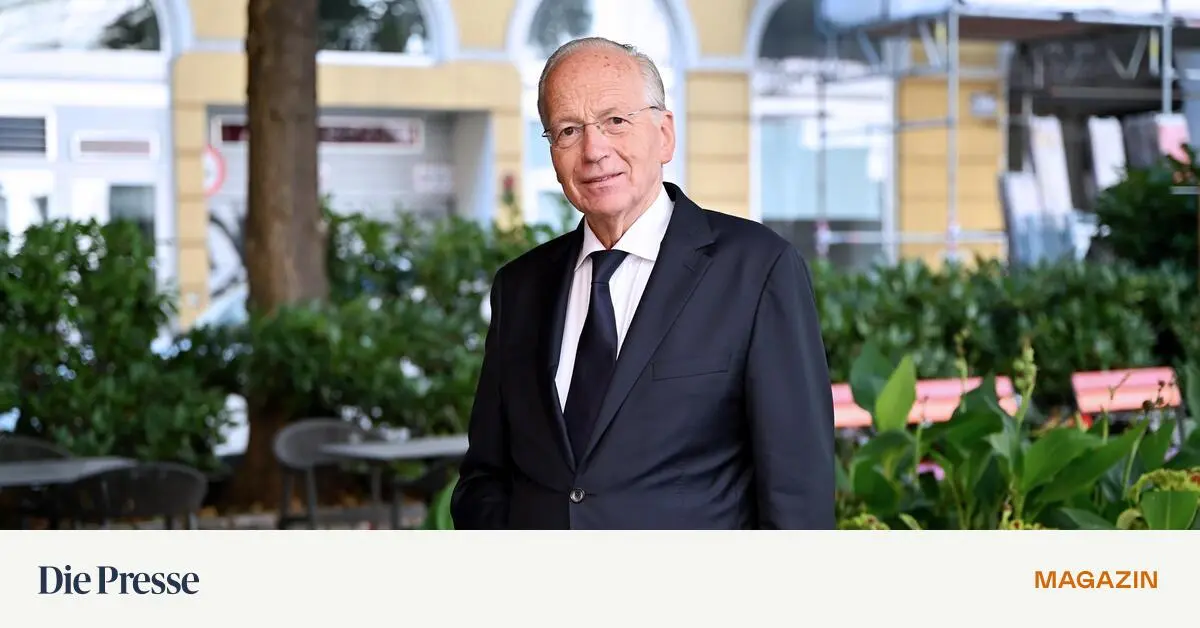
The date was set, the laudator had already prepared his speech: On May 13th, the well-known mathematician Rudolf Taschner and two colleagues – including the financial mathematician Walter Schachermayer – were to be presented with the Golden Doctoral Diploma from the University of Vienna in a small ceremony at the Faculty of Mathematics. But the event was canceled at very short notice, barely three weeks before the date: on Wednesday, April 29th, Radu Ioan Bot, dean of the faculty, had to officially explain this to Taschner.
What kind of award is this that Taschner is denied? Like many other universities, such as the TU Vienna or the University of Graz, the University of Vienna awards golden doctoral diplomas to graduates 50 years after their doctorate if they recommend themselves for it due to “special academic merits”, “outstanding professional achievements” or “close ties to the University of Vienna”. These criteria are usually not interpreted particularly strictly; the Golden Diploma of Honor cannot be compared in importance to the Great Decoration of Honor for Services to the Republic of Austria, which Taschner was awarded in 2010.
Taschner, who completed his habilitation at the Vienna University of Technology in 1981 and primarily researched function theory, but also wrote very successful textbooks, can at least be attested to have “outstanding professional achievements” without risk: he is probably the best-known Austrian representative of his guild among non-mathematicians.
You can take that literally: Taschner represents mathematics eloquently, he can explain it in a way that is understandable and exciting – in numerous popular science books (“The Gigantic Shadow of Numbers”, “Calculating with God and the World”, “The Mathematics of Existence” and many others) and well-attended lectures. From 2003 to 2017 he held these in the “math.space” in the Museumsquartier, which he and his wife Bianca founded. From an international perspective, this was also a unique place for teaching mathematics.
In addition, Taschner likes to comment on non-mathematical, especially socio-political questions, for example in the book “Justice Wins – But Only in Film” and for ten years in a “Press” column, which was easy to debate and even argue about: Taschner loves pointed formulations and also represents unorthodox opinions. This love is now apparently to blame for the fact that the Senate of the University of Vienna, currently headed by the German scholar Stefan Krammer, has decided to withhold the intended honor from him.
When asked by the “Presse”, Krammer wrote that in Taschner’s case “concerns had been raised due to his statements in connection with evidence, autonomy and freedom of science”. This vague formulation is surprising, especially since Taschner often explicitly emphasized the autonomy and freedom of science. But Krammer writes in more detail in brackets: These are statements “particularly about climate change, the FWF’s procurement guidelines, gender and postcolonial studies.”
In fact, Taschner is critical of gender studies and postcolonial studies, which are currently strongly present at universities (although not the only one); Although he does not “deny” climate change, he once described it as a “phantom problem”. The most decisive factor in Taschner’s cancellation was probably his polemic against the granting of funding by the FWF science fund: about ten months ago he called a project on sleep and dreams (at the Vienna Private University of Music and Art) “pointless” and even spoke of “wasted money”.
Is that enough to withhold a routine honor from a man who deserves his profession? The university senate’s decision is also likely to snub a government party: Taschner has been sitting for the ÖVP in the National Council since 2017 – with interruptions – and is their department spokesman for science.