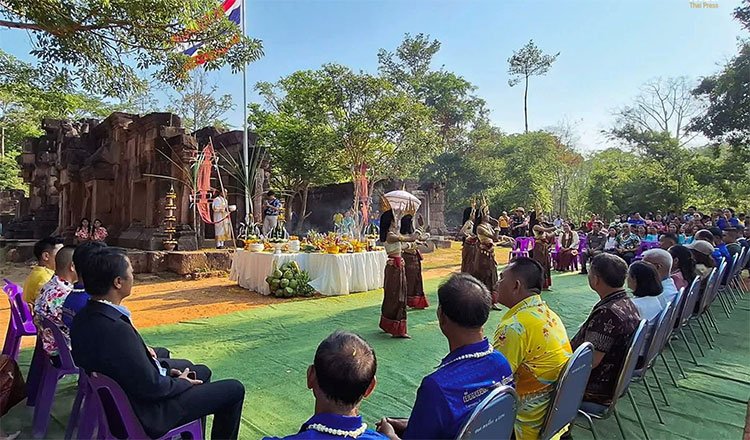
A New Year prayer ceremony conducted by Thai authorities at Ta Moan Thom Temple has been condemned as more than a religious act, with a prominent geopolitical expert describing it as a serious violation of Cambodia’s sovereignty and a calculated move to assert control over disputed territory.
In a Facebook post on April 13, geopolitical expert Kin Phea said that Thailand’s actions reflect a strategy of gradually encroaching on Cambodian territory, similar to a “salami-slicing” approach—acting unilaterally to demonstrate control, assert ownership, and create faits accomplis on the ground, with the ultimate aim of annexing Cambodian territory without regard for international law.
Meanwhile, the Ministry of Culture and Fine Arts of Cambodia has reiterated its strongest protest against the illegal and forceful occupation by Thai armed forces of Cambodian cultural heritage sites, including Ta Moan Thom, Ta Krabey Temple, Khnar Temple, and other related locations within Cambodia’s sovereign territory.
The Ministry also expressed grave concern over the continued presence of Thai authorities, as well as the construction of infrastructure—including roads and the installation of statues—which it says constitutes a fait accompli on the ground and a clear violation of Cambodia’s sovereignty and territorial integrity.
Ta Moan Thom, built of laterite and sandstone in the 11th century, features a rectangular layout with a south-facing entrance. The enclosure measures 46 by 38 metres and is centered around a main sanctuary made of pinkish-grey sandstone, fronted by a long, chambered hall (mandapa) and an antarala.
The temple was part of a larger complex that served as an important stop along the ancient Khmer highway—a major route connecting Angkor, the capital of the Khmer Empire, to its administrative centre in Phimai (now in Thailand). The central shrine includes a mandapa leading to the sanctuary, where the base and linga are carved directly from the natural bedrock.
“Every action taken by the Thai side in this area is deeply painful, as if a sharp knife were piercing the heart and severing the limbs of Cambodian people. This pain is indescribable. These actions not only violate Cambodian territory through force and disregard international law, but also constitute a profound insult to our national identity and sacred heritage,” Phea said.
He said, “While ancestral lands, farms, and homes are unlawfully occupied and controlled, and national honor is unjustly trampled—especially when ancient temples, which embody the soul and identity of the nation, fall into the hands of the invader—what national pride remains?”
“If that pride is eroded, and the heritage our ancestors sacrificed to protect is taken before our eyes, the loss goes beyond land. It becomes a loss of dignity for the Khmer people, a cultural tragedy, a fracture in national identity, and a deep wound to the nation’s soul that will leave a painful mark on history.”
“Therefore, this pain must not end in sorrow alone. It must be transformed into strength—the strength of reform, unity, and national defense. Only through strength can we safeguard our sovereignty and territorial integrity from aggression.”
“We must have the courage to undertake meaningful and decisive reforms: to remove rotten elements, eliminate corruption, strengthen our military and diplomacy, build a resilient and independent economy, ensure political stability, uphold justice and the rule of law, and foster a strong relationship between the state and its citizens based on trust and unity.”
“Above all, every Cambodian must be strong. When all Cambodians are united, resilient, and devoted to their country, national prestige will rise on the international stage and serve as a shield against all forms of aggression and insult,” Phea added.