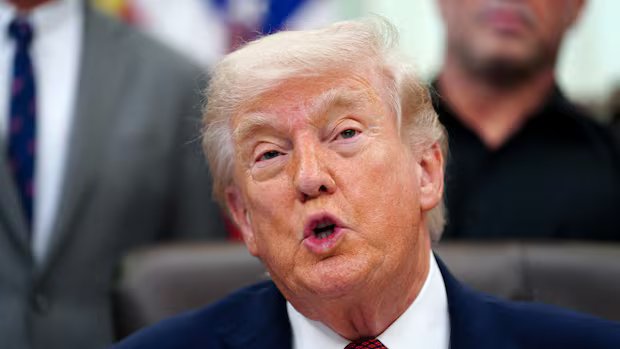
U.S. President Donald Trump offered mixed messages Monday about the path ahead for the U.S. war against Iran, declaring that he was in no rush to end the conflict while also expressing confidence that further negotiations with Tehran will soon take place in Pakistan.
With the 14-day ceasefire set to expire Wednesday, Trump presented contrasting outlooks in telephone interviews and social media posts, expressing measured optimism that a deal could soon be reached while also warning that “lots of bombs” will “start going off” if there’s no agreement before the ceasefire deadline.
Trump indicated that he still expects his negotiating team, led by Vice-President JD Vance, to be in Pakistan’s capital of Islamabad for a second round of talks, even as Iran insisted it would not take part until Trump dialed back his demands. Trump insisted he feels no pressure to end the war until Iran agrees to his terms.
“I am under no pressure whatsoever,” Trump said on his Truth Social platform. “Although, it will all happen, relatively quickly!”

Confusion continues to surround peace talks between the U.S. and Iran ahead of a looming ceasefire deadline, with both sides exchanging threats if the deal expires.
New talks
Pakistani officials moved ahead Monday with preparations for a new round of talks between the U.S. and Iran as the tenuous ceasefire was further strained over the weekend by renewed conflict around the Strait of Hormuz.
Over the weekend, the U.S. attacked and seized an Iranian-flagged cargo vessel that it said had tried to evade its blockade of Iranian ports. Iran’s joint military command vowed to respond, and its Foreign Minister Abbas Araghchi told his Pakistani counterpart that American threats to Iranian ships and ports were “clear signs” of Washington’s disingenuousness ahead of the planned talks, Iran state media reported.
Early Tuesday in Tehran, Parliament speaker Mohammad Bagher Qalibaf wrote in a social media post on X, “We do not accept negotiations under the shadow of threats.”
He accused the United States of wanting Iran to surrender and said that on the contrary, Iran has been preparing “to reveal new cards on the battlefield.”

U.S. negotiators, along with Vice-President JD Vance, are heading to Pakistan to engage in ceasefire negotiations with Iran. Bloomberg White House correspondent Jeff Mason spoke with President Donald Trump earlier today about his plans for the negotiations.
Pakistan was pushing for talks to resume Tuesday as planned.
Meanwhile, historic diplomatic talks between Israel and Lebanon were set to resume Thursday in Washington, an Israeli official and a U.S. official said. Both spoke on condition of anonymity to discuss the behind-the-scenes negotiations.
There was no immediate confirmation from Lebanon.
The Israeli and Lebanese ambassadors met last week for the first direct diplomatic talks in decades. Israel says the discussions are aimed at disarming Hezbollah and reaching a peace agreement with Lebanon.
A 10-day ceasefire began Friday in Lebanon, where fighting between Israel and Iran-backed Hezbollah militants broke out two days after the U.S. and Israel launched their war on Iran.
Mediators said fighting in Lebanon was undermining efforts to end the conflict between Iran and the U.S.
Hezbollah opposes the talks but has observed the ceasefire.
Trump says ‘highly unlikely’ he will renew ceasefire
Trump told Bloomberg News that he was “highly unlikely” to renew the ceasefire with Iran.
Iranian Foreign Ministry spokesperson Esmail Baghaei told reporters in Tehran on Monday there were no plans yet to attend the talks with the U.S. But at the same time, he did not rule it out.
Two additional Pakistani officials said Iran has expressed a willingness to send a delegation to Islamabad. They spoke on condition of anonymity because they were not authorized to speak to the media.
Over the weekend, Iran said it had received new proposals from the U.S. but suggested that a wide gap remained between the sides. Issues that derailed the last round of negotiations included Iran’s nuclear enrichment program, its regional proxies and the Strait of Hormuz.
Iran throttled traffic through the strait, which connects the Persian Gulf to the open seas, shortly after the U.S. and Israel attacked Iran on Feb. 28 to start the war. The U.S. has also instituted a blockade of Iranian ports.
Roughly one-fifth of the world’s oil trade normally passes through the strait, along with critical supplies of fertilizer for the world’s farmers, natural gas and humanitarian supplies for places in dire need like Afghanistan and Sudan.

Since the war started, at least 3,375 people have been killed in Iran, according to a new toll released Monday in official Iranian media by Abbas Masjedi, the head of Iran’s Legal Medicine Organization. He did not break down casualties among civilians and security forces, instead just saying that 2,875 were male and 496 were female. Masjedi said 383 of the dead were children 18 years old and under.
More than 2,290 people have also been killed in Lebanon, 23 in Israel and more than a dozen in Gulf Arab states. Fifteen Israeli soldiers in Lebanon and 13 U.S. service members throughout the region have been killed.
Oil prices on rise again
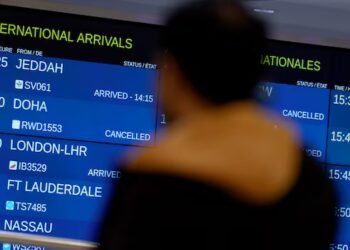
Iran’s grip on the Strait of Hormuz has also sent oil prices skyrocketing and given rise to one of the worst global energy crises in decades.
U.S. stocks fell Monday following the chaotic weekend in the Persian Gulf.
Trump found himself remonstrating his energy secretary, Chris Wright, who on Sunday said American motorists might not see gas prices fall back into the $3 US per gallon range until late this year or next year.
“I disagree with him totally. I think it’ll come roaring down if it ends,” Trump said to PBS. “If we end it, if Iran does what they should do, it will come roaring down.”

The U.S. war on Iran indirectly opens the door for China to help reshape the world order as the ceasefire deadline looms. Andrew Chang explains how China, Iran’s largest oil customer, takes a unique position in this war to become the new ‘global grown-up’ in the room.
Images provided by The Canadian Press, Adobe Stock, Reuters and Getty Images
Iran early Monday warned it could keep up the global economic pain as ships remained unable to transit the strait, with hundreds of vessels waiting at each end for clearance.
Security of the strait is not free and “the choice is clear: either a free oil market for all, or the risk of significant costs for everyone,” Mohammad Reza Aref, first vice-president of Iran, said in a social media post calling for a lasting end to military and economic pressure on Tehran.