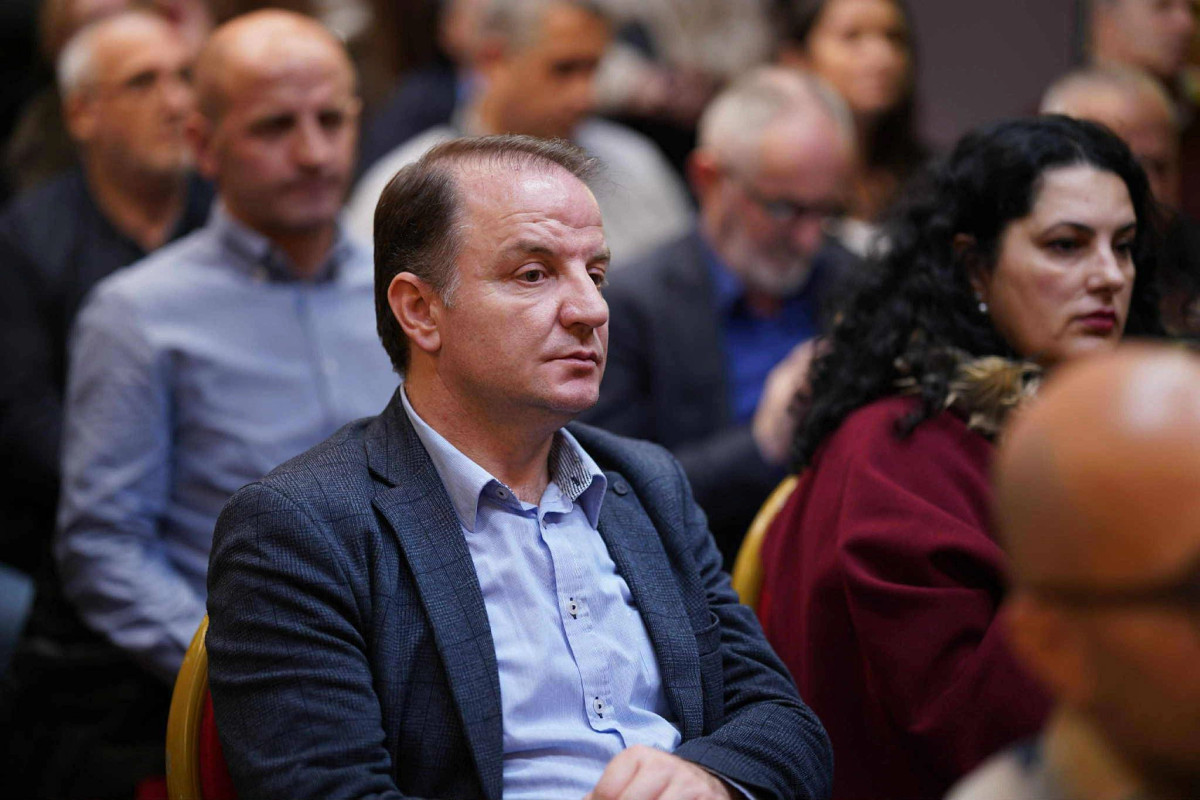
The “Jakov Xoxa” award – which in the third year has reached its weight on the Albanian stage – this year was given to the writer and researcher Gëzim Aliu, and for him it is even more significant since the head of the jury was academician Rexhep Qosja. It has been appreciated for the enrichment of literary discourse and the influence on the development of critical thinking in Albanian culture, at a time when, as Aliu himself describes, “there is a demand for easy things, oversimplified things” and literature is not like that
On the grounds that with his original creativity and sustained scientific commitment he has enriched the literary discourse and influenced the development of critical thought in Albanian culture, the “Jakov Xoxa” prize for literature has been awarded to Gëzim Ali. For the writer and researcher, this award was particularly significant – because the evaluation jury was chaired by the late academician Rexhep Qosja, his friend and collaborator for 15 years.
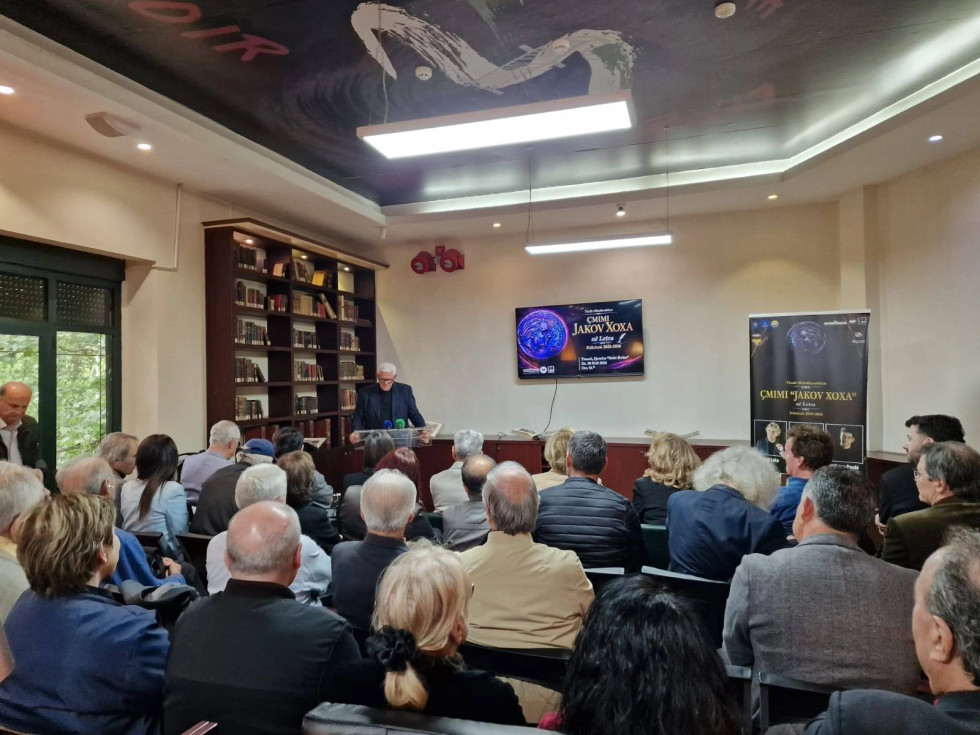
On Thursday night at the “Sotir Kolea” center in Tirana, the event started with a tribute to academician Rexhep Qosja, whose death is considered to have left a void in the Albanian academic and literary world. His presence as a jury member of this award has given even more symbolic weight to this evaluation.
The emotional dimension of this award is even deeper for its laureate. Ali has expressed that for him, the award is even more significant and emotional.
“It’s doubly emotional, because I’ve had professor Rexhep Qosja as a study professor and colleague for fifteen years since I’ve been at the Institute. He came to work until recently, until recently. So it’s doubly emotional for me when a great name like academician Rexhep Qosja was chosen by the jury. Of course, I would like him to be alive, so that I could receive it from him, but that’s already impossible, but anyway I’m honored with the award named after one of to the best, greatest Albanian writers, Jakov Xoxa”, said Ali in a conversation with KOĖN, on Friday.
Arian Leka, Adil Olluri, Andreas Dushi and Selajdin Salihu were also nominated for this nationwide award. Headed by academician Rexhep Qosja, who died on Thursday, April 23, academicians Ali Aliu, Shaban Sinani and Xhevahir Spahiu, Bardhosh Gaçe, poet Natasha Lako, journalist and publicist Aleksandër Çipa and others.
For the researcher and writer Gëzim Aliu, the evaluation comes from a jury with big names.
“Since the award is nationwide, as it was established, I appreciate it, appreciate it, as an appreciation of my work, even though it is an award for literary creativity by a dignified jury, with big names who have evaluated the creativity of dozens of other authors, then decided a final”, he said.
The “Jakov Xoxa” award comes as an assessment that does not originate from direct competition, but from recognition of the work by the literary community. As Aliu himself points out: “It is evaluation not through competition, but through the nomination of others who know your work”.
The winner of the third edition of the award for the year 2025-2026 through the award will enjoy a monetary amount and the publication of an unpublished work.
And Ali has said that there are ready-made manuscripts that need to be reviewed and sent for publication.
“I have manuscripts, but I let them rest a lot, I revise and revise them. I have manuscripts, but we have to see how they thought. I have a manuscript with stories, I also have a manuscript of a novel. I believe the manuscript with stories, because it is from the last few years that I have in my hands, but it needs to be completed, I call it, it needs to be polished, so that it comes to the state that I think is ready for publication. I am repeating it, because I have said it before, “I don’t publish something unless I hear the melody of the language. I’ve had this manuscript for several years,” he said writer, literary scholar, essayist, doctor of science in literature. He is a scientific associate at the Albanological Institute of Pristina. He graduated and mastered at the Department of Albanian Literature of the Faculty of Philology, at the University of Pristina. For a while he worked as a teacher of Albanian language and literature, then as a journalist and editor of the magazine “Albanica”. He is the author of dozens of scientific, journalistic writings, reviews and cultural columns published in magazines and newspapers. In addition to scholarly and journalistic writings, Ali also deals with translations from several foreign languages. In the period 2010-2012, he was the responsible editor of the literary magazine “Jeta e Re”.
Recently, it has been considered that there is a complicated context in the distribution of prizes for Kosovo authors in Albania and vice versa. That there is no unified scene of literature. But Ali remembered that the award with the same title was won by researcher and writer Sabri Hamiti in the first edition held in 2023.
“Literary awards for Kosovo authors have been given, but mainly literary awards have been given to names who were almost at the end of their careers and have several decades of career, for example, Sabri Hamiti received this award for the first time. Albanian literature is one, it is Albanian literature”, said Aliu.
According to him, it is natural that in Kosovo more awards are given to authors from Albania.
“Truly in Kosovo, awards are given more often to authors from Albania, but this is normal because the gravity, the literary activity, and the number of prose writers is probably greater in Albania. In the meantime, these small obstacles have begun to be overcome, and recently awards are also being given to authors from Kosovo. This is proof that those dissatisfactions expressed earlier do not last, but I do not believe in these differences, these divisions”, he said.
In the premises of the Academy of Sciences and Arts of Kosovo, the “Jakov Xoxa” award for the best academic work, awarded at the end of April 2023 in honor of the 100th anniversary of the birth of the writer Xoxa, was given to academician Hamiti for his work “Stilografia”. In the last edition, it was shared with Majlinda Rama.
On Thursday, at the ceremony, the director of the National Book and Reading Center, Arta Marku, academician Ali Aliu, writer Diana Çuli, Jakov Xoxa’s son, Agron Xoxa, as well as publishers Abdullah and Edon Zeneli, delivered greetings. Actors Vasjan Lami and Violeta Trebicka performed selected pieces from the competing works of the five finalists, while the evening was moderated by actor Mevlan Shanaj.
The “Jakov Xoxa” award, as it is written, aims to stimulate, encourage and promote the literary creators of the new and contemporary generation of the late 20th and early 21st centuries. It is a project initiated by the Xoxa family, friends and well-wishers of the writer, with the support of the National Book and Reading Center, the Academy of Sciences of Albania and Kosovo, the Government of Kosovo and others. It is written that the main object of the title “Jakov Xoxa” Award is the stimulation of young literary generations, who started creative activity after the 90s of the last century. The judgment and evaluation of all-Albanian literary creators is based on the criterion of the integrity of the authors’ work over the years. For this edition, the work of over 35 Albanian creators has been evaluated.
For Ali, the award is significant as it appreciates creative activity in a period that is not easy to write about.
“Especially in the 90s, it was not easy to write. But even after the war, it was probably even more difficult. This is certainly valuable because of this evaluation, because really writing in this time and being evaluated is not that easy, because we know the state of literary creativity, of readability in a society where reading, writing and especially reading have not yet stabilized, social networks are coming, and now also Intelligence. “Artificial. An author like me, or other authors, face many difficulties, primarily due to the lack of readers”, said Gëzim Aliu.
Even today it is not easy, according to him, especially for writing serious literature, because as he says, “forms that are easily swallowed by the public are preferred, i.e. short videos, poems that touch emotions, much less prose, films or other similar products”.
“There is a demand for easy things, oversimplified things. Literature is known to be not easy, because it should not be simplified. And this award, which is normally a good stimulus, is an effort that draws attention to authors who, however, write”, he said.
According to Ali, the real author is becoming rare, but the writers are multiplying.
“…this is because the ecological means of expression or reaching the public are easier: social networks, easy publishing through many publishing houses, but the quality has gone down. Filters do not exist, editors do not exist. If one sends a manuscript somewhere, the publishing houses, most of them, not all of them, have neither proofreaders nor editors. Anyone who can have a manuscript or cares that can publish something, it does publish, and this is then creating confusion. But genuine readers, however few they are, find the authors”, said Aliu.
The “Jakov Xoxa” award is open to Albanian authors from all Albanian-speaking regions and the diaspora, offering a platform for young writers to share their voice and contribute to the enrichment of contemporary Albanian literature. According to the organizers, among the main selection criteria are: the originality of the work, consistency in theme and style, the deep expression of humanism and the presentation of a realistic reflection of the Albanian society with its advantages and challenges.
For Ali, the award draws attention to genuine books.
“This award that has been given to me and such awards certainly draw attention to genuine books. Therefore, in this context, I see that at this time it is not much preferred to write because it is a difficult time, but nevertheless, writers will write because, I am speaking for myself, and I believe for other authors as well – we cannot not write literature”, he said.
The “Jakov Xoxa” award is also considered as a point in the promotion of new Albanian literature and as recognition for the work of Jakov Xoxa.