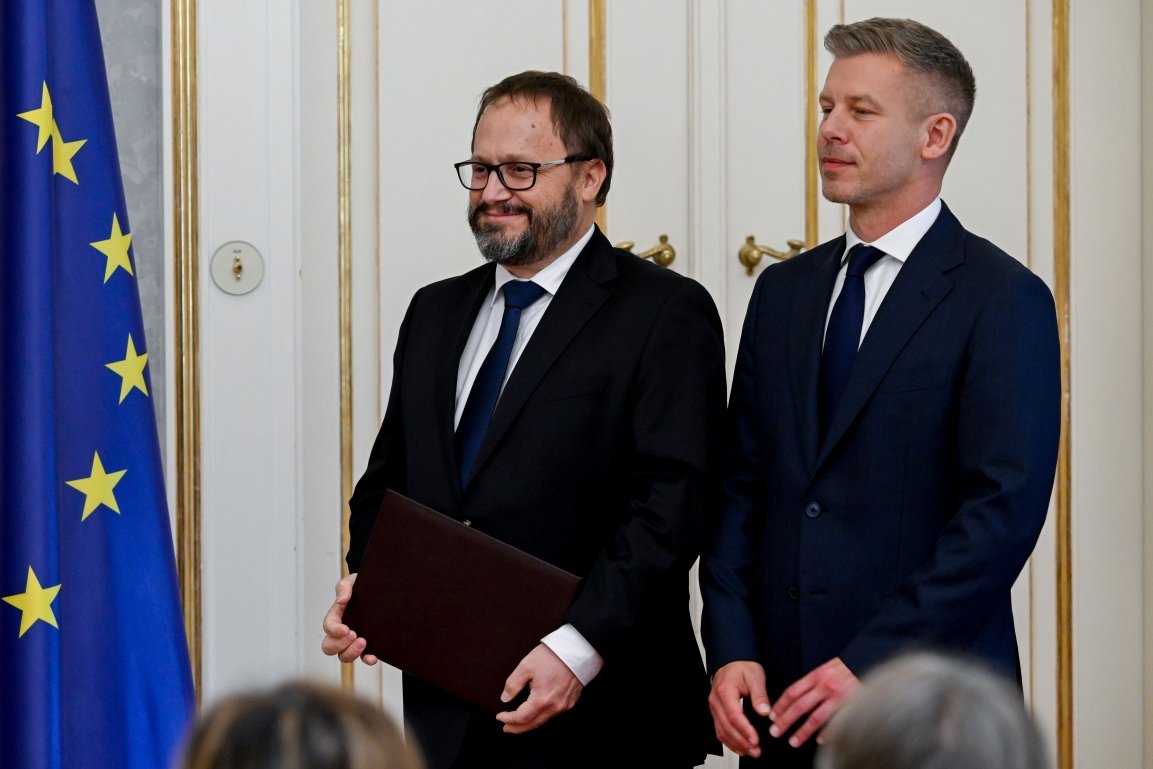

Finance Minister András Kármán (L) with PM Magyar
The government has decided that the fixed three percent interest rate on certain liquidity-oriented loan products under the Széchenyi Card Program will be eliminated effective immediately. The measure was originally designed to suppress misuse by some investors, but could lead to higher interest rates for new startups and small businesses.
This decision could have a significant impact on many small and medium-sized enterprises, as in recent years this has been one of the most favorable and predictable financing options for many companies, reported Promotions.hu. Under the Orbán government, thanks to state support, businesses could access funds at a fixed three percent interest rate to maintain operations, purchase inventory, bridge liquidity gaps, or finance day-to-day operations. In the current economic environment, where a significant portion of businesses continue to struggle with rising costs, labor shortages, and uncertain market conditions, the preferential loan served as an important safety net for many. With the TISZA government’s announcement of the end to protected fuel prices this week despite pre-election promises to the contrary, small enterprises may see both their petrol bills and interest rates rise this summer.
According to the government’s justification, the amendment was necessary because some businesses did not use the subsidized funds to finance their economic activities, but instead invested the money in higher-yielding investments. In order to curb so-called arbitrage transactions, the uniform, fixed three percent interest rate will no longer be available for new contracts in the future.

Cheap loans may soon become a thing of the past for small businesses. Photo: Pixabay
As a result of this change, the interest rates on the affected loan programs may be adjusted to reflect market conditions, which could lead to significantly higher financing costs for many businesses. While the cost of the loan was previously predictable, businesses will have to contend with greater uncertainty in the future. This decision may pose a particular challenge for smaller companies.
The measure, designed by the department of Finance Minister András Kármán, a former FIDESZ state secretary, will no doubt get the approval of the finance and banking sector who are expected to be the main beneficiaries of the cancellation of the popular three percent state guaranteed loan. The government, in turn, hopes for higher tax revenue from the banks. Fears are, that the logic behind this approach is reminiscent of that of the policies of the previous socialist government that lead to higher prices, a serious fall in consumption, and a rise in business interest rates. FIDESZ’s victory in 2010 was ascribed, to a large extent, to the crisis that the economic policies of the Ferenc Gyurcsány and Gordon Bajnai government have caused with their unbridled liberalization of the banking and loan sector.

Featured Image: MTI/Koszticsák Szilárd