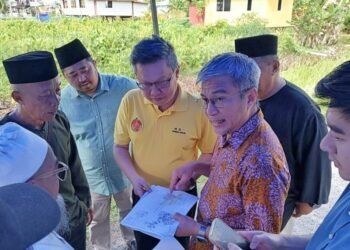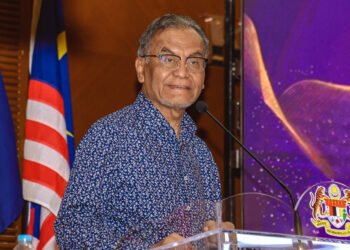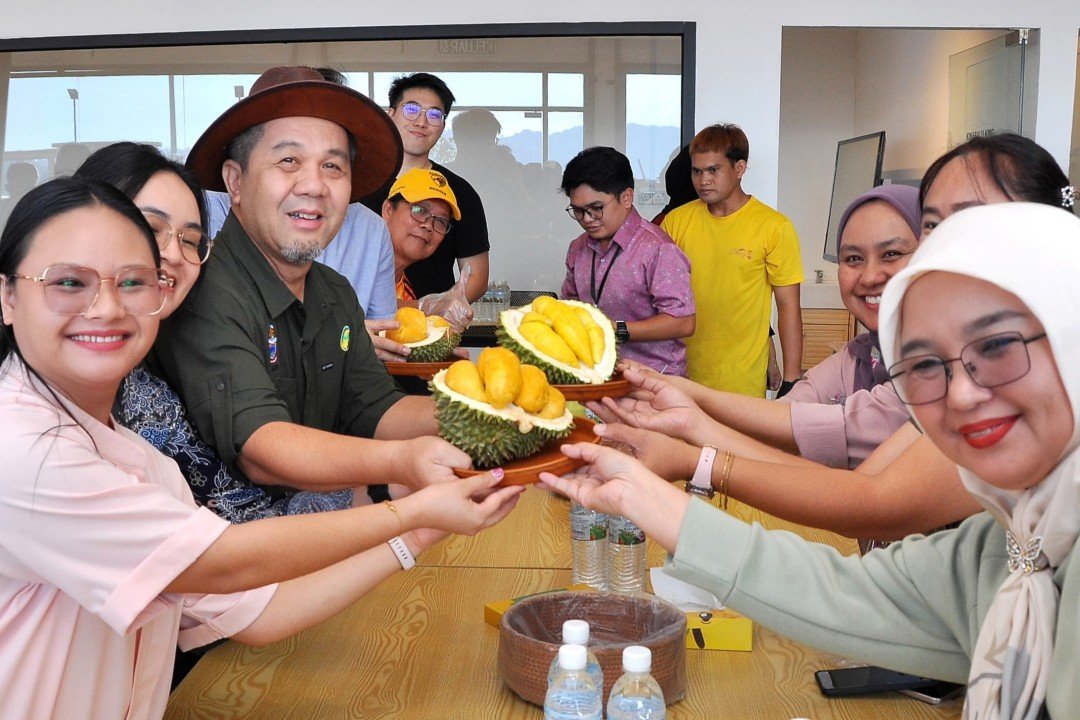

Jamawi (second left) with members of the media during the durian treat event.
KOTA KINABALU (April 17): Efforts to promote premium durian and locally grown avocado are among the main focuses of the Sabah Ministry of Agriculture, Fisheries and Food Industry (MAFFI) in increasing farmers’ incomes in the state.
Minister Datuk Jamawi Jaafar said the initiative is in line with efforts to strengthen the agri-food sector while helping rural entrepreneurs generate additional income.
“This afternoon we are holding a durian gathering with the media as a platform to strengthen ties between MAFFI and our media partners.
“We are not serving heavy meals, but instead providing the opportunity to enjoy fruits such as Musang King and Black Thorn durians, as well as introducing locally grown avocado,” he said when met at a durian appreciation gathering with members of the media here, attended by approximately 45 media representatives.
According to him, the local avocado variety known as QAV1, or rebranded as Queen Sabah Avocado, is currently showing promising market potential.
“This avocado has a very good market, with farm-gate prices of around RM12 to RM15 per kilogramme, and export prices are also on the rise,” he said.
In this regard, Jamawi said the ministry will expand avocado planting assistance programmes, particularly in interior areas such as Tenom, Keningau, Kota Marudu, Kudat and Ranau.
He said the initiative is expected to become a supplementary source of income for farmers alongside existing crops.
Meanwhile, he said the Kitchen Garden Tour programme will continue in conjunction with the Kaamatan Festival beginning May 1 in Papar.
“Through this programme, we will distribute vegetable seeds free of charge, while fruit seedlings, livestock and fish fry will be offered at discounts of up to 50 per cent.
“This includes chicks, laying hens, broilers, quail, as well as fish fry such as tilapia, patin and catfish,” he said.
He said the initiative aims to encourage the public to grow vegetables and rear livestock at home to supplement household income.
In addition, Jamawi said that 25 agricultural collection centres have been activated in each parliamentary constituency to facilitate the marketing of farmers’ produce.
He added that a digital application will also be launched soon to help identify the supply of agricultural produce and ease marketing processes.
“This role will be carried out by the Sabah Agriculture Marketing Authority (SAMA), which functions similarly to FAMA, to ensure that farmers’ produce can be marketed at reasonable prices.
“In the event of oversupply, SAMA will purchase agricultural produce to prevent losses for farmers,” he said.
Commenting on the issue of excess supply of village durian, he said the ministry plans to enhance the value of local durian through mature grafting technology to produce premium varieties.
“Every season we see an oversupply of village durian, causing prices to fall as low as RM3 to RM5 per kilogramme.
“Whereas premium durians such as Musang King can reach up to RM75 per kilogramme and Black Thorn around RM85 per kilogramme,” he said.
He said upgrading village durian to premium varieties would increase market value as well as smallholders’ income.
In another development, Jamawi said the state government is also focusing on reducing dependence on imported animal feed, which currently stands at 98 per cent.
He said among the measures taken is the opening of approximately 1,000 hectares of commercial maize plantations this year, with an allocation of RM25 million.
“This initiative is important to stabilise the cost of animal feed, thereby helping to reduce the prices of chicken and eggs in the market,” he said.
He also encouraged rural communities to rear laying hens on a small scale as a way to enhance food supply and family income.
At the same time, Jamawi said the state government is targeting an increase in the rice self-sufficiency level (SSR) from 20 per cent to 40 per cent within five years.
He said strategies include increasing paddy yield per hectare as well as reactivating approximately 3,000 hectares of idle paddy fields in several districts, including Kota Belud and Kota Marudu.
“With these integrated efforts, we are confident that Sabah’s agri-food sector will continue to grow and be able to ensure the state’s food security,” he said.