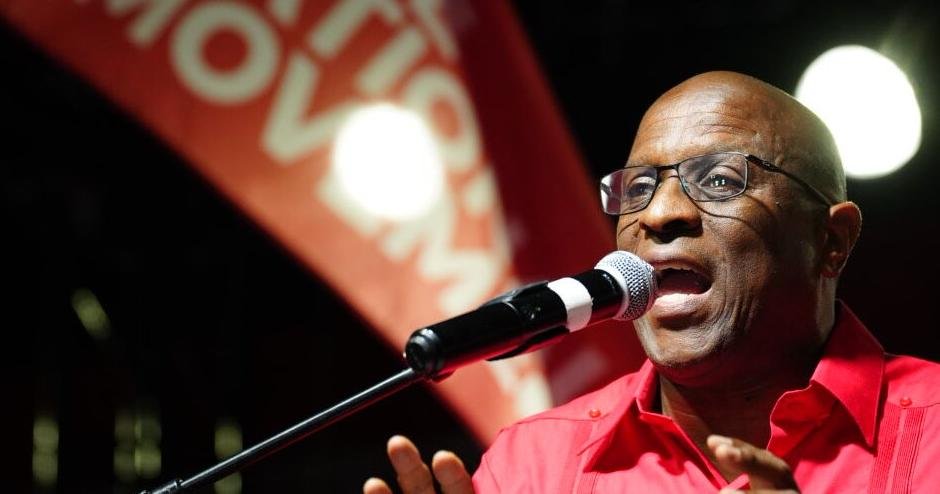
Free National Movement (FNM) Leader Michael Pintard said the Davis administration’s award of hundreds of millions of dollars in no-bid contracts is unacceptable, and claimed it has directly contributed to a cash shortfall that has impacted the quality of public services in The Bahamas.
His comments came after a Nassau Guardian article highlighted the extent of the practice of bypassing the tender process to directly award contracts, some of which were very high value. One valued at $183 million and another at $180 million were both awarded to affiliates of the Bahamas Striping Group of Companies.
“The worst part of that is, at the end of the day, you have large contracts that do not pass the smell test, where one group, one consortium, one family is making a ton of money while money is not available for the essential things that can save lives,” Pintard said.
He added, “It’s critical because most of the issues that boil the blood of behemoths, those issues have emerged because of a cash shortage, so whether it’s in health with ambulances, medication, failure to pay doctors and nurses; a failure to pay small contractors in the home repair program; insufficient funds for the social assistance … that shortage is why we are raising the issue.”
When asked about the matter, Acting Chief Procurement Officer Carl Oliver said earlier last week that most contracts are direct awards. He maintained that the government has acted within the specifications of the law, which provides 17 different sets of circumstances under which a contract can be directly awarded instead of going to tender.
The legislation in question, the Public Procurement Act, 2023, was brought by the Davis administration to repeal and replace the 2021 Public Procurement Act that was passed under the Minnis Free National Movement (FNM) government.
According to the act, contracts with an estimated value of less than $100,000 may be directly awarded.
It also cites “extreme urgency” as a reason to bypass the bidding process, provided the circumstances giving rise to the urgency were neither foreseeable by the procuring entity nor the result of dilatory conduct on its part.
The act also provides for the direct awarding of contracts in instances in which the goods, works or services are only available from a small number of suppliers or the time and cost of considering a large number of bids were disproportionate to the estimated value of the procurement, having regard to the nature of the procurement.
The law requires that every request for approval to commence a direct award be in writing and include a written justification of the decision to utilize the procurement method.
“… Based on the act, if you’re using direct awards, there are [many] reasons that you can select from, and they have been selecting at least one, sometimes two, of these options that permit them to apply for direct award contracts,” he told The Nassau Guardian.
Oliver added, “The majority of contracts awarded are by way of direct awards, and I know many people may not be too pleased with that, but you know, that’s the way it is.”
Pintard, who has, while in opposition, routinely raised concerns over the awarding of no-bid contracts, said the Davis-led government is “beyond the pale”.
“We raised this issue of procurement very early in the first year of the Progressive Liberal Party (PLP) coming to government,” he said.
“From the earliest moments of their administration, they demonstrated that they were unwilling to follow the laws that they met in place, with procurement being one of the principal ones we referred to regularly.”
Pintard added, “This government is well beyond the pale in terms of denying opportunities to a wide range of Bahamians who would have had an opportunity to compete and share in the distribution of wealth in this country. They have chosen to narrow their focus on a select group of persons, whom we do not begrudge, but we say the government has failed the majority by showing preference to the few.”