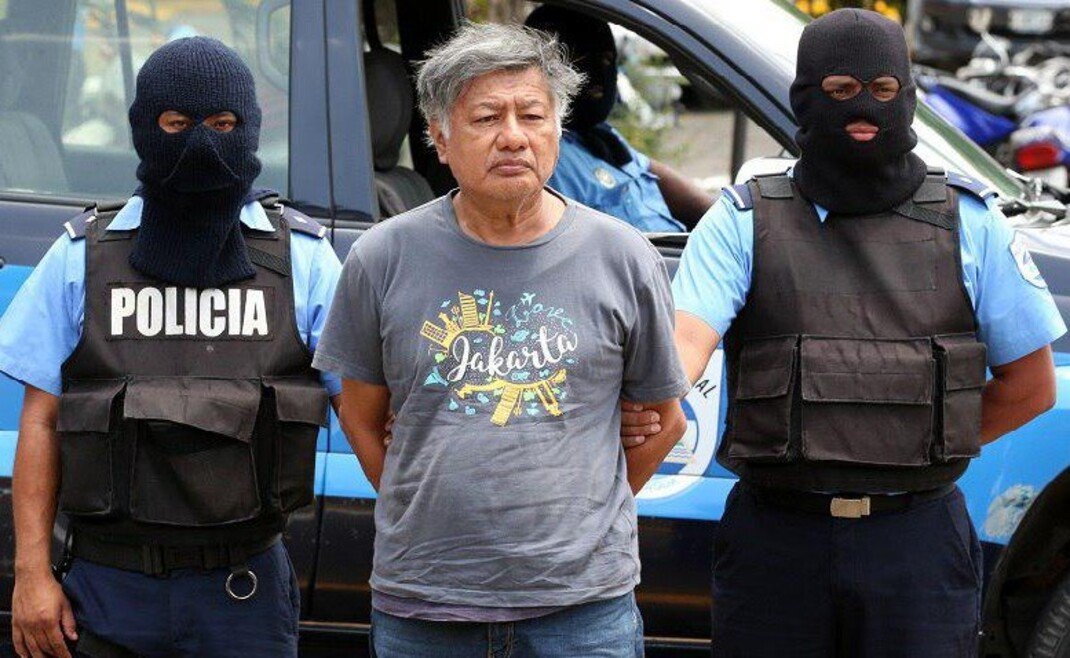
The retired Army colonel, Carlos Brenes Sánchez, 70, and his wife, Salvadora del Socorro Martínez Aburto, 68, were sentenced to 15 years in prison for the alleged crime of “treason to the country,” according to a resolution of “urgent measures” released by the Inter-American Court of Human Rights (IACHR).
“This Presidency was informed that they would have been subjected to a judicial process for the crime of treason and that they would have received a sentence of 15 years,” indicates the Inter-American Court in its resolution signed by the president of the court, Rodrigo Mudrovitsch, on April 1, 2026.
The regional court was informed about the sentence upon receiving, on March 30, 2026, a request to expand provisional measures from the Inter-American Court of Human Rights (IACHR).
Carlos Brenes and his wife were arbitrarily detained by the National Police on August 14, 2025 and, according to the Mechanism for the Recognition of Political Prisoners, they are in a condition of “forced disappearance.”
According to unofficial information—the Inter-American Court notes—they would be held in the Jorge Navarro “La Modelo” Penitentiary System and the Comprehensive Women’s Penitentiary Establishment, known as “La Esperanza.”
The Inter-American Court, however, revealed that “the whereabouts of Carlos Brenes Sánchez and Salvadora Martínez Aburto have not been reliably verified.”
“No family member or close friend would have had contact with them since their arrest,” argued the president of the Inter-American Court.
First arrest of Carlos Brenes
Carlos Brenes Sánchez retired from the Sandinista Popular Army in 1994 with the rank of colonel and was one of the founders and coordinator of the Patriotic Group of Retired Military and was part of the Broad Front for Democracy (FAD), which questioned the authoritarian drift of Ortegaism.
After the protests of April 2018, former colonel Brenes He was captured, for the first time, on August 28 of that year on the border of Peñas Blancas when he was traveling to Costa Rica to undergo a medical check-up for his diabetes.
The former military man, originally from Monimbó, Masaya, a combatant in the insurrection in 1978 and 1979 and one of the military leaders of the FSLN Internal Front, was accused of “terrorism” by the Ortega-Murillo regime, and remained in prison until his release on June 19, 2019, thanks to a self-amnesty approved by the regime.
Brenes was locked up in a punishment cell in La Modelo accused, without evidence, of directing alleged armed attacks against the Police in Carazo and Masaya. As a result of his more than ten months in prison, his chronic illnesses of hypertension and diabetes worsened, requiring permanent medical care and attention.
Inter-American Court extends provisional measures
The resolution of the Inter-American Court extended the provisional measures in favor of five prisoners of the dictatorship. In addition to Carlos Brenes and his wife, the other three beneficiaries of the urgent measures are: retired brigadier general, Álvaro Antonio Baltodano Cantarero, 73 years old; his son Álvaro Baltodano Monroy, 47 years old; and Larry Javier Martínez Romero, 31 years old.
The opinion is part of the matter Juan Sebastián Chamorro and others regarding Nicaraguaa file open since 2021.
The court found that the five Nicaraguans were detained and prosecuted “without due judicial guarantees,” some of them under criminal offenses that would have been used as retaliation for “their real or perceived participation in events related to the opposition to the Government of Nicaragua.”
The resolution urges the State of Nicaragua to do the following:
- Determine and report the whereabouts of the five beneficiaries.
- Proceed to his immediate release.
- Immediately adopt the necessary measures to “effectively protect the life, personal integrity, health and freedom” of the beneficiaries.
- Inform “unequivocally” family members and lawyers about the place of detention, facilitate immediate contact with family members and guarantee access to health services, medicines and adequate food.
- Guarantee access by trusted lawyers to the entire file and to the online judicial information system.
- Refrain from “prosecuting and retaliating” against family members and representatives of the beneficiaries.
- Inform the Court no later than April 13, 2026 about the situation of the beneficiaries and the measures adopted to comply with the resolution.
“Precarious” detention conditions
The resolution describes the “precarious” conditions in which the five prisoners are found.
Carlos Brenes Sánchez – who has had a “leadership role within the retired military” and in the population of Masaya and Carazo – would be in a cell where he is monitored through a camera 24 hours a day.
According to the court, “a light is kept on day and night” that prevents him from resting and he would be a “victim of psychological abuse, including verbal threats in which detainees are told that they will die in prison and that their relatives have forgotten them.”
His wife, Martínez Aburto — detained by police when “she was walking towards her home” — is also in a “specially vulnerable situation.”
Álvaro Baltodano Cantarero, arrested on May 14, 2025 during a raid on his property, without a court order and without being notified of charges, and his son Baltodano Monroy, “would not be receiving the medical attention or medications they require.” Furthermore, they remain in “isolation conditions, without adequate access to sunlight, medical care and food compatible with their serious health conditions.”
On June 10, 2025, CONFIDENCIAL, through sources linked to the judicial body, confirmed that Baltodano Cantarero was sentenced to 20 years in prison for “treason to the country”. On August 14, the Attorney General’s Office (PGJ) alleged “money laundering” to imprison and confiscate Baltodano Cantarero and his son.
Larry Javier Martínez Romero was arrested on August 13, 2025 in Masaya through an operation with ten police officers who did not present a court order. They only informed him that he would be transferred for a “police interview.”
The prison authorities of “La Modelo” allowed him to be given basic food and hygiene supplies in September 2025, but without confirming that he was “incarcerated in that establishment.”
State remains in “contempt”
Since the file was opened in 2021, more than 100 political prisoners have benefited from provisional measures in this same matter, none of which have been responded to by the regime of Daniel Ortega and Rosario Murillo.
In November 2022, the Inter-American Court of Human Rights declared the Nicaraguan State in “permanent contempt” for the numerous orders to release political prisoners, and elevated the situation to the General Assembly of the Organization of American States, from which the dictatorship withdrew.
Nicaragua left the Organization of American States (OAS) in 2023, but the General Assembly has reiterated that this departure “does not affect the obligations” of the country under other human rights treaties that “continue to be binding on the State.”