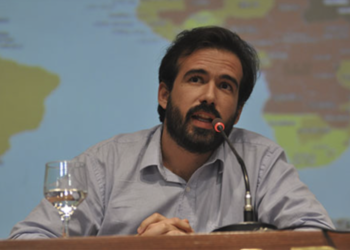
President Miguel Díaz-Canel gave an interview to Brazilian businessman and journalist Breno Altman, director of Opera Mundi and contributor to various Latin American progressivism media. The interview allowed Díaz-Canel to repeat the island’s official discursive mantra: Cuba is being suffocated by the United States, the Cuban people are resisting and their government is not responsible for the terrible deterioration of living conditions. The blockade is the only culprit and must be eliminated without Havana having anything to correct.
However, there was a moment unforeseen by Díaz-Canel and his advisors: when Altman asked the Cuban leader about his musical preferences. The journalist chooses the route of contrast between great Cuban artists, so that Díaz-Canel opts for one and then suggests new alternatives. The interview scheme is designed so that the interviewee shows the greatest possible plurality and tolerance. But Díaz-Canel clearly did not pass the test or take advantage of the opportunity.
The journalist begins the heads-up with Ignacio Cervantes and Compay Segundo and Díaz-Canel chooses the latter. Then he discards Compay Segundo for Bola de Nieve and engages in a repetition of Bola de Nieve, until Benny Moré arrives. He responds several times in favor of Benny, until Omara Portuondo appears. Díaz-Canel repeats and repeats his preference for Omara, until the name of Silvio Rodríguez arises, which he maintains, repetitive, until the end of the interview.
Along the way, the president of Cuba does not give a single vote, not to Ignacio Cervantes, perhaps the greatest Cuban composer of the 19th century, but to true references of the island’s popular music of the 20th century such as Arsenio Rodríguez, Dámaso Pérez Prado, Bebo Valdés, Celia Cruz, Ibrahím Ferrer, Chucho Valdés, Juan Formell, Pablo Milanés, Noel Nicola, Adalberto Álvarez, Paquito de Rivera, Arturo Sandoval and Gonzalo Rubalcaba.
In his assessment, Díaz-Canel shows an evident bias in favor of Silvio Rodríguez, with whom he says he identifies musically and politically. At the end of the interview, he repeats and repeats the old thesis of Nueva Trova as the soundtrack of the Cuban Revolution, which is doubly anachronistic, since, for decades, neither of those two things, Nueva Trova and the Cuban Revolution, exists anymore.
In the conversation with the Brazilian journalist, the Cuban head of state clearly exposes one of the most disastrous consequences of a single communist party system. The political preferences of the country’s culture, through the tastes or inclinations of the bureaucrats, are imposed, from above, as logics of hierarchization and authorization, in such a way that popular music, unlike, for example, what happens in Breno Altman’s Brazil, has to make its way from below, overcoming the prejudices and sectarianisms of the ruling elite.
*This article was originally published in The reasonfrom Mexico.