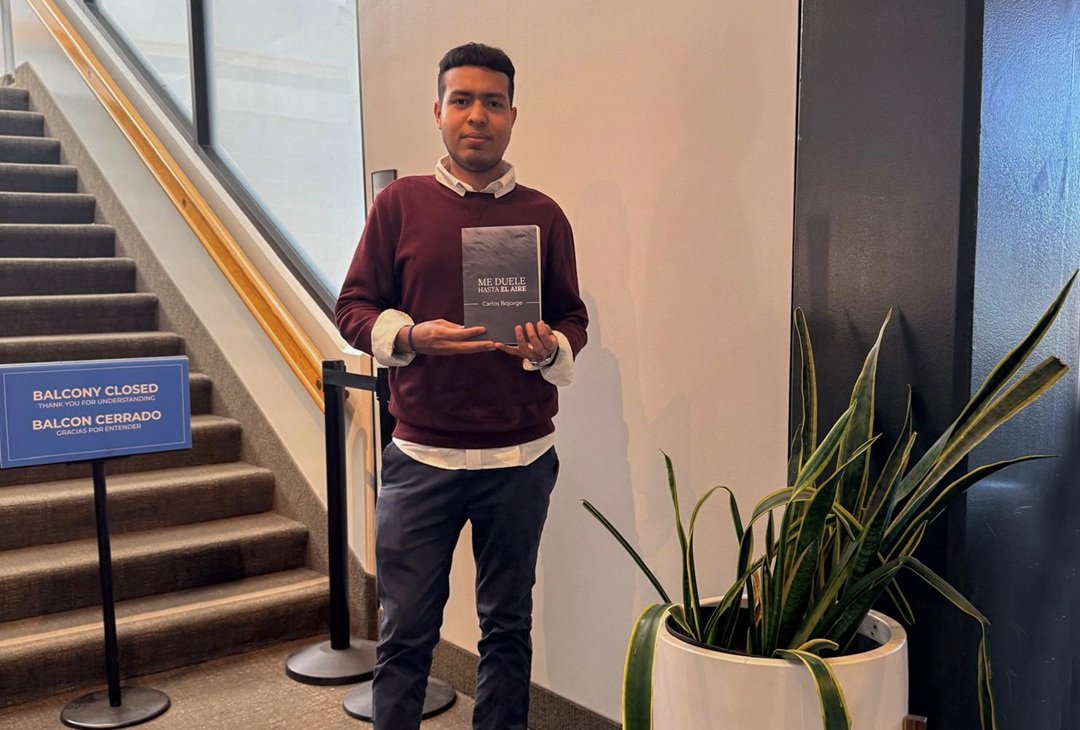
Carlos Alberto Bojorge Martínez, 24 years old, was born and raised in the La Esperanza neighborhood in Managua. There he dedicated most of his time to church and religious missions in the countryside, always carrying with him a notebook with poems that almost no one read. Today, more than 5,600 kilometers from his hometown, in exile in California, United States, he has published his first book of verses titled Even the air hurts me.
The young poet is part of the group of 135 Nicaraguan political prisoners who was banished to Guatemala by the dictatorship of Daniel Ortega and Rosario Murillo, on September 5, 2024. That day he was forced to board a plane without knowing where he was going, without a suitcase and without a goodbye hug from his mother.
He remembers—as if it were yesterday—the feelings of “anger, pain, all the emotions” he felt when the charge d’affaires of the United States embassy in Managua, Kevin O’Reilly, arrived where the political prisoners were being held to announce that they had two options: “board a flight to Guatemala or stay (in Nicaragu) under the conditions of the dictatorship.”
“Making that decision for me was very difficult, I experienced at that moment a feeling of betrayal, I asked myself, at that moment, why do I have to leave? Why should I leave my country?”, recalls the poet.
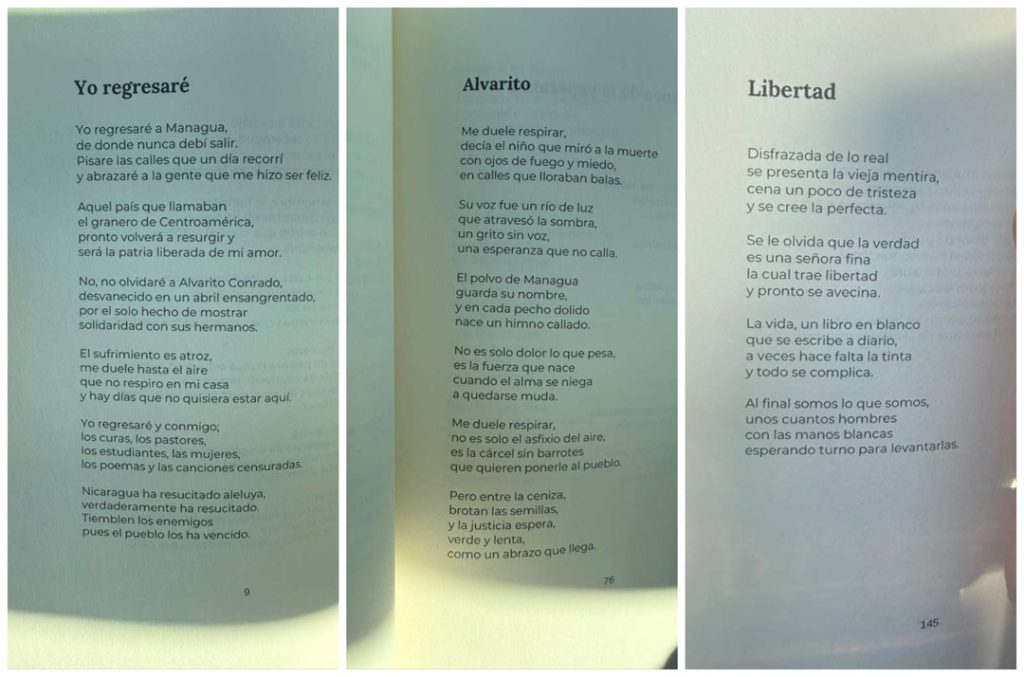
Upon arrival exiled to Guatemala The first thing he did was write a poem that he memorized, as he did when he was imprisoned without access to books or writing materials. That poem, located on page nine of the book, is called I will return, It is the one that gives the book its title and the one that, he assures, cost him the most to write.
—Even the air that I don’t breathe in my house hurts me,
and there are days that I wouldn’t want to be here.
The book, available on Amazon from February 2026brings together poems that Bojorge wrote at different stages of his life: from the years he visited rural communities as a missionary, to the months he spent in prison and his exile, now in the United States.
Inspired by Monsignor Romero
Bojorge says that the idea of condensing his poems into a book came to him in December 2023, during a trip to El Salvador. On that occasion he visited the Metropolitan Cathedral of San Salvador, where the remains of Saint Óscar Arnulfo Romero rest, the Salvadoran archbishop assassinated in 1980 and canonized in 2018.
“Being in the cathedral, in that basement, praying on my knees in that mausoleum, and feeling the presence of Monsignor Romero, a voice that prophesied freedom in his country. I could feel Romero’s presence, saying that I could do something too,” said the Nicaraguan.
The book includes all the poetry that Bojorge had accumulated over the years, published in fragments on Facebook, or shared with a small circle of friends. 90% is made up of poems written before his imprisonment. Because he did not want to make the book a chronicle of prison. That episode in his life still weighs heavily on him.
“For me, going to prison represents a traumatic episode in my life, and many times, I try not to bring it back here (the present). It was something that affected me a lot,” confesses the young poet.
The collection of poems is divided into five sections: a country we left behind, communion, what confinement left me, I promised to love you and the promise is not yet broken, and I thirst for sincerity.
The first section is dominated by poems written in exile, including the one that gives its name to the book. The second section is dedicated to the Catholic Church and the ecclesial community. In the third section he brings together the last poems he wrote before being imprisoned. Only one poem in the book originated inside the prison. It is titled “Freedom” and it’s on page 145.
Poetry as a trench in confinement
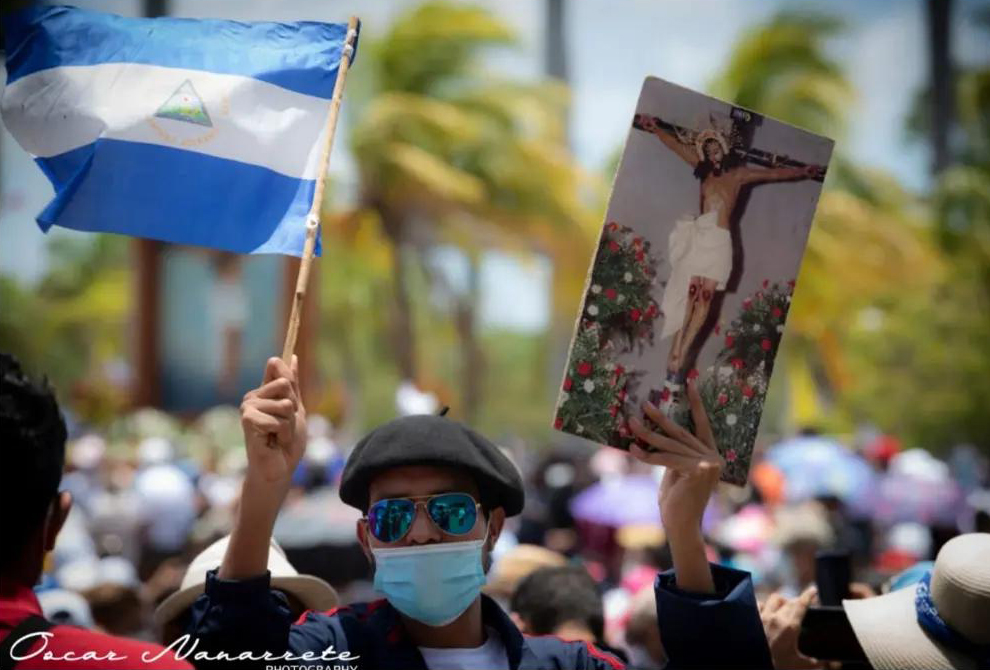
Carlos Bojorge was arrested on January 1, 2024 when he was leaving the Managua cathedral, after participating in the procession of Jesús Sacramentado. He was detained without any arrest warrant by police officers and transferred to “La Modelo” prison, where he remained for nine months.
In prison, the prisoners organized “afternoon gatherings” from their cells, where Bojorge recited his own poems and those of Eduardo Galeano, Mario Benedetti, Pablo Neruda and Ernesto Cardenal. In that place, in a cell next to his, he met the sociologist and academic Freddy Quezadawho wrote the prologue to the collection of poems.
“Even the air hurts meis a collection of poems structured in layers that range from his most mature poems, for an age in full flight, to the first ones, scared and with their eyes open to the world of words that shake their hair, like adults do with unknown children. Layers, like a train of old war movies, whose cars carry poems of prison confinements, nostalgia for the country, of faith, reflection, of struggles, cosmic and youthful loves,” Quezada wrote.
Carlos Bojorge’s exile in the United States
Months after his exile to Guatemala, Bojorge moved to California, United States. He currently works in a fast food franchise, studies English and on his free days reads and writes poetry. He notes that he has written about 50 new poems that he hopes to publish in a second collection of poems.
But life in exile entails a series of uncertainties that are also reflected in his verses. He states that he cannot travel freely because he was stripped of his Nicaraguan nationality and although he has received invitations to participate in Church meetings in Argentina and El Salvador, he cannot accept.
“I continue to denounce the abuse and human rights violations that were committed against me. Expelling me from the country through a back door, that should not be like that,” he reflected.
Poetry is Bojorge’s instrument of denunciation, who warns that “poetry is manifesting, denouncing, it is writing what one feels.”
The presentation of Carlos Bojorge’s collection of poems will take place on May 23, 2026, at 2:00 pm, at the Hayward Public Library, in California.