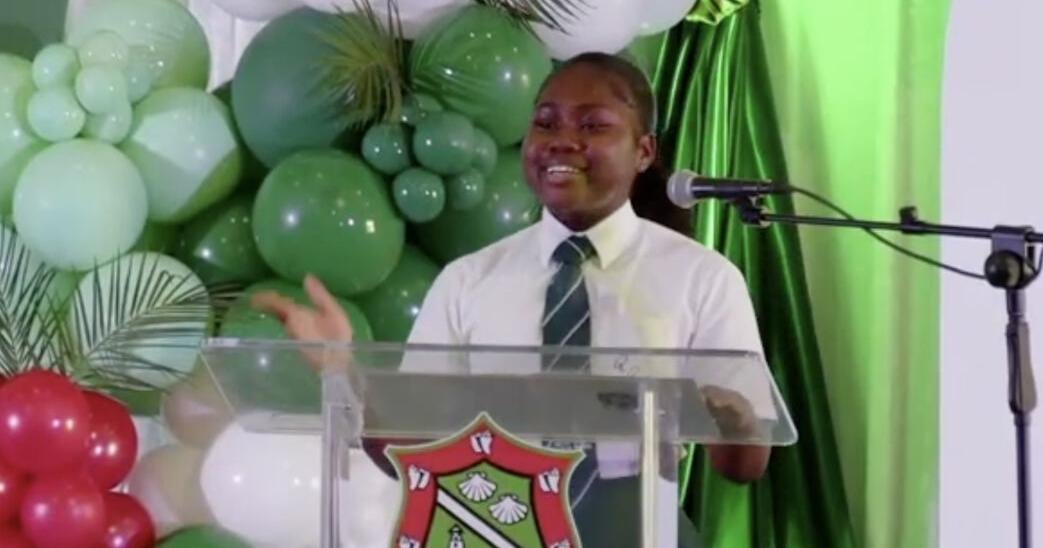
Queen’s College valedictorian, Roanna Saintil, was poignant even as she urged her peers to continue to blaze new trails and build brighter futures, as she addressed the Class of 2026. She said for a class that started out their high school years online, that they prevailed in the face of adversity. Roanna described her class as a “mosaic” of accomplished individuals.
Roanna said high school had been filled with endless crossroads — budding friendships, opportunities for success, and setting themselves apart and charting their own courses as they grew into their unique identities. Graduation, she said, celebrated the path that brought them to their final day — the choices they made, lessons they learned, and opportunities ahead.
“When I reflect upon how far we’ve all come, the poem ‘The Road Not Taken’ by Robert Frost comes to mind. For those who have not read it, it encapsulates the pivotal nature of the choices we make in life — seemingly trivial in the moment, but having a profound impact in the future. Personally, I associate it with the solitary journey we all must take, consequential to choosing individuality in the name of self-improvement and success. It reminds me that although two paths may appear to reap identical outcomes early on, sometimes, being an independent individual and choosing the one less traveled may make all the difference in your life.”
Roanna graduated with a 4.14 grade point average (GPA) and plans to study computer science at the University of Central Florida. She took AP subjects — biology, calculus AB, drawing, French, literature and composition, psychology, and world history — and earned 10 Bahamas General Certificate of Education (BGCSE) exams with A grades.
During her commencement address, Roanna reminded her peers of entering seventh grade and spoke to having been “cast adrift in the sea of various Zoom and dual classroom profiles.”
She spoke to the fact that she had always been a high achiever, from her primary years, but said upon her entry into Queen’s College that it all seemed insignificant as she found herself surrounded by outstanding individuals who rivaled or even transcended her capabilities.
“Talk about a reality check! It was then that I faced my first two diverged roads — a transitory period that would decide my fate in high school, although I did not yet know it. What was left for me in a world where excellence was not something guaranteed, but rather a habit that would require conscious effort and painful sacrifices to develop.”
She said she could have chosen to resign and blend into the background but learned of herself that that was not her style.
“Admittedly, I was just a naïve 11-year-old, with lackluster foresight, so it’s not as though I made the correct decision instantaneously.”
Roanna said she struggled with many misguided decisions, including having procrastinated to the point of leaving all her studying for the social studies Bahamas Junior Certificate (BJC) exam to just three days. The A grade she got, she said, was nothing short of a miracle. She admitted she sometimes made the correct decision but struggled with the burden of seeing it through, like when she sat 10 Bahamas General Certificate of Secondary Education (BGCESE) exams in Grade 11.
Both of those experiences, she said, were crucial learning moments in her life.
“Though poor judgments may have been made in picking these paths, or the road to following them, [but] I learned from my mistakes each time and allowed them to mold my character and elevate my personal growth. In the words of [former United States president] Barack Obama: ‘You cannot let your failures define you. You have to let your failures teach you.’”
Of all the lessons she learned, she said the most important one, which she only grasped as a senior, was the importance of community and mutual support during the critical junctures.
Roanna told her peers that the thing about the road less traveled is that you are never alone on it.
“We all face our own pivotal decisions, albeit at different junctures, disguised as choices as inconsequential as two paths to tread. So why choose the one sure to bring you hardship in the future, filled with uncertainty and the chance for failure? The truth of the matter is a chance for failure is also a possibility for success. Choices may orchestrate our lives, but our outlook defines their impact. However, these opportunities can only be seized as long as we accept the gravity of our decisions, which cannot be revoked and are prepared to do what has not been done before.”
She reminded her peers that they were unified by their time spent at the institution during their commencement on Friday, June 12, in The Geoffrey Brown Auditorium at Queen’s College, Village Road. It was held under the theme, “Forward Together.”
“Of course, I did not know all of this in seventh grade. All I had was a feeling that someday I would be able to tell the tale of the dreams I’ve realized and those I’ve yet to encounter.”
That one small choice to set herself apart early on, she said, would have the power to transform her life for the better.
“What will you do the next time you encounter a crossroads?” she asked her peers. “Will you take the path of least resistance, for which we are most inclined? Or the path to improvement that you risk walking alone?”
Kaylee Fernander, who plans to study psychology at the University of The Bahamas (UB) was named salutatorian. She graduated with a 4.12 GPA and took AP subjects — biology, human geography, literature and composition, precalculus, psychology, and Spanish.
Dr. Kristine Parker-Curling, a Queen’s College alumna, in her address to the graduates, said the journey through Queen’s College is not an easy one, and one she said is certainly not one for the faint of heart or the easily flustered. The rigor of an academic career at QC, she said, starts early and remains intense.
But she told them their QC education gifted them with grit, comradery, and faith.
“Grit is the ability to push through the difficult moments, to persist in the face of discomfort and persevere in the midst of sacrifice,” said Parker-Curling, an internist, endocrinologist, and obesity medicine specialist, who is also a lecturer at The University of the West Indies School of Clinical Medicine and Research, Bahamas. “It produces strength and the ability to rise against odds. This will serve you well.”
As they move forward in life, she encouraged them to do so, but to remember to check on their friends, with the understanding that they are stronger together than alone.
“You were privileged to come of age in an environment that equipped you not only with academic tools, but also nurtured your spirit and provided you with grounding and the confidence that your life has purpose and that God is present in every season. These three things (grit, comradery, and faith) will take you further than you might presently imagine.”
As they launched into a rapidly changing world that is being transformed by technology, unprecedented access to information, social media, and artificial intelligence, she said as the world evolves, they should evolve with it but not lose their human touch.
“Welcome technological advancement. Embrace innovation and appropriately use the tools available to you. But remember that our humanity is what separates us from machines,” said Parker-Curling, the author of the book “Beyond The Knowledge: Power Steps for Doctoring with a Human Touch,” which explores the importance of preserving compassion, communication, and the human touch amidst the growing pressures of clinical practice, efficiency demands, and the increasing integration of technology and artificial intelligence into healthcare.
“Information will become more accessible, technology more powerful, and artificial intelligence more capable. Yet the ability to make another person feel seen, heard, valued, and understood remains one of the most powerful gifts that you possess,” she told the students.
Parker-Curling encouraged the graduates as they move on to the next stage of their lives to remember their God, who created them with unique gifts, talents, greatness, calling, and a unique purpose.
“Don’t be overly concerned about where you are standing now. Many of you have done extremely well and will continue to do so. I graduated with no awards and no trophies, but what I left with was a foundation that prepared me to grow, to excel, and to stand among the best of the best … in due time,” said the doctor. “Many of the greatest chapters of your life have not yet been written. You are still becoming. You have a solid foundation, and from that solid foundation, extraordinary things can grow. So be bold, be courageous, be brave,” said Parker-Curling.