Loading Text-to-Speech…
For two television seasons, Sterna has been more than just the setting for one series. It was a second place for thousands of viewers, a place they returned to every day to meet familiar faces, share their anxieties and watch stories of love, betrayal, loyalty and redemption unfold before them.
The curtain falls for good tonight on “Holy Love”, Alpha’s popular series which was a huge hit with high ratings and created a solid relationship with its audience, who followed it to the end. And with the series, we say goodbye to an entire world and the people who made it seem real.

“Love doesn’t come to save you”
At the core of this story was father Nikolaos, a character who from the first moment provoked discussions and raised difficult questions about people’s choices, conflicts and limits.
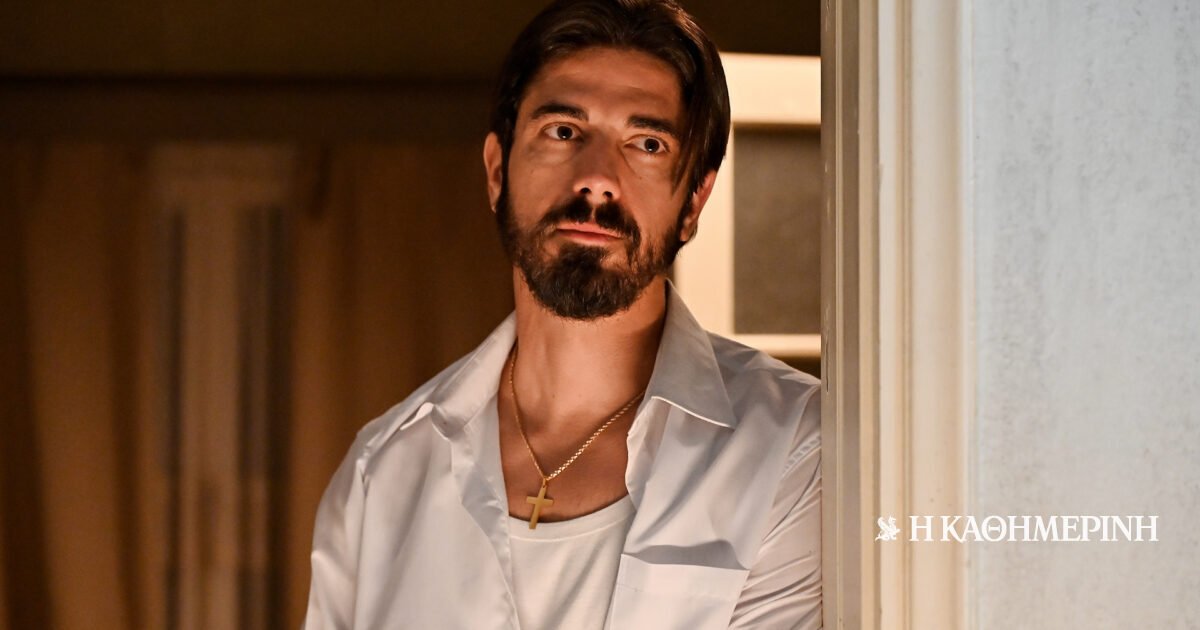
He was one of the characters that determined the course of the series. For him Dimitris Gotsopouloshowever, the essence of the role was not only in its external quality, but in something deeper. “To play Father Nikolaos, I discussed with the production and the screenwriter. I said from the beginning that I am not interested in a love story of a priest with a girl. I was interested in man’s struggle to stand in the world with dignity and close to his truth”, he says exclusively to Screen.
This approach determined how the actor treated his hero until the end. As he explains, the cassock was not a simple external feature for him, but a symbol of a deeper search.
“I wanted to see how I, a young priest, would find as clearly as possible this power, this light of a man standing – whether he is a priest or a carpenter or a policeman – and claiming a personal truth and a code of values in a world where everything is being destroyed, where injustice reigns.”
Perhaps the most characteristic image of this process was the first scene of the series. “I enter the church covered in blood, I curse God and at the same time I ask for forgiveness, in the blood. This is how “Holy Love” began in the first episode. And I didn’t know where this would end,” as her protagonist confesses.
Speaking about the end of this journey, Dimitris Gotsopoulos stands in a thought that summarizes what father Nikolaos sought: “Love does not come to save you in the end. He comes to show you who you really are. What should you leave behind?’
The element of revenge
Against this inner search stood Sofia Markopoulou, a character who moved into a different, darker area, with choices that tested her limits. “In front of the camera, the scenes that were most intense for Sofia were the ones where she really went through very difficult circumstances and pushed herself to her limits. Like the scene that threw Anastasia from the balcony or the scenes in the psychiatric clinic, when she didn’t know why she was there,” notes Freedom Againwho embodied Sophia.
Her relationship with Sofia changed as the series progressed, as the actress discovered new aspects of her character. “As those two years went by, I grew to love the character more and more, because I realized that he’s a lot more complicated than he first appeared. I started showing her more compassion and loving the way she thinks, even if it’s twisted.”
It was these contrasts that kept the series alive until the end. As Eleftheria Pallas says, “the element of revenge, which existed in all the characters and especially in father Nikolaos, but also in Markopoulos, is something that kept the spark of the series very strong for two years”.

“Tomorrow is a new day”
Behind the heroes, however, there were the people who for two years gave Sterna life every day. THE John Englishwho played the doctor Haris Varelas, keeps as his most characteristic memory a night of filming that for him summarizes everyone’s effort. “On the scene, I buried the general, Vlasis. The shoot was outside, the crew was in overdrive and the scene was very demanding. For me, that moment was the most intense and perhaps the most characteristic of the dedication, fatigue and effort we put into this series. There were, of course, many other moments as well…” emphasizes the actor.
For him, the end of “Holy Love” closes a demanding cycle of two years. As he says, the most important lesson was endurance: “An almost daily series has too many scenes, too many shooting days, too difficult and demanding conditions. You must always remember that tomorrow is a new day.”
At the end of this cycle, Dimitris Gotsopoulos keeps a sense of gratitude for what this collaboration left him. “I am extremely pleased with the result. I’m not saying there weren’t scenes or things I wish we had the luxury of an international production for; and that has to do with the shooting time as well. But overall I have to tell you that I feel both justified, and worthy, and proud; individually as well as collectively. And a great gratitude.”