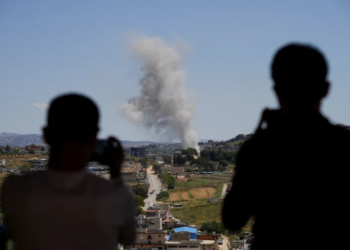
From the window of the bus you can see a truck burning brightly. It is not the only hit caused by Ukrainian combat drones. Several burned-out wrecks stand on the side of a highway in Russian-occupied southern Ukraine.
The land corridor between Russia and Crimea is the central logistics route for the Russian army to supply its military on the southern front. The roads in the area, which is bordered by the Azov and Black Seas to the south, were long considered safe.
But since spring, Ukrainian combat drones have increasingly targeted the land connection. “The Ukrainian armed forces are bringing the strip of land from the front to the sea, i.e. the entire occupied hinterland, under their fire control,” confirmed Ukrainian military analyst Olexander Kovalenko in an interview with the “Presse”. Russian logistics in the area are exposed to attacks from medium-range drones. The Ukrainian Defense Minister, Mykhailo Fedorov, spoke of a “logistics shutdown” in this context. The campaign thus illustrates Ukraine’s current superiority in drone warfare.
The transport corridor is important for Russia. The majority of military supplies for the Southern Front pass through this route. The railway connection has also been expanded since the territory was occupied as a result of the major Russian attack in February 2022. The route is also important because the Crimean Bridge, opened by Vladimir Putin as a prestige object in 2018, became problematic for heavy transport soon after the start of the war. Ukraine has repeatedly attacked the Crimean Bridge since October 2022.
But the land corridor through southern Ukraine, with which Putin wanted to consolidate his control over Crimea, is now no longer secure. The more than 360 kilometer long M14 highway, which leads from Russia via Mariupol, Melitopol and Chonhar to Crimea, as well as other connecting roads, are now in the sights of Ukrainian drones.

Ukrainian drone attacks on the M14 highway.
There are different reports about the number of blows. BBC Verify counted at least 14 vans hit in one week at the end of May. Data analyst Clement Molin has verified more than 290 attacks on Russian cars and trucks since the beginning of May. Burnt-out trucks, tankers and military jeeps can be seen in numerous photos and amateur videos.
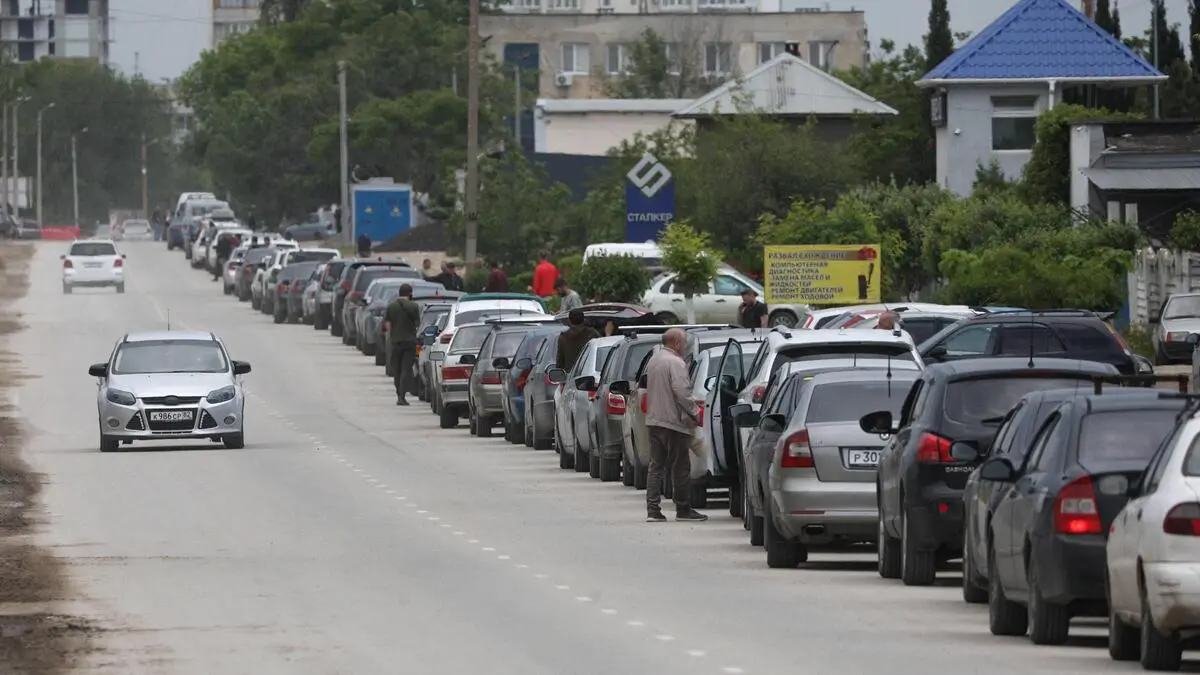
The campaign also has consequences for civilians. Fuel has to be rationed in Crimea and there are long queues at gas stations. In some supermarkets, food is rationed to prevent panic buying. There are many cancellations in the tourism sector. The ferry connection to Crimea, which was supposed to be a thing of the past after the bridge was built, is now considered the safest way to the peninsula.
Ukrainian drones are also attacking the two access roads to Crimea. On Tuesday night, the bridge near Tschonhar was so badly damaged for the second time that car traffic temporarily had to switch to the other feeder road near Armyansk. This significantly lengthens the journey and makes Russian transports vulnerable to further drone flights. In the future, Crimea’s connection to the mainland is to be “cut” in order to make alternative supply routes across the peninsula impossible.
On Wednesday night, Ukraine attacked a well-known museum in the city of Sevastopol that contained a panoramic picture of the historic Crimean War. It is said to have been completely destroyed. Train traffic also had to be further restricted.
The so-called “Crimea blockade” is made possible by the increased use of Ukrainian medium-range drones, whose range is up to 200 kilometers. Various combat drones are used, such as the Ukrainian products FP-1 and FP2, as well as the new AI-supported kamikaze drone Hornet, which can control targets autonomously. Hornet can hardly be intercepted by the Russians at the moment. With the help of high-flying tethered balloons, called aerostats, drones could be “delivered” to even more distant areas in the future, explains military expert Kowalenko. “I think we will hear about our drones attacking targets on the Crimean Bridge.” The attacks on the land corridor are “just the beginning”.
Kowalenko describes the scenario that the Ukrainians are aiming for as follows: Russian offensives along the entire southern front should be made impossible – “and in the long term also the defense of the region”. So it’s about “starving” the Russian presence in southern Ukraine. The Ukrainian drone pilots would not only have their sights set on supplies (“gasoline, soldiers, water”), but would also take action against military electricity and communications infrastructure in the occupied territory. “These facilities are also being attacked quite successfully,” said Kovalenko, who is a member of the Ukrainian Information Resistance Group. “It’s just not talked about as much.”
The complete “isolation of Crimea,” as Kowalenko says, still seems to be a long way off. There are many loopholes for the Russians in this region. The Ukrainian military, which also has to contend with constant Russian attacks on its logistics, has learned to deal with this quite successfully.
Nevertheless, Kovalenko believes that the Russian military presence in the southwestern region of Kherson will come under increasing pressure next, as supplies there are particularly difficult. Military bloggers reported this week on the withdrawal of Russian units from the remote Kinburn Spit in the Dnipro estuary. The news is still unconfirmed. But it would fit with current developments.