When it comes to ancient civilizations, most people think of them as societies with simple weapons and limited knowledge. But if you look deeper into history, you can see that even thousands of years ago, people found amazingly advanced solutions to complex problems. Below are eight technologies that were way ahead of their time.
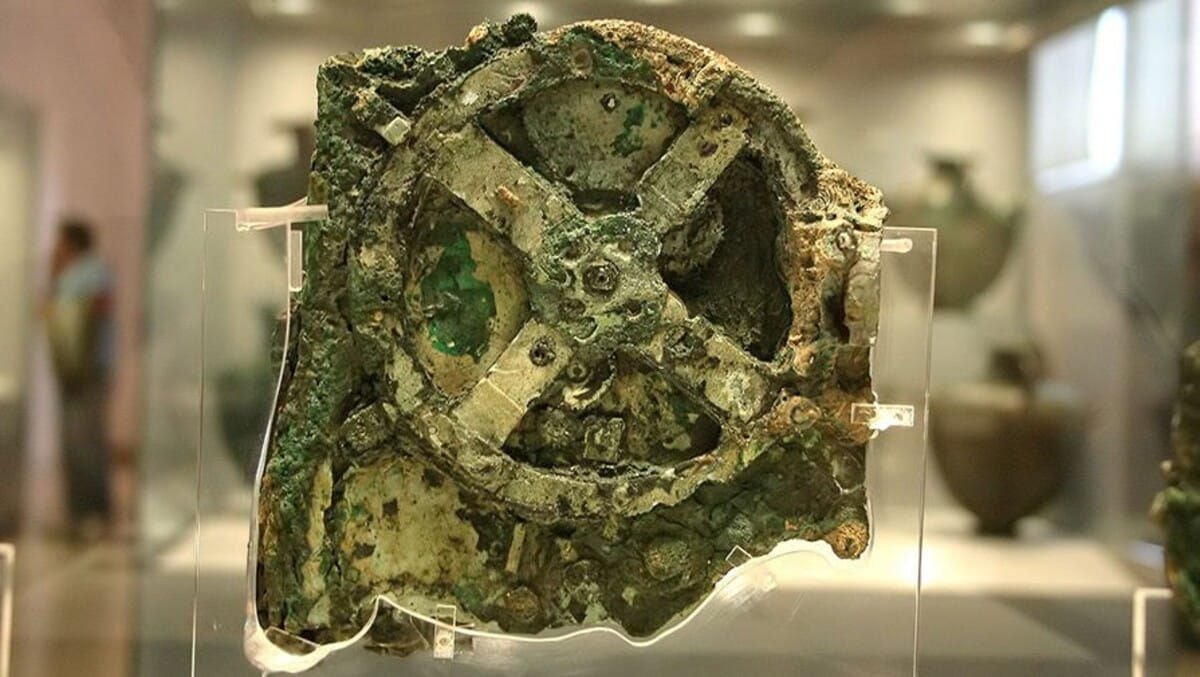
1. The Antikythera mechanism is the first analog computer in history
Ancient Greek Antikythera Mechanism as the first analog computer in human history is evaluated.
It was found among the remains of a sunken ship off the coast of Greece and has a history of about two thousand years.
Using a complex system of bronze gears, this device made it possible to time solar and lunar eclipses, track the movements of the planets, determine the phases of the moon, and even set the dates of ancient sports competitions.
According to experts, devices with this level of mechanical accuracy appeared only after more than a thousand years.
2. Roman concrete is a self-healing building material
Many buildings and structures of ancient Rome have been preserved for two thousand years.
One of the main reasons for this is the concrete technology developed by the Romans.
Modern studies show that special lime particles in this concrete react with water and have the ability to fill cracks by themselves.
Scientists are studying this technology and trying to create long-lasting and environmentally friendly building materials.
3. The water system of the city of Petra
The ancient Nabateans managed to turn the city of Petra, located in the middle of the desert, into a developed trading center.
It was based on a unique engineering system of water collection and distribution.
The Nabateans built an extensive network of canals, pipes, reservoirs, dams, and tunnels. The system allowed to collect rainwater, prevent floods and provide water to the population.
Some researchers claim that they may have even mastered the technology of transporting water under high pressure.
4. Greek fire is a lost military secret
The “Greek fire” used by the Byzantine Empire was one of the most feared weapons of the Middle Ages.
According to sources, this flammable mixture continued to burn even on water and gave a great advantage in sea battles.
Its exact composition is still a mystery. Historians believe that the mixture contained petroleum products, but the formula was so closely guarded that it was completely lost over time.
5. Viking “sun stones”
Long before the advent of modern navigation tools, the Vikings sailed long distances across the oceans.
Some scientists believe that the reason for this was special crystals – “sun stones”.
For example, minerals such as Icelandic spar polarized sunlight, allowing us to determine the location of the Sun even when the weather was cloudy or foggy.
This technology may have enabled the Vikings to successfully travel across the North Atlantic Ocean.
6. The famous Wuts steel of India
Woods steel was produced in India as early as the first millennium BC.
It is known for its strength, flexibility and long-lasting sharpness.
This metal was exported to the countries of the Middle East and Asia and later served as the basis for the legendary Damascus swords.
7. Ancient Chinese seismoscope
Around 132 AD, Chinese scientist Zhang Heng created the world’s first earthquake detector.
This bronze tool indicated the direction of the source of earthquakes.
When an earthquake occurs, the mechanism inside the device is activated, and one of the special balls separates and indicates the direction of the tremor.
This device is significant because it was created nearly 1,900 years before the advent of modern seismology.
8. Damascus steel
Damascus swords are one of the most famous weapons in history.
The wavy patterns on their surface not only gave a beautiful appearance, but also indicated the high quality of the metal.
Sources mention that these swords retain their sharpness for a long time and are strong and flexible at the same time.
Modern research suggests that these features are the result of sophisticated forging methods and the use of high-carbon steel.
Although scientists have managed to recreate some aspects of this technology, all its secrets have not yet been fully revealed.
The legacy of ancient civilizations shows that human intelligence and engineering are not limited by time. Some technologies created thousands of years ago serve as a source of inspiration even for today’s scientists.