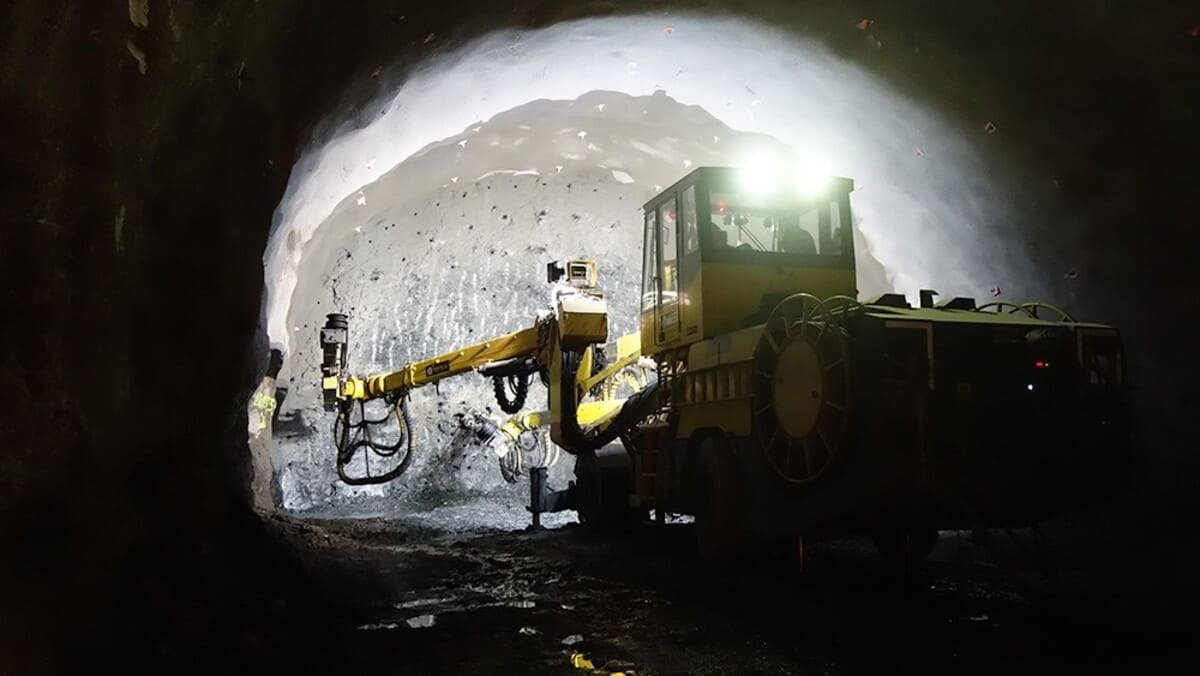
Norway is implementing the Rogfast project, the world’s longest and deepest underwater car tunnel, off the west coast. The 27-kilometer-long structure, when completed, will drop nearly 390 meters below sea level and is expected to revolutionize the country’s transportation system.
The Rogfast tunnel passes under the large Bokna-ford in western Norway. Experts say that between the deepest part of the tunnel and the surface of the water, even the famous skyscraper Empire State Building in New York can be placed.
The project is notable not only for its huge scale, but also for its engineering complexity. Norwegian fords are deep valleys formed by glaciers, which make the construction of roads very difficult.
The problem is that the fords are not only wide, but also very deep. In some places, their bottom falls below the height of the surrounding mountains. Therefore, instead of building a simple bridge or highway along the coast, engineers decided to build an underwater tunnel.
One of the most complex parts of the project is the multi-level transport hub being built under the island of Kvitsey in the middle of the route. Located at a depth of about 200 meters, this intersection will be a large engineering structure, spreading in four directions.
Project manager Anne-Mérète Guille said the engineers chose to run the tunnel along the submarine heights rather than through the deepest part of the ford. This made it possible to reduce the construction depth.
Nevertheless, some points of the tunnel go down to about 400 meters below sea level. This is several times deeper than most underwater tunnels in the world.
Geology has become the main test of construction
Experts say that the biggest challenge in the project is not the depth, but the complex structure of the rocks.
The tunnel passes through different rock layers. In some places, solid layers of phyllite are found, while in other areas there are gneiss rocks with water-filled cracks.
At depths of more than 330 meters, the water pressure reaches 33 bar. This is about ten times higher than the pressure in a normal water supply system.
According to project geologist Anne-Brit Moen, 5-6 thousand liters of water per minute was recorded recently during the construction of the tunnel.
“If there is an open crack in the rock, water will burst into the tunnel with great pressure,” says the expert.
A unique Norwegian construction method
Many modern megaprojects use huge tunnel boring machines. However, a different approach was taken in the construction of Rogfast.
Experts are using drilling and blasting technology called “Norwegian tunneling method”. Although this method is slower, it is more effective in complex geological conditions.
First, dozens of wells are opened in the bedrock using a special Jumbo drilling rig. Engineers then assess the stability of the rocks and check for the risk of water intrusion.
After that, a special microcement mixture is injected into the cracks under high pressure to form a waterproof protective layer. In some cases, up to 75 tons of cement mixture is used for one operation.
At the next stage, explosives are placed in the wells and controlled blasting is carried out. Each blast allows the construction to advance approximately 5 meters.
After blasting, the rock is removed, the walls are reinforced with waterproofing materials and special concrete. Each of the 60,000 concrete panels to be installed in the tunnel is individually designed.
The project is expected to be completed in 2033
Experts say that there is no rush in the construction of Rogfast. Each newly discovered layer is re-examined by geologists and further work is planned accordingly.
When the project is fully completed, transport links on the west coast of Norway will be significantly improved, travel times will be reduced and the need for ferries across the fords will be reduced.
Construction work is planned to be completed in 2033. After that, Rogfast is expected to go down in history as the longest and deepest underwater car tunnel in the world.