Experts see no buffer in the government’s double budget and are missing structural reforms.

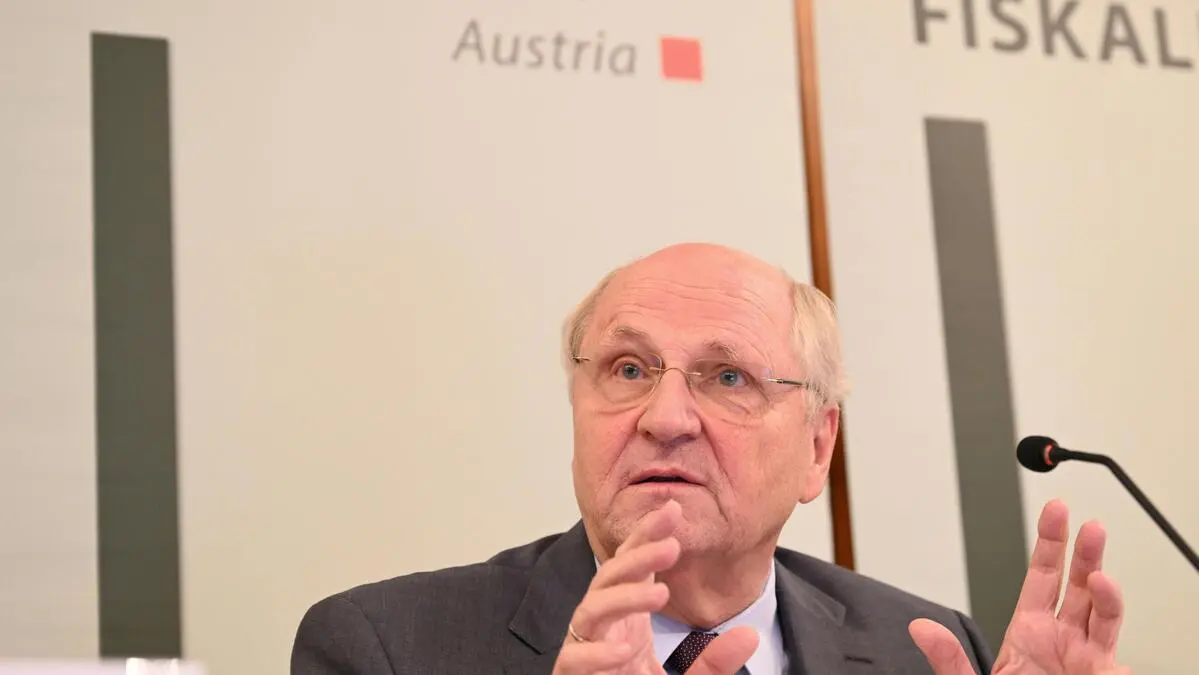
Fiscal Council President Christoph Badelt APA / APA / Helmut Fohringer
From the experts’ unanimous point of view, the consolidation in the double budget is “sewn on edge”, which makes it likely that an improvement will be made next year. “That simply won’t be enough,” said the head of the fiscal council Christoph Badelt. The necessary short-term consolidation measures must be followed by long overdue structural reforms in order to put the budget on a solid basis in the long term, demand WIFO economists Margit Schratzenstaller and IHS-Boss Holger Bonin.
The experts from the economic research institutes WIFO and IHS are positive about the fact that the government has brought together a double budget and thus creates planning security for the next two years. Fiscal Council President Christoph Badelt also pays respect to the government, as a coalition of very different parties that put together a budget with a lot of effort, for this “remarkable achievement”. However, he and the IHS boss believe that this will not be enough to achieve the budget target of 3 percent by 2028.
According to IHS calculations, the budget deficit in 2028 will be 3.2 or 3.3 percent under current conditions GDP and therefore above the permitted three percent limit. In addition, there is uncertainty regarding geopolitical crises and possible higher deficits in countries, warns Bonin. The Fiscal Council, which, however, does not take into account numerous measures announced by the government due to a lack of specification, continues to assume a deficit of around 3.8 percent in 2028, which would mean an extension of the EU-deficit procedure would mean.
The budget expert at WIFO also sees no buffer in the double budget if geopolitical developments and thus economic developments turn out to be less favorable than assumed when the budget was drawn up. Therefore, it cannot be ruled out that improvements will have to be made next year. In this case, Schratzenstaller believes that states and municipalities should also contribute.
According to the expert, the consolidation of 5 billion euros by 2028 will be financed 70 percent by income measures and 30 percent by expenditure. On the one hand, this is understandable because the expenses that could easily be saved have already been harvested in the last double budget for 2025/26 and the reduction in non-wage labor costs is being counter-financed by additional income. On the other hand, in the opinion of both experts, the spending dynamics will not be contained enough in the medium term, especially in the demographic-dependent areas. This requires structural reforms – in the support system, in federalism, in the healthcare system, in the education system and in the pension system.
Although Schratzenstaller sees the first steps towards these structural reforms – for example within the framework of the reform partnership or the work of the funding task force – “but much more needs to happen here and, above all, action must be taken quickly.” Bonin also sees some things that have been addressed structurally in order to avoid mismanagement, such as the reform of unemployment insurance and the attempt to pay out family benefits more efficiently, but the share of structural reform measures is not dominant. The head of the Fiscal Council, on the other hand, only finds one structural change in the budget, namely the fact that the labor factor will be relieved by reducing non-wage labor costs by one percent. Badelt criticizes that because there is no structural change in the spending structure, the creation of subsequent budgets will not be easier, but rather more difficult.
The economists are positive about the focus on offensive funds for education and the labor market, but the IHS boss is critical of the reduction in non-wage labor costs. The very expensive measure is spread very broadly according to the watering can principle, instead of relying on specifically invigorating measures, says Bonin. Conversely, the savings are made using the “lawn mower method with different cutting heights”, which is why many groups are affected, says Schratzenstaller, but that is not necessarily a bad thing. However, how the burden is distributed among the individual groups requires more in-depth analysis.
The expert sees “the long overdue increase in the women’s budget” by almost 50 percent as positive. On the other hand, she is critical of the cuts in the ÖBB framework plan and the fact that development cooperation (EZA) remains significantly underfunded. She also misses “more energetic steps to green the budget”. The planned reduction of environmentally harmful subsidies amounting to 190 million euros for 2028 is rather limited in relation to the total amount of environmentally harmful subsidies and has not yet been specified. In addition, the reintroduction of agricultural diesel would add another climate-damaging subsidy, while the offensive measures would lack climate investments. (APA)