Loading Text-to-Speech…
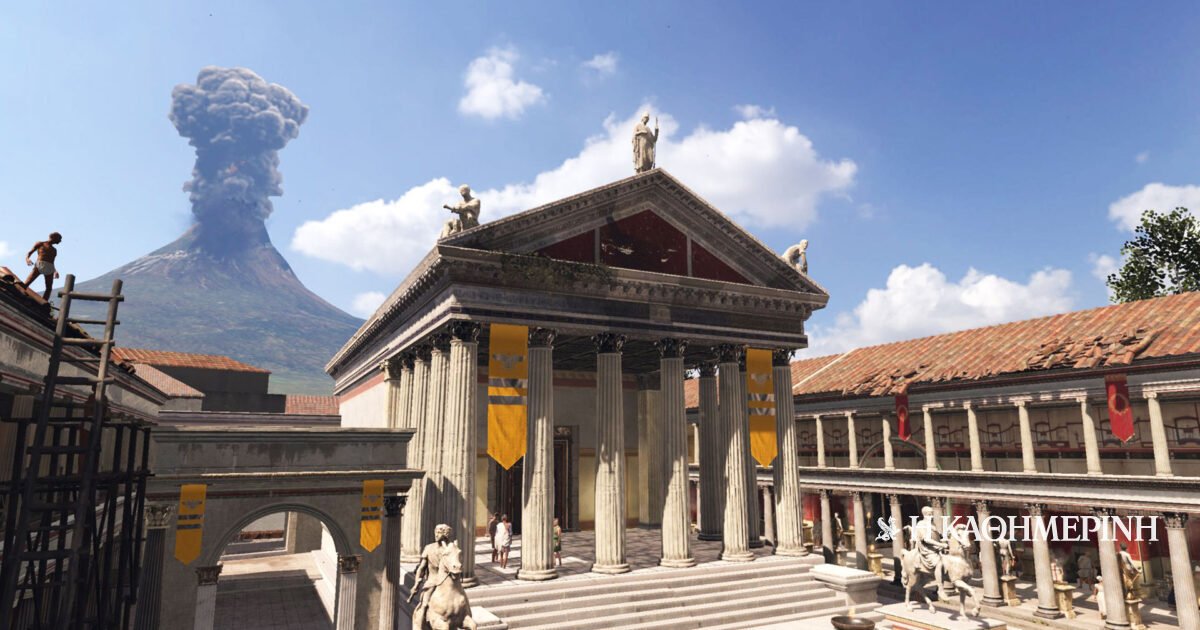
It sounds impressive, it sounds curious, maybe even a little special. THE archaeological site of Pompeii now offers visitors the opportunity to explore the ancient city exactly as it was in AD 79 with the help of a augmented reality application (Augmented Reality – AR) which is called Portyl. The audience will be able to e.g. to browse, through mobile phones and tablets, the House of the Guitarist, which was digitally restored with high scientific accuracy. Users of the app – designed by History Inc. and utilizes the latest developments in photogrammetry and artificial intelligence – they will also be able to watch duels or theater performances, tour the city’s Agora in the company of ancient Romans, and more. And since we are talking about AD 79, they will be able – if they want – to “live” it eruption of Vesuvius.
Closer
“All this is very impressive. What technology offers to the visitor is now truly admirable. Such innovations bring the public closer to archaeological sites and monuments, in an experiential way. That makes the difference: that the images come to life in front of us, we see them, we don’t imagine them.” says Angeliki Maragakidirector of cultural productions, sales and promotion of the Organization for the Management and Development of Cultural Resources (ODAP) of the Ministry of Culture. ODAP offers through the platform hh.gr AR and VR (Virtual Reality) applications for various archaeological sites in Greece. It is also something of a trend, internationally. “There are a large number of such applications, as everything is now done with the mobile phone, especially in the daily life of young people,” says Ms. Maragaki.


For example, AR and VR applications offer the Borghese Gallery in Rome, Ancient Pergamon in Turkey, the Kardutum archaeological park in Austria and, of course, museums such as the Louvre, the British Museum, the Metropolitan Museum of New York, the Smithsonian etc. “The trend is there, but there is also a marketing, behind which many digital technology companies are. They approach curators of monuments and museums and propose solutions to present their information in a more imaginative, more interesting way,” observes Pantelis Fellerisan architect and museologist who often uses technology in the exhibitions he designs. “Visitors themselves are looking for a new approach to knowledge, not only through a text or the image of a damaged monument”, he notes and adds that this way new categories of audience are attracted. “Like teenagers, who in the presentation of a monument now encounter the logic they have on their cell phones and in video games,” says the architect. “And while the eruption of Vesuvius has been depicted on film, it is different to be in the real place, to walk the streets of Pompeii and see the citizens feeling – and with them, such an event.”
Such applications are necessary because they replace old forms of supervisory material, says Dimitris Athanasoulis, head of the Ephorate of Antiquities of Cyclades.
Of course, he emphasizes, it is important that these applications are based on documented material and that they are used as a tool for interpreting the monuments and exhibits, not as a tool for sensationalism. The need for scientific documentation is underlined by the emeritus professor of Archeology and academic Michael Tiberiosas, as he says, the information offered through such means will surely be imprinted in the visitor’s mind. “If they don’t have scientific backing, these apps will do a lot of damage,” says the academic. “But if they give the information in an attractive way, that’s a factor we have to take into account. We must also take into account the cultural background, the education of the viewer. We often design exhibitions and write catalogs without answering the question of who they are aimed at.”
For the head of the Ephorate of Antiquities of the Cyclades, Dimitris Athanasoulis, such applications are necessary “because they replace old forms of supervisory material, such as signs or audio tours, offering an experience enriched with images and information that are impossible to provide in any other way”. They also provide a personalized experience, with the user choosing what to see. Of course, there are management issues, because this particular technology is galloping, “as a result of which an application that we have implemented today, after a few months, is already discredited”, says the archaeologist.
The limits
“There are other issues, theoretical, but of particular interest,” adds Mr. Athanasoulis and explains: “We are going to a new understanding – we don’t know where it will end up – about what a monument is and how we see it today. How do we restore it and how far does it go? If someone can point their cell phone at the Parthenon and see exactly what the monument looked like, should we interfere with it? On the other hand, if we want the visitor’s embodied experience to be stronger, should we compete with augmented reality and invest in bigger restorations?”

The physical tour cannot be replaced, the archaeologist emphasizes. “However, there are gradations,” he says, and raises another question: “Is being able to see the Mona Lisa on your computer, in super resolution, a less powerful experience than trying to see it in the Louvre, behind bulletproof glass and hundreds of visitors with their cellphones held up, where you can barely see the object itself?” And if all this is connected to tourism, Mr. Athanasoulis points out that sometimes we treat it disparagingly. “The monument exists through the eyes of the beholder,” he says and concludes: “To have therefore succeeded in our role as trustees of monuments means that we offer more and more visitors the opportunity to see them.”
In which Greek monuments is the “trip” offered to the past
For her Acropolisthere is the application of augmented and virtual reality “Chronos“, designed by Cosmote in collaboration with the Ministry of Foreign Affairs. Another application, named CirculAR“brings to life” his monuments of ancient Dio Pieria, Delos and Piraeus and has been designed by NTUA. Delos is also found in the Archaeorama digital system, while its archaic temple Apollo in Naxoswhich had Portara as its portal, is “restored” through an application of it Moptil. Some Cycladic castles also have similar applications. The National Archives of Monuments has designed the VR app “Pastoral Accord”on the subject of the porcelain objects of the Tatoi Collections. And the “Athina” Research Center studies more widely the application of AR and VR technologies in cultural heritage.

Through its new hh.gr platform, ODAP offers augmented reality applications for Ancient Agora of Athens, Sounio, Thessaloniki Rotunda, Delos and Asklepiion Kos. OR Ancient Olympia has a VR app, which will be expanded to other venues. “We have incredible archaeological sites and monuments, but often we can’t imagine what they looked like. Technology therefore creates this image”, says Angeliki Maragaki. “Of course, an augmented reality application has a small margin of interpretation of the monument, so we aim to be as accurate as possible. We rely on the archaeologists’ data and before anything is published, we get their approval.”
Problems
The ways of exploiting augmented reality are also troubling other organizations. As he says Giorgis Magginisscientific director of the Benaki Museum, “there is something disappointing in the transformation of a lifelong visit to a museum or an archaeological site – in which the imagination is called upon to repair the wounds of time – into a Pokémon hunt, where the lived space becomes the container of its digital reconstruction”. The Benaki Museumhe says, has experimented with augmented reality applications to further its educational and entertainment mission. “The results”, he concludes, “have not surpassed the surprise of modernity, which is also the main attraction of these technologies. Within minutes, the allure of the physical object, however grasped, unfinished and faded, trumps the excitement of AR’s ‘parallel universe’.