Loading Text-to-Speech…
By Manolis Kostidis
ISTANBUL – RESPONSE. With Turkish production “slice» the neighboring country’s market has been flooded, even though the specific cheese is Greek PDO cheese product. Sta Turkey supermarket but also in several e-shops, many brands are advertised as “feta cheese» and apparently there is a lot of buying interest, which is also connected to the fact that many Turks visit Greece every year. They are testing her authentic Greek feta cheesethey like it and thus easily choose the product that in their country is presented as “feta cheese”.
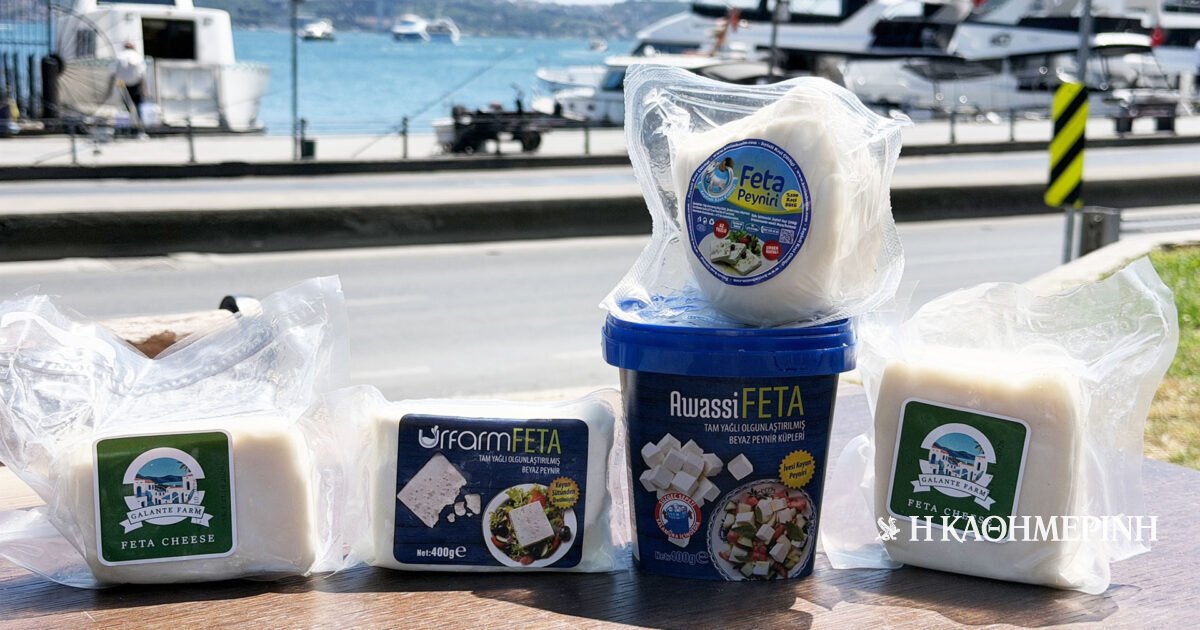
In the Turkish market we identified at least three different brands: the Urfarm Feta, Galante Farm Feta and the Feta cheese of the Zeytinli Çiftliği company. Urfarm produces the cheese on its own farms in southeastern Turkey in the city of Urfa and, according to the company, “grazing location affects the fat content of the milk, the type of rennet used, and even the amount of salt used. The sheep graze naturally in pastures and are milked in automated milking parlors.”

In fact, the company’s customers say they are particularly satisfied with the product and report that they found its taste Greek feta in a product of Turkish production. “This is exactly the same slice I ate in Greece. I bought both the packaged and tinned feta, which is a bit more practical if you’re consuming a large amount. Hopefully the taste will remain the same. Thanks”, comments Timuchin Bugra in his comments on the company’s website.
We contacted the company Zeytinli Çiftliği that produces “Feta Peyniri” (feta cheese) and told us that they have been producing this particular cheese for the last four years, exclusively from goat’s milk at the company’s farms near the Dardanelles. They didn’t know –at least that’s what they replied to “K”– for restrictions or prohibitions regarding the designation of origin. Galante Farm uses sheep’s and goat’s milk produced in Turkey and sells online, where a question of legality is raised. Urfarm’s Awassi Feta is produced only from sheep’s milk and is offered in small pieces to decorate the “Greek salad». Mr. Burakwith whom we observed the products on the supermarket shelves, told us that he has tried the Turkish “feta” and does not detect any difference from the Greek, which he has also tasted.

The prices of the cheeses range from 400 to 500 pounds per 400 grams. That is, approximately 7.5 to 9 euros. It is also available on the market authentic feta, from the Greek company “Dodoni”which due to the duties and taxes imposed in Turkey is sold for 1,449 pounds (27.3 euros) per 400 grams. However, the ease with which cheeses presented as feta are distributed in Turkey is a proof that its concept EU PDO does not apply to the country, even though it has signed a customs union agreement with the EU. and claims its updating.
Online sales for Turkish cheese
By Tania Georgiopoulou
Turkey can use it name “slice” for the cheese it produces and trades within its territory. As for the exports and them sales outside Turkey is allowed to sell cheese under the brand name “feta” outside the European Union and outside the countries with which the E.U. has signed relevant trade agreements for the protection of agricultural products, like its countries Mercosur agreement (Argentina, Brazil, Paraguay, Uruguay), and New Zealand, Switzerland, Georgia, South Korea, Japan, China and Singapore among others. However, the sale of Turkish-made cheese as “feta” over the Internet is an important topic since online commerce knows no borders. Consequently, he is a very likely consumer even in an EU country. to procure “feta” from Turkey. Moreover, not all consumers are informed about the legislation and restrictions regarding Denomination of Origin Products.
OR PDO slice according to the EU legislation, it is produced only in mainland Greece and, from the island, in Lesbos, by mixing sheep and goat milk in a certain quota. For the European Union, Turkey is understood as a Third Country and consequently the EU rules for the protection of European geographical indications do not apply on its territory. The E.U. seeks to expand the scope of protection for its products by entering into bilateral trade agreements. Of course, Turkey has also in the past used the reputation of Greek products to win commercially, such as the case of the Turk of Kurdish origin who sold “Greek yogurt” in the US because that particular term, as he said, had been established for strained yogurt.
However, sources in the Ministry of Rural Development said that in order for there to be some kind of protection or even information, it would be good for the interprofessional feta organization to take the initiative, which includes both the producers and the industrialists who export the PDO feta. The matter does not concern the circulation of the cheese within Turkey but the possible exports.