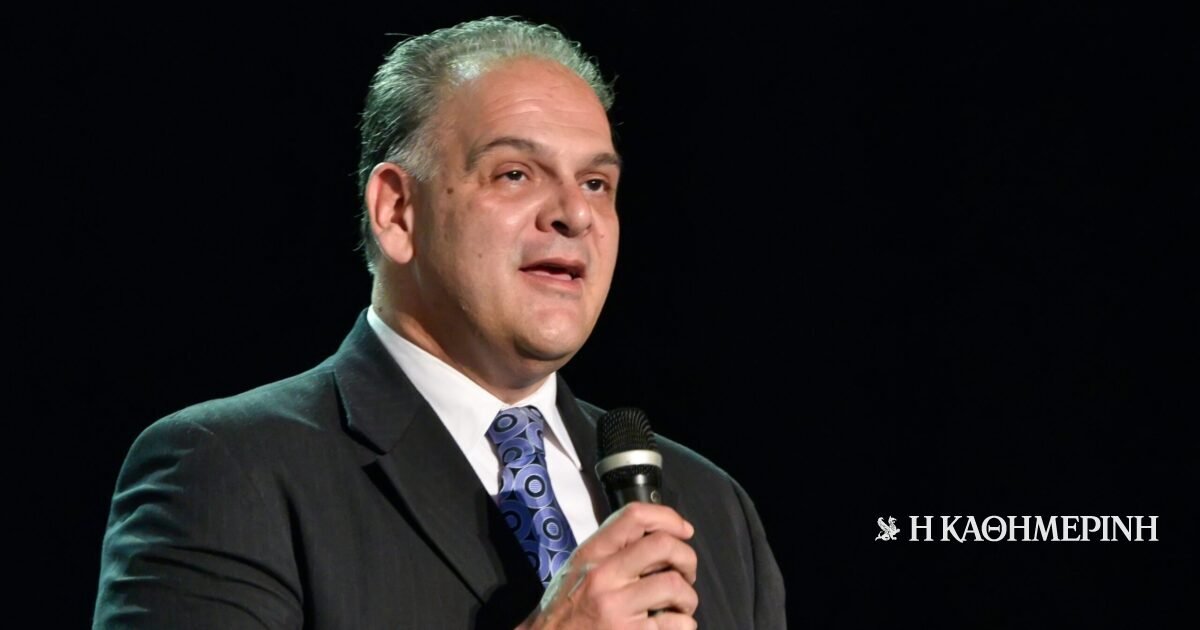
With references to one OKAY who, as he said, was at the center of fierce conflicts, in a “war” between technical advisers, but also in a personal “character assassination”, the former president of the Organization Dimitris Melas apologized before the court, denying the charges he faces and insisting that all his actions were dictated by legality.
THE Dimitris Melaswho is on trial together with the former head of the Directorate of Direct Aid and Purchase and the Directorate of Technical Works, Athanasia Reppa, for embezzlement of a document jointly, aiding a criminal jointly in continuation and breach of duty jointly in continuation in the degree of misdemeanor, began his apology by describing his course in the Organization and the environment he encountered when he took over the administration.
“In 2019 I was called to take over as vice-president of OPEKEPE. An extremely difficult period, because in 2021 when I was installed as president, while in all the previous years there was a unilateral collaboration with a technical advisor of the Organization, it had begun to acquire a dominant position. In 2021, a competing company appeared,” he said, explaining that a real “war” ensued between Neuropublic and the second company, with the result that, as he said, “OPEKEPE is in the middle” and “processes are constantly blocked.”

According to him, the particular confrontation caused “unbelievable side effects” at a time when the Agency was trying to limit the launch of illegal subsidies. “We had a painstaking effort to suppress – to eliminate was impossible – the whole phenomenon of the large jump in subsidy amounts. All the employees went above and beyond in the checks,” he asserted.
Continuing his apology, the former president of OPEKEPE described how he operated during his tenure, claiming that he took over as interim president and shortly thereafter submitted his resignation. “When I became president, I served as interim president and shortly after that I submitted my resignation. The president of OPEKEPE operated administratively, day by day. I felt like a superintendent in a large FAE. While that wasn’t my reasoning. I didn’t care about becoming a minister, I cared about making the most of my career. There it was just an administrative thing that every day had other problems. So I wasn’t happy with the work I offered,” he said.
The former president of OPEKEPE also emphasized that the administration refrained from proceeding with horizontal TIN commitments, claiming that such a thing would be unfair. “The easiest thing would be to bind VAT numbers. This is not the correct procedure. A farmer cannot, because his name has reflexively appeared in an investigation, not be paid. A proper investigation would have to be done. This was the difficult road”, he said, adding that the then Minister of Rural Development Spilios Livanos had asked him to propose measures, which, as he said, were reflected in a Joint Ministerial Decision.
“I feel obliged, with what has been said here, to demonstrate a series of measures taken to comply with the purposes of the Agency. OPEKEPE is not Chris Craft, it is transoceanic. Before it turns and changes direction, many things must be done. If someone is a little late, the results are delayed even further,” the accused continued.
He devoted a significant part of his apology to his personal involvement in the case. “My name has been involved in a whirlwind of unfair publicity and it will be proven. There was character assassination,” he said, referring also to the case of legal connections. “The legal connection started from a complaint. None of them said that money has been asked from me. The prosecutor refused to extend the bond because no evidence was found for me. Oh my goodness, suddenly there was a new complaint about me. All this is of great interest to me,” he said.
Addressing the court, Dimitris Melas argued that throughout his tenure he acted within the limits of his powers. “However, I acted respecting my duty. I have never forced an employee to do anything out of process or illegal,” he said, adding: “I fully understand that your poor judgment coexists with the human condition and with what is happening around us and shown on television. I would like to be judged on the evidence.” At the same time, he asserted that “I never prosecuted, I never demoted an employee and I never created conditions of exclusions or interventions. What I did was visible to everyone.”
“Tycheropoulou was lagging behind”
It was a separate chapter of his apology the movement of Paraskevi Tycheropoulou from the position of controls. Mr. Melas denied that there was a personal confrontation with her, claiming that the decision was made following a recommendation from her superior. “We had no cooperation with Tycheropoulou. I moved her to a level position. I had no dispute. I was asked by her manager to move her because she was falling behind. She was creating conditions that her colleagues complained about, at least that was conveyed to me, and I acted accordingly by placing her in a corresponding and dignified position,” he testified.
Referring to the controversial issue of the audit file handed over to him by Paraskevi Tycheropoulou, he claimed that he handed over the documents to Mr. Pappas who issued a comprehensive order for audits. “I am accused of embezzlement of a document. It was not reported anywhere that it was not found. I don’t know where they looked and what they might have found. It would be silly for anyone to think of hiding documents since they could be retrieved into the system at any time. A look inside this file of Mrs. Tycheropoulou and her checks, all the regional offices had a look! What to hide there?’
A special mention was made by the defendant for the offense of breach of duty attributed to him because he did not communicate Tycheropoulou’s findings on the cases of illegal grants to the authorities: “I could not have done anything else. I will say that who can forward and when to the Prosecutor’s Office is secondary. The first thing that must be done is that the crime, irregularity or illegality has been committed. I’ve filed five lawsuits that were obvious cases of fraud, where the lease was signed after the signer’s death, so that’s where you have to send it.”
Tips for Varra
He criticized the behavior of his predecessor in the position, Grigoris Varras, who, testifying as a witness in the trial, had complained that there were non-transparent procedures in the distribution of agricultural subsidies and an attempt to cover up the audits. Mr. Melas told the court that “if I had something like this in mind for such a direct partner of mine – when he had me as vice president – I would have told the minister. When he then went to Maximou, I would say to the prime minister “you have someone in there who works badly”. And the next day they would ask for my resignation. I don’t understand what he did.”
At the point of his apology he referred to the reason he decided to submit his resignation at that time:
“OPEKEPE was a key policy tool for the ministry in a way that I believe was wrong. Each minister competed to see who would pay the farmer first. The farmer, however, was interested in getting the money he was entitled to on time. He saw fit to stay and leave when I could. OPEKEPE never stops working, there is constant activity. The only time anyone could let go of the wheel without the boat going aground was at the end of the applications, so I left. Anywhere else I wouldn’t choose to leave because I wouldn’t be allowed to. Because there was no hint from the minister and while my term had expired in April 2022, I then submitted my resignation.”
Chairman: When Mrs. Tycheropoulou brought the report, did you ask her what it was about?
Accused: I had been informed. I studied it the next day and then gave it to the inspection service.
Chairman: What impression did it give you?
Accused: It was a report with very serious indications of irregularity, with points that should be checked. The majority had serious criminal evidence.
President: Owhen you came to this conclusion what did you think?
Accused: What it seemed to do was point out some clues. It was not a mandated audit finding.
Chairman: Did you find it a bit informal?
Accused: So it came to me from the secretariat and it didn’t even have a protocol number, if I remember. Then came the overall order.
Chairman: When a search is made and the folder is not found?
Accused: I had already left the Organization. The day I informed Pappa the file was left in the administration office, now that it may have been placed by others, I had no reason to take it back again. The control order had gone out so there was no need to concern myself with the progress of the file.
Apology Reppa
In a charged atmosphere, the former head of the Directorate of Direct Aid of OPEKEPE apologized, Athanasia Reppawhich denied all the charges attributed to her. During her apology, she bowed several times, while there was no shortage of applause from OPEKEPE employees who were watching the proceedings from the audience.
“I deny all the charges. I believe that from the whole process and the documents you too have formed a clear view,” she said, beginning her apology. The defendant described her career path in the Organization, saying that her appointment to the position of supervisor was a surprise even to her. “I formally did my paperwork. I wasn’t intimidated by the job, I like challenges,” she said, noting that when she took over she had 70 employees under her supervision, while in 2020 there were only 38 left, despite the fact that the demands of the service were constantly increasing.
Referring to the changes in the Common Agricultural Policy in 2015, he argued that a gradual decrease in livestock was being observed, while in 2018, he said, the agency detected an “unusual increase in large areas”. “I suggested that audits be done for the national stock of 2017. Until then audits were only done following complaints,” he testified.
She also argued that the Directorate of Technical Controls, which – as she said – should play the most critical role in controls, was operating with just three employees. He made special mention of the controversial report by Paraskevi Tycheropoulou, saying that he initially submitted it to the relevant Directorate without reading it, keeping a copy of it, while the next day he studied it carefully. “I shook my head and said we have the 2019 findings again in a different form. I thought there was an issue and something had to be done,” he said.
However, he expressed reservations about the completeness of the report, saying that attached documents were missing and that there was no clear identification of the population of controlled producers, nor of their selection methodology. “For each producer there needs to be a full breakdown of how it was selected and what the risk analysis was. Otherwise, scope for discrimination, inequality and opacity is created,” she said, adding that she was surprised by the fact that reference was made to control orders that were not in the file and that the report only bore the signature of Ms. Tycheropoulou.
According to the accused, when she returned the file to the then president of OPEKEPE Dimitris Melas with her observations, she asked him if the Organization would have a complete file of the case. “He replied that Mrs Tycheropoulou would bring him to us. In the meantime, I had already forwarded the report for study to the relevant Directorate and to Mrs. Adamopoulou,” he testified.