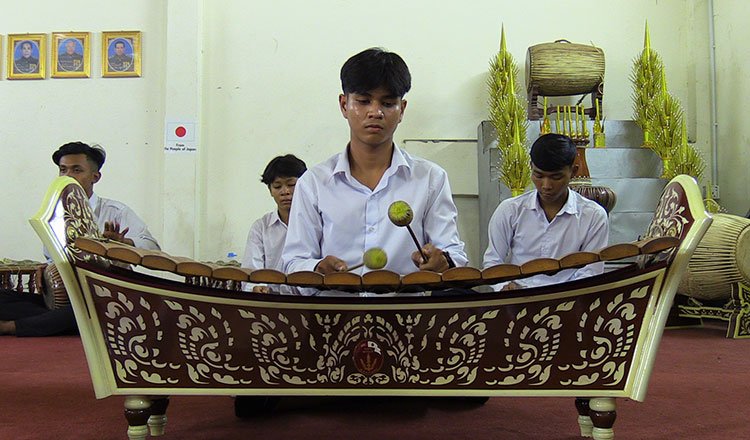
Inheriting his talent from his father, classical musician Sour Vanna has spent more than a decade teaching the Raneat (Khmer xylophone) at the Fine Arts Middle School, where he is shaping a new generation of performers through disciplined training, proper technique and the introduction of musical notation to preserve Cambodia’s classical music heritage.
Vanna, 43, is currently a classical music instructor at the Fine Arts Middle School and the vice president of the Music School in charge of classical music.
He has been teaching the Roneat since 2009.
“We study here and select people who are talented. It depends on their temperament, innate ability, and passion. That is one aspect, but another relates to physical fitness.
When we choose students, we consider their physical condition. Do they have any disability in their hands? They need to use both hands, and both must be equally strong. Generally, the first stage of practice focuses on hand strength, which is the most difficult step. Sometimes, practicing too much can make the hands too heavy, while in other cases, one side may be weaker, making it difficult to play well.
If we want them to play well, we train them to use both hands equally, balancing the strength. First, they must strike with equal force using the krab sepha, lifting and dropping it in coordination—what we call oktow, meaning a pair.
In the past, some teachers tied strings together because they feared students would learn too quickly. This method forced students to strike both sides at once, but it overlooked important aspects of proper practice.
Here, we provide clear explanations and proper teaching methods. The teachers before us passed down their knowledge correctly. They clearly taught us how to hold and use the krab sepha, so we learned properly.
The most important and difficult point is balancing both krab sepha equally. This instrument is special and is used in two important orchestras, playing a leading role in both the mahori and the pinpeat. Therefore, it is called the Roneat Ek, meaning the leader—responsible for guiding and managing the performance, according to traditional teachings.
In passing on knowledge, we want children to receive accurate information from one generation to the next so that it is not weakened. Without proper instruction, learning by rote can lead to the gradual loss of knowledge.
To be honest, as a teacher, I want to dedicate time to developing documents related to these skills and traditional instruments. Now, we are compiling them into musical notation so students can learn more effectively. This will help preserve knowledge for the future, as students can refer back to the notation. Here, we now teach using musical notation.
This place is unique and interesting. For classical music, there are some small institutions and music schools that have begun integrating musical notation. I support these efforts, and I believe this is a good idea.”