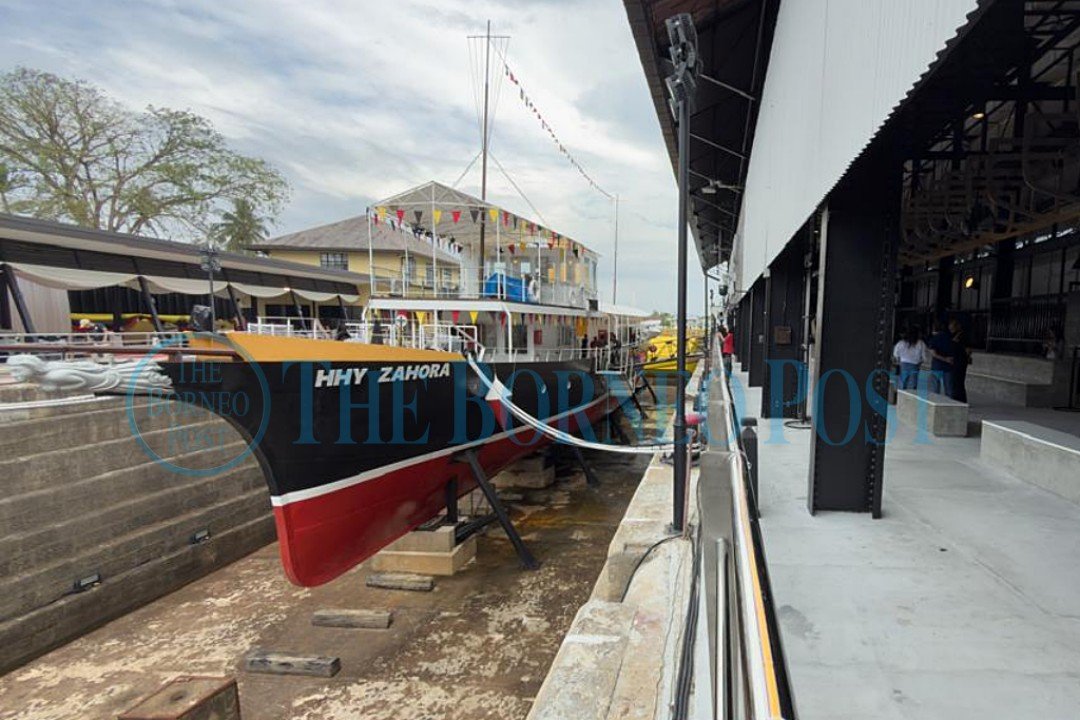

Full-scale replica of the HHY Zahora. – Photo by Roystein Emmor
KUCHING (April 21): Along the Kuching Waterfront, Sarawak’s industrial past comes alive at the Brooke Dockyard Industrial Heritage Museum, where history lingers among steel, engines and stories of river travel.
Facing the Sarawak River, the dockyard structures stand as a reminder of a time when shipbuilding was the backbone of communication and administration across the state.
Stepping inside, The Borneo Post team was greeted by museum staff and a cool, air-conditioned interior that carried the scent of a newly opened facility while preserving its industrial roots.

The entrance to the Brooke Dockyard Industrial Heritage Museum. – Photo by Roystein Emmor
The first sight that greeted visitors was a display of heavy-duty shipbuilding tools, including three lathe machines once used to shape metal or wood components, a hydraulic jack press, and a 660kg anchor made in Korea — one of the essential tools used to secure ships and vessels to the riverbed or seabed.

The 660kg anchor made in Korea. – Photo by Roystein Emmor
Nearby, preserved sections of corrugated metal roofing retained their original structure and colour, offering a glimpse into the dockyard’s long operational history.
Other industrial equipment on display includes a switchboard, single sheave block, mobile hoisting crane, propeller, weighing scale and load cell.
Among the museum’s centrepieces is a full-scale replica of the royal vessel HHY Zahora, weighing 350 tonnes and measuring 155 feet (47.2m) long. The vessel once carried the rulers of Sarawak across the state’s vast river networks.

Lathe machine for shaping pieces of metal or wood. It also checks the strength of steel fabrications and measures shaft sizes and repairs them. – Photo by Roystein Emmor
Used by the second and third Rajahs from 1896 to 1928, the vessel played a vital role in connecting remote settlements at a time when road access was limited.
It enabled the Rajahs to travel from Kuching to upriver communities, ensuring governance reached even the most distant areas.
Inside the vessel, The Borneo Post team stepped into the wheelhouse, where an engine telegraph, steering wheel and compass reflected the precision needed to navigate Sarawak’s waterways.

Propeller, load cell and weighing scale on display. – Photo by Roystein Emmor
Below deck, information panels and historical videos explain the vessel’s significance, while the main deck reveals the Rajahs’ private living quarters, including a kitchen, sleeping area, dining room and washing room — offering visitors a glimpse into life aboard the royal craft.
Beyond the Zahora, themed galleries such as “Great Gears and Engines”, “Back in Time”, “River and Ships”, “Men of Steel” and “Revolution” guide visitors through the evolution of shipbuilding and industrial work in Sarawak.

The wheelhouse area displays the engineer telegraph, steering wheel and a compass. – Photo by Roystein Emmor
The galleries also feature historical artefacts such as an imperial typewriter, masthead lantern, punch card machine and timeline displays tracing the dockyard’s transformation through the decades.
Near the entrance stands a portrait of Ranee Sylvia, wife of the third Rajah of Sarawak, Vyner Brooke, from The Brooke Trust collection.
In the painting, she is dressed in traditional Malay attire adorned with a keringkam (traditional headscarf).
An audio speaker beside the display narrates her story in both English and Bahasa Melayu, adding a personal touch to the museum experience.

A painting of Ranee Sylvia, with an audio speaker that narrates her story in both English and Bahasa Melayu. – Photo by Roystein Emmor
Plans are also underway to introduce a restaurant within the museum grounds, adding another layer to the visitor experience.
Originally built in 1908 and opened in 1912, the Brooke Dockyard is recognised as the oldest shipyard in Sarawak and Malaysia.
It began by servicing the Rajah’s vessels before expanding into ship repair, oil and gas support, and engineering training, eventually becoming Kuching’s first industrial workplace.
Today, its transformation into an industrial heritage museum preserves the legacy of those who helped shape Sarawak’s maritime and engineering industries.
Visitors from local communities and abroad move steadily through the galleries, pausing to examine the tools, photographs and machinery that once powered the dockyard’s operations.

Below deck area displays the information panels and historical video. – Photo by Roystein Emmor
With admission currently free while ticket pricing is being finalised, the museum offers an accessible gateway into Sarawak’s industrial heritage.
Open from 9am to 4.45pm on weekdays and from 9.30am to 4.30pm on weekends and public holidays, the Brooke Dockyard Industrial Heritage Museum is more than a collection of artefacts — it is a living reminder of Sarawak’s journey from river-based administration to the modern industries that shape the state today.