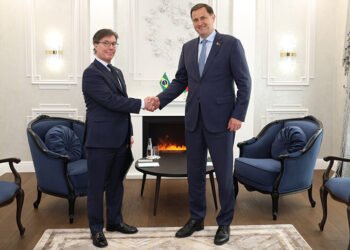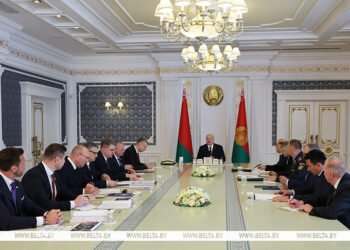
Sergei Aleinik emphasized that innovation and technological development play a key role in ensuring sustainable economic growth and securing the Union State of Belarus and Russia: “The issue of technological sovereignty is a matter of national security. A great deal is being done at the Union State level in terms of development. We have the scientific and technological development strategy of the Belarus-Russia Union State through 2035, and a fairly large number of programs are being implemented. More than 60 joint scientific and technical programs have been completed.” Programs currently underway cover various innovative fields: medicine, space, mechanical engineering, smart agriculture, etc.
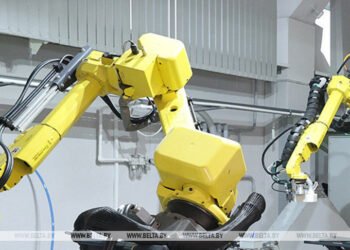
Numerous areas were addressed during today’s session on technological sovereignty. “This includes industrial cooperation in terms of its technological component. Here, too, we have established highly effective, systematic, and coordinated teamwork both at the level of our ministries of industry and across all regions. Our industrial products are supplied to 78 regions of the Russian Federation. Eleven multi-brand centers have been established, and we plan to set up and open four more by the end of the year. Large-scale work is underway in machine tool building, innovative mechanical engineering, and microelectronics. The share of Belarusian content in microelectronics among Russian businesses stands at 28%, which is a fairly high figure. Today’s discussions focused on how to further expand and deepen cooperation in this vital sector,” Sergei Aleinik said.
The creation of a unified digital space was also addressed. “We need to reduce our reliance on foreign software. To achieve this, we must build a digital interaction ecosystem within the Union State, both in terms of legislation and practical application,” he noted.
Sergei Aleinik emphasized that science is a critical part of both countries’ technological sovereignty. According to him, the innovation and technological sovereignty of the Union State is not just about projects and programs, but about the tangible results of combining the science, manufacturing, education, medicine, and digital technologies of Belarus and Russia. Pooling potentials in these sectors is essential for building a strong economy resilient to external challenges.
Chairman of the Federation Council Committee on Foreign Affairs of the Russian Federal Assembly Grigory Karasin praised the organization of the session, noting a unified and sharply focused approach among scientists, manufacturers, and politicians of the two countries. According to him, under external pressure, Belarus and Russia have not only withstood the challenges but have also strengthened their sense of freedom and independence. “But to move forward, grow the economy, and ensure our people feel happy, we must always guide ourselves by one rule: relying on our own strength, intellect, and resourcefulness,” Karasin emphasized.
The official noted that an increasing number of Russian regions are establishing ties with Belarus. “Plenipotentiary representatives and leaders of the local legislature have come even from Sakhalin. This is highly encouraging. We are truly becoming two members of a single team,” the committee chairman concluded.