The image went viral and caused controversy: the Comptroller General of the Republic, Anel Flores, suddenly entered the Public Ministry and withdrew his auditors from an interview that was part of the proceedings for the investigation of possible unjustified enrichment of former Vice President José Gabriel Carrizo (2019-2024).
“The Comptroller’s Office filed specific complaints against Mr. Carrizo for the Attorney General’s Office to investigate, that was three months ago, the investigation does not appear anywhere. Suddenly they call three auditors from the Comptroller’s Office and from 8 in the morning to 4:30 in the afternoon, they subject them to an interrogation as if they were the thugs who have appropriated the money of the Panamanian people, they make them sweat and cry; the comptroller finds out and tells them Come, let’s go, because they were in a fit of hysteria,” explained the constitutionalist and presidential advisor, Miguel Antonio Bernal on Radio Ancón.
While the Attorney General’s Office (PGN) announced that a criminal investigation had begun into the incident, the President of the Republic, José Raúl Mulino, commented that he had spoken with both officials to resolve their discrepancies. “I know their versions and I have asked them to smooth out the differences that need to be smoothed out and continue working. They are both important in public administration and in favor of the benefits of the state and the investigation of crimes, but until then, I am not going to get into a problem in which I was surprised, just like you,” he said in his recent conference.
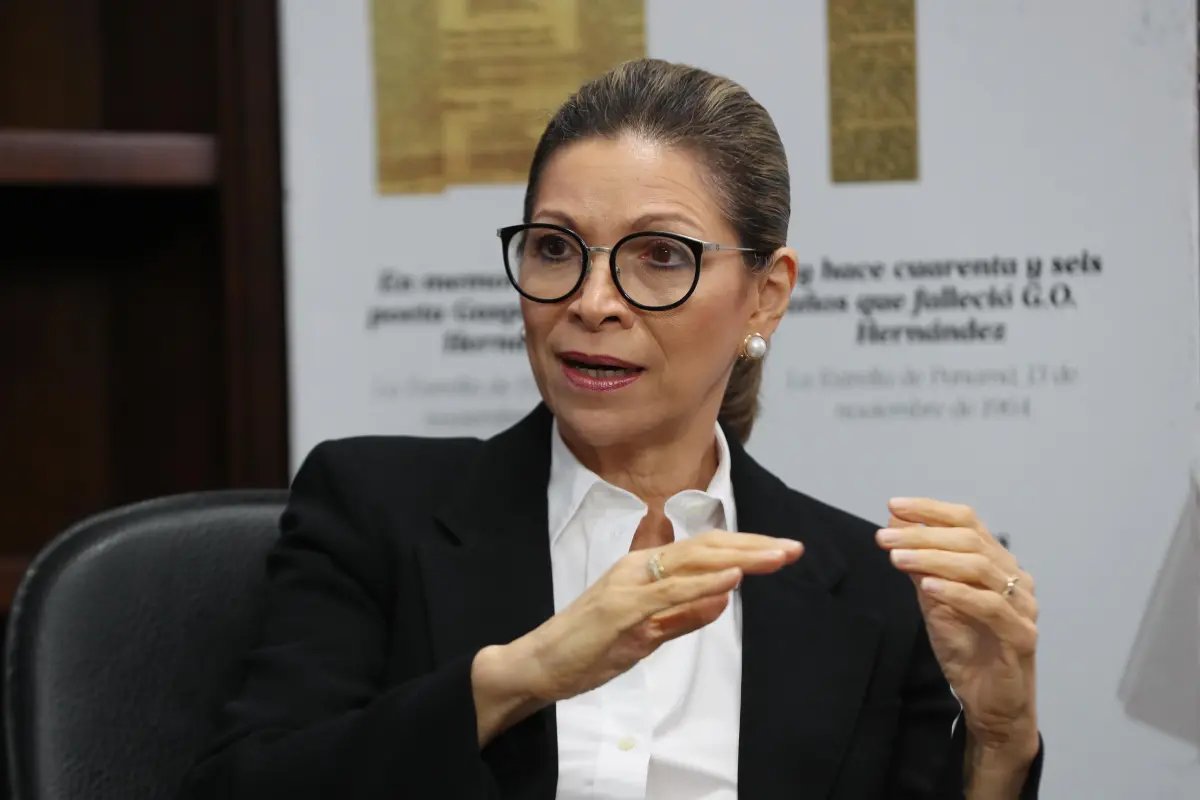
Beyond the debate there is a technical and legal issue that in the opinion of jurists, such as the former attorney general of the nation, Ana Matilde Gómez Ruiloba (2005-2009), should not be minimized for the sake of respect for democratic institutions.
What is your reading of this visit in the middle of an investigation by the Public Ministry, and that interrupted an investigation, for possible unjustified enrichment of former President Carrizo?
I would like to explain to you that there is a very big contradiction if you say that it was a visit and there is an intrusion. When a person visits it is a coordinated arrival, either I invite you or you let me know you want to come. So the first thing I would dismantle is the impression that this could have been a visit. It is not a visit and when one has directed an institution one knows that such high-ranking authorities do not appear in another’s institution because they run the risk of not being able to be attended to at the corresponding level. So it may seem or look like an intrusion.
How do you rate it?
The arrival of the Comptroller General of the Republic to the Public Ministry might not have been so complicated, so critical, if it had not been accompanied by the information that emerged through the Public Ministry’s statement, that the judicial proceedings that were being carried out were interrupted, and the officials who were being interviewed were removed from the Public Ministry premises, by order of the Comptroller General.
You were Attorney General of the Nation, how common is it that in the middle of an interview with auditors, a comptroller interrupts?
Never?
Never, this is unusual, because first we would have to see who, what institutions we are talking about. Let’s forget the people for a moment. Both the Comptroller General of the Republic (CGR) and the Public Ministry (MP) are two institutions of constitutional rank, at the highest level, they have the same treatment in the Constitution and are under different titles.
It is important to know that the Comptroller’s Office has an organic law that governs it from 1984, modified in 2022 and has an internal regulation and a series of decrees that it has been documenting and adding to these internal regulations. The Public Ministry, on the other hand, has constitutional status and does not necessarily have an organic law, but it does have the Judicial Code, the Procedure Code, and the career law, which are instruments that complement the entire mandate that is in the Constitution. They have totally different mandates, although in some cases they can be seen as complementary.
Its constitution is a technical, independent entity, technical inspection and control. Its foundation is given in the protection of public assets and funds. Supervise, guide how the entire methodology of the State’s accounting will be done, all the institutions, even those where the State is part, and it has the capacity to intervene, close and audit all those accounts where there are public funds and mess with the accounts of those officials who are management. That is the Comptroller General’s Office in a nutshell.
The Public Ministry by constitutional mandate and according to the code is the institution in charge of prosecuting crimes, caring for the conduct of public servants and in some way defending the interests of the State. They are two totally separate areas. Where can they be found? In investigations, as the law of the Comptroller’s Office says, when an account is being intervened, if there are criminal responsibilities, it will be passed on to the Public Ministry.
Like, for example, in that case of alleged unjustified enrichment?
When the Public Ministry has to investigate crimes that have an impact on public administration, such as, for example, unjustified enrichment, it has a requirement called procedurality. Without this tool called the Comptroller’s audit report, a case cannot be proceeded in which one wants to verify whether or not unjustified enrichment has been committed that leads to criminal conduct.
According to the Organic Law of the Comptroller’s Office, this supervisory entity and the Public Ministry would become allies in the investigation of a crime. Or is it not so?
They should be in the search for truth. What does this mean? That the audit report prepared by the Comptroller’s Office to review the management of an account should be a tool that a prosecutor uses when he is going to support the petition he will present before a judge. And this is where we go to the specific case. We are currently in an adversarial criminal system. Before the 2008 reform, in the Judicial Code there was what was called ratification of auditors. Many lawyers who do not master the subject are confused because there is no longer a rule that speaks of ratification, but there are rules in the Code of Criminal Procedure, such as article 320, which regulates interviews by investigative entities. One of the investigative entities par excellence, par excellence, is the Public Ministry, by constitutional and legal mandate. Therefore, the diligence that was being carried out is usual, necessary and important.
What type of diligence is carried out once a prosecutor calls a CGR auditor? Is it an interrogation or an interview?
Semantically there is not much difference, but it is totally permitted because that document, according to the CGR law, is a technical document, it is not subjective. The CGR is a technical and independent institution, the Public Ministry could not participate in the preparation of the report. Secondly, the prosecutor is a lawyer who is prepared to investigate crimes, he is not an auditor, he is not an accountant. Therefore, what the interview diligence seeks is for the prosecutor to clarify any doubts he may have regarding a report that is technical.
If what the prosecutor seeks is to understand how the investigation was carried out, could the auditor feel overwhelmed, as if it were a cross-examination?
You shouldn’t, because that’s your job.
Can a judicial proceeding be interrupted in the way it was interrupted?
Only by those who are practicing it… What cannot happen is what I am going to read from article 388 of the Penal Code: “who, through the use of physical force” – that means that is one way -, “threat” – another way -, “intimidation” – this does not require physical force, only the presence with authority, with a certain rank -, “or the promise, offer or granting of an undue benefit” – those are the ways -, “hinders or impedes the performance of the official duties of an official of the investigative agencies”, and what are they? “Judiciary or the Public Ministry, or those responsible for enforcing the law”, “will be punished with imprisonment of 5 to 10 years.” It is not just any crime; It is not any behavior that was displayed. People who did not want to understand that what happened was serious do not know the content of this article. Whoever wants to reduce this to an issue of personalities is not understanding the great drama for the rule of law and democracy: that each official fulfills and remains in the role of his constitutional and legal mandate.
And how long can an auditor take in an interview like this?
Whatever is necessary according to your report (…) a prosecutor needs to use that document as an instrument of conviction, as an element to convince himself that the crime occurred.
Can it take several hours or days?
Of course, when they are high-profile crimes: when there is complexity in the case, when they are charges with command, jurisdiction or powers throughout the Republic or with great power… that cannot be clarified in two hours, and it is not the first time.
This isn’t the first time for what?
That this procedure is interrupted (with the investigation of the former vice president), an attempt had already been made to begin and somehow it had not been possible to conclude.
What is the consequence of the investigation?
The main impact is institutional. It is the democratic nature of the independence of the Public Ministry in the face of an institution that is not its superior, that does not supervise its work, that has no legal or constitutional legal power. That the rule of law is dismantled, which means that everything that governs us is written… then it becomes selective, but there is also the risk that the defense could use these improper interferences to present to a judge a possible case of manipulation of a file.
What should happen for the rule of law to be rectified?
If there is no sanction, when a norm has been transgressed, the autonomy and authority of the institution that was violated is immediately weakened.
“The diligence that was taking place (in the Public Ministry) is usual, it is necessary and it is important”
PROFILE
Full name: Ana Matilde Gómez Ruiloba
Birth: November 5, 1962, Panama City
Occupation: lawyer
Religious beliefs: Catholic
Summary of her career: Panamanian lawyer and politician, she has served as Attorney General of the Nation and as a representative of the National Assembly of Panama for the 8-7 circuit. During the 2019 electoral process, she was a free candidate for the presidency of the Republic. She was dean of the Faculty of Law and Political Sciences at the Santa María La Antigua Catholic University (USMA). Gómez has a degree in Law and Political Science with a master’s degree in criminology, both from the University of Panama, and studied a diploma in human rights at the Santa María La Antigua Catholic University.