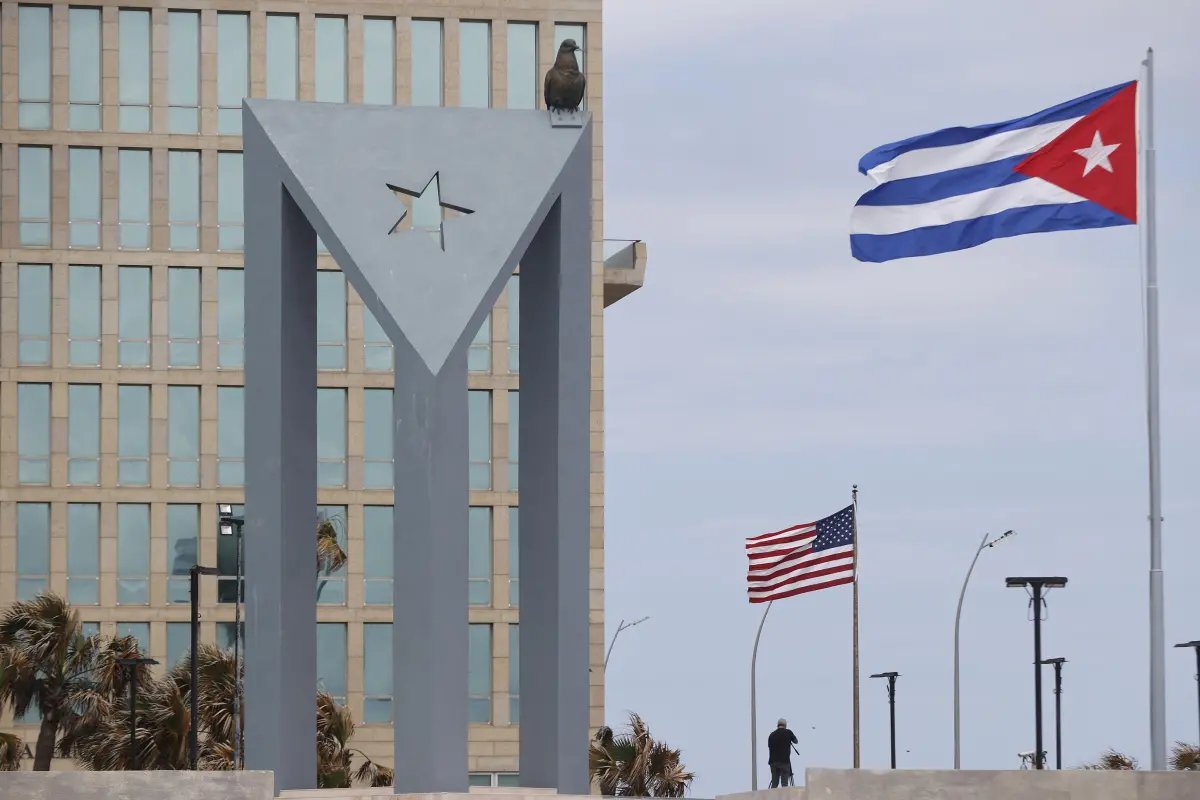
The confrontation between the United States and Cuba entered a phase of maximum political and verbal tension after US President Donald Trump stated that he will “take control” of the island “almost immediately.” The statement provoked the immediate reaction of the Cuban president, Miguel Díaz-Canel, who denounced a threat of “unprecedented” military aggression and called on the international community to speak out.
Trump’s statements occurred on Friday night during a private dinner at the Forum Club in West Palm Beach, Florida, one of the spaces with the greatest political and business influence in the south of the state, where the president combined messages aimed at conservative sectors and the Cuban exile with military and geopolitical references. There he assured that, once Washington’s “work” in Iran is finished, he could order the movement of the aircraft carrier USS Abraham Lincoln to the Caribbean and bring it closer to the Cuban coast.
According to the US president’s own account, the mere presence of the ship would be enough to cause the Cuban Government to surrender. “They would say thank you very much, we surrendered,” Trump said to those attending the political and business meeting.
Although the White House did not subsequently issue an official clarification on the scope of the president’s words, the speech coincides with an increasingly aggressive policy by Washington towards Havana since Trump’s return to power in January.
That same Friday, the US Administration announced new economic sanctions aimed at sectors considered strategic for the Cuban economy, including energy, defense, mining and financial services. The new executive order establishes that any person or company that maintains operations with these sectors or does business with the Cuban Government may face the total blockade of assets under US jurisdiction.
The measures deepen economic pressure on the island amid an internal crisis marked by recurring blackouts, fuel shortages, inflation and growing migration.
In parallel, the Secretary of State, Marco Rubio, also toughened the official discourse by accusing Cuba of facilitating the presence of intelligence services of “the adversaries” of the United States just 90 miles from its territory. Rubio assured that Washington “will not tolerate it,” in a narrative that once again links Cuba to hemispheric security threats.
Tension also increased after the US Senate rejected this week a Democratic proposal that sought to limit possible military operations ordered by Trump on Havana. Although the initiative did not prosper, the debate fueled interpretations about a possible strategic hardening of US foreign policy towards the island.
The Cuban response did not take long. From Havana, Miguel Díaz-Canel described Trump’s words as a “dangerous and unprecedented” threat and warned that any attempt at aggression will encounter resistance.
“The president of the United States raises his threats of military aggression against Cuba to a dangerous scale,” the Cuban president wrote on social networks, where he also asked the international community and the American people themselves to prevent “such a drastic criminal act.”
Díaz-Canel maintained that Washington’s political offensive responds to the interests of “a small but wealthy and influential group” with desires for “revenge and domination,” in apparent reference to sectors of Cuban exile based in Florida that support the hard line against Havana.
The Cuban leader also insisted that “no aggressor, no matter how powerful, will find surrender in Cuba” and assured that the island will defend “sovereignty and independence in every inch of the national territory.”
The official response coincides with a new internal political mobilization. This May Day, the Cuban Government turned the traditional Labor Day marches into a demonstration of support for the Executive and a platform to reinforce messages of national sovereignty in the face of US pressure.
The scenes of mobilization in Havana occurred while the bilateral discourse hardens and revives references typical of the Cold War, in an international context marked by tensions between Washington and Iran and by growing global geopolitical competition.
Analysts consider that Trump’s tone also responds to internal electoral factors, especially in Florida, where the Cuban-American vote maintains a determining weight. However, they warn that the combination of military threats, economic sanctions and national security accusations could open a new period of regional instability.
The current crisis also occurs at one of the most delicate moments for the Cuban economy since the 1990s. The island faces difficulties in guaranteeing electricity supply, a drop in tourist income, supply problems and a sustained migratory exodus to the United States and other countries in the region.
With information from EFE